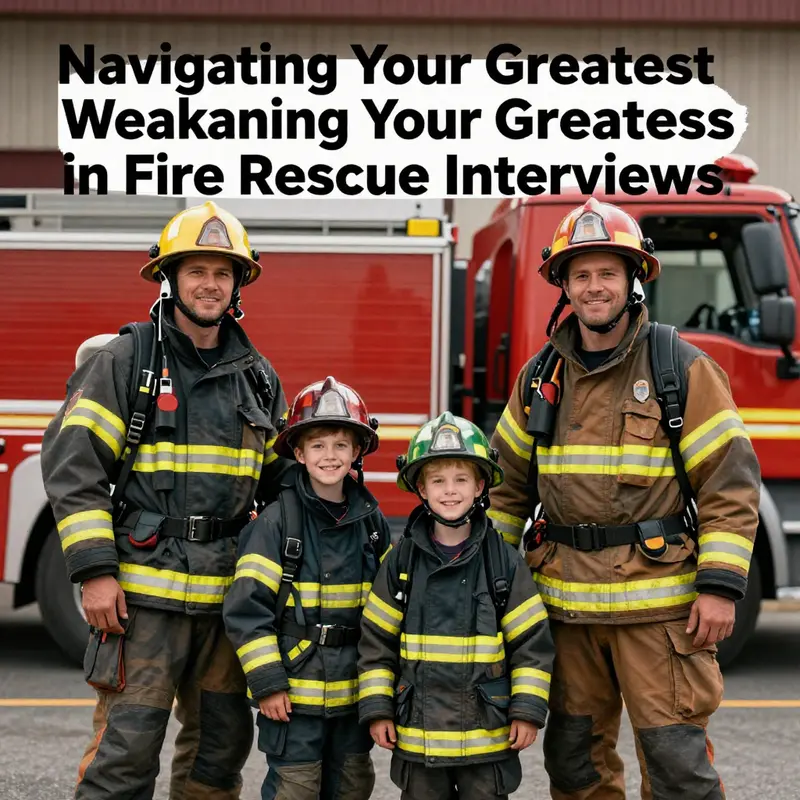
Fire rescue interviews often dive deep into candidates’ motivations, skills, and self-perceptions. A pivotal question frequently arises: What is your greatest weakness? This inquiry serves multiple purposes; it assesses a candidate’s self-awareness, the acknowledgment of personal challenges, and the commitment to improvement. For aspiring firefighters and rescue personnel, addressing this question effectively can significantly influence their candidacy. As we delve into this article, we’ll explore the nuances of responding to the greatest weakness question, examine common pitfalls, and ultimately demonstrate how self-reflection and growth are vital in the fire rescue field. Each chapter is designed to equip candidates with the tools and insights needed to turn potential vulnerabilities into commendable strengths, showcasing the charisma and resilience that define successful fire rescue professionals.
null
null
null
null
From Common Weakness to Clear Strength: Framing Gaps in a Fire Rescue Interview
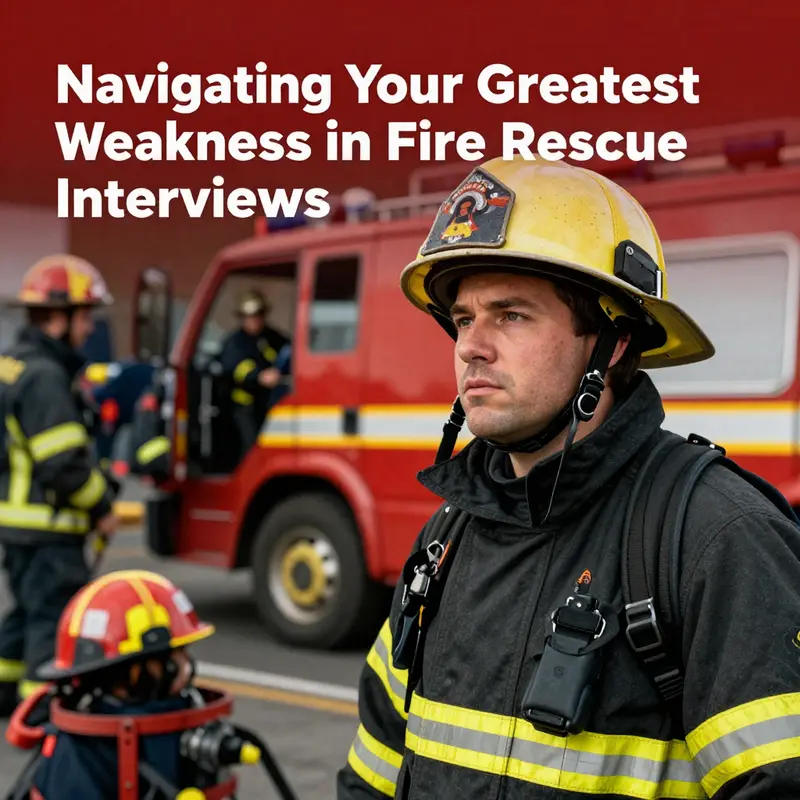
When a fire rescue interviewer asks for your greatest weakness, the real test is not the weakness itself but how you translate self-awareness into action. In this field, where split-second decisions can save lives, a candidate who can name a limitation and show a concrete path to improvement signals readiness to learn under pressure, to adapt, and to protect both the team and the public. The most effective responses do more than acknowledge a gap; they illuminate the deliberate practice that closes it. They weave a narrative of professional growth that aligns with the core demands of emergency response: rapid assessment, disciplined action, clear communication, and resilient leadership when things go wrong. A well-crafted answer demonstrates that you understand the terrain of firefighting work and that you are not simply working around a weakness but actively strengthening the muscles that matter most on the front lines.
A nuanced approach begins with choosing the right kind of weakness to discuss. Not every shortcoming should be aired, and some are better framed as ongoing development rather than fixed flaws. The best responses center on traits that are common in strong performers yet are never complete. They acknowledge a pattern that can hinder performance if left unaddressed, then move swiftly to specific steps that have already yielded demonstrable improvement. Consider the instinct to be overly critical of one’s own performance. In high-stakes settings, dwelling on mistakes can become counterproductive, yet there is value in thoughtful reflection. The key is to show that you have learned to channel reflection into constructive feedback—seeking guidance from mentors, engaging in structured debriefs after drills or real incidents, and turning every setback into a learning opportunity. This kind of framing reassures interviewers that you understand the difference between rumination and purposeful growth, an essential distinction for anyone who may be the first to act in a crisis.
In practice, channels of improvement must be concrete and observable. A narrative built around a weakness becomes credible when it is anchored to specific actions, measurable results, and ongoing commitments. Take the archetype of overemphasizing perfection. In emergency scenes, speed matters almost as much as precision. The ability to make timely decisions while maintaining safety margins is a hallmark of proficient responders. A robust response to this weakness tends to describe how training and drills shift the balance from meticulous but slow execution toward disciplined rapidity. It becomes clear that the candidate has learned to prioritize critical steps, build speed through repetition, and still uphold the safety checks that define good practice. This is not a resignation to haste; it is a recalibration of priorities under pressure, achieved through deliberate, repeatable practice. The narrative should also reflect a mindset of continuous improvement: the admission that perfection is an impossibility in dynamic emergencies, paired with deliberate attempts to narrow the gap between intention and outcome.
Another common weak point is difficulty in saying no, especially when team members reach out for help or when additional tasks pile up in the same time window. In a firehouse, clear role definitions and boundaries are not about rigidity; they are about safeguarding mission effectiveness. Framing this weakness well involves describing a learning process. You might explain that you recognized the cost of overextending yourself and, through mentorship and structured communication, learned to set boundaries without sacrificing support for teammates. The crucial elements here are clarity, accountability, and reciprocity. The interviewee demonstrates that the ability to assert boundaries is a leadership skill in its own right—one that preserves the team’s overall efficiency and safety. The goal is to show that you can balance personal limits with a willingness to assist others within a defined scope, thereby maintaining mission focus even under duress.
A third category concerns gaps in experience, such as exposure to a particular hazard or industrial setting. In real-world terms, some departments confront chemical exposure, confined-space operations, or wildland-fire scenarios differently from urban structure fires. Framing this weakness involves a proactive stance: acknowledging the area where experience is thinner, then detailing proactive steps to close it. This might include targeted training, simulation exercises, or seeking assignments that broaden the range of emergencies encountered. The strength of such a response rests on two pillars: evidence of initiative and the confidence that learning can be accelerated in a disciplined environment. It is essential to connect these steps directly to the role you seek. Emphasize how your learning plan aligns with the department’s risk profile and response priorities. The credibility of the answer is amplified when the learner clearly maps a pathway from the gap to tangible competencies, such as enhanced hazard recognition, improved use of protective equipment, or refined tactical decision-making under pressure. In other words, the gap becomes a road map rather than a dead end.
Across these examples, what binds a strong answer together is how it ties back to the department’s mission and to personal conduct in the station and field. The story should radiate three qualities that are highly valued in fire rescue: emotional intelligence, disciplined adaptability, and a commitment to safety both for the public and for teammates. Emotional intelligence is shown through the willingness to seek mentors, accept feedback, and reflect without defensiveness. Disciplined adaptability emerges when you describe how you adjust plans midincident without losing situational awareness. A true commitment to safety is evidenced by the deliberate forms of accountability you practice—after-action reviews, checklists, and pre-incident planning that reduces risk. The chain from weakness to improvement should feel iterative, not linear, mirroring the daily grind in a firehouse where learning happens in small increments under pressure.
The practical texture of this approach comes alive when you translate it into the cadence of a well-rehearsed answer. You begin with a brief acknowledgment of the pattern you have observed in yourself, then pivot quickly to a concrete example of how you addressed it. You describe the steps you took: the training you pursued, the mentorship you sought, the drills you recorded, and the metrics you tracked to prove progress. You then illustrate how the improvement translates into better performance on the fire ground: faster scene assessment, clearer communication, or more effective teamwork during a critical maneuver. Importantly, the narrative avoids glorifying the flaw or exposing personal vulnerability in a way that undermines confidence. Instead, it presents a mature, professional evolution—one that people who lead teams want to see in a candidate who may someday lead them through a difficult incident.
In this light, a well-rounded answer also gestures toward the resources that support ongoing growth. Professional development in firefighting is not a lone effort; it grows from structured training, mentorship, and continuous feedback loops. For practitioners preparing for interviews, there is value in keeping a line of sight to training frameworks and credentialing pathways that validate expertise and signal a commitment to public safety. For instance, engaging with foundational safety and credentialing programs helps cultivate the practical habits that interviewers look for when they hear about a candidate’s development plan. A practical touchpoint you can mention is participation in recognized training that builds essential safety, communication, and decision-making competencies. This kind of reference adds credibility to the story of growth and helps the interviewer see the tangible impact of your efforts in the context of a real fire rescue team. The narrative ends with a reminder that growth is ongoing and that you view weaknesses as opportunities to become a more capable and trusted responder.
From Weakness to Resilience: Demonstrating Growth After Identifying Gaps in Fire Rescue Interviews
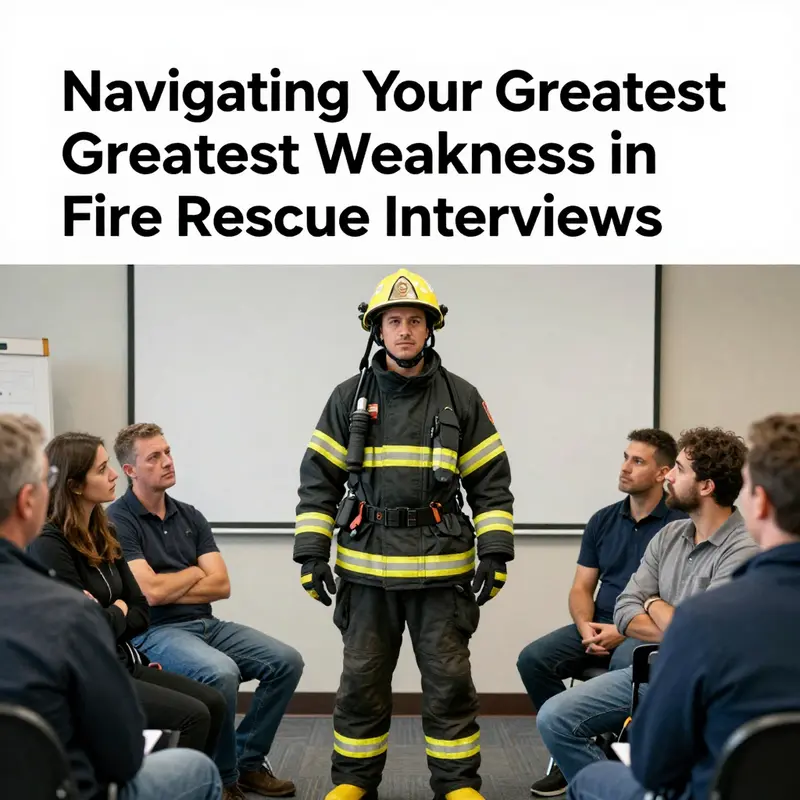
When a firefighter candidate faces the toughest question in the interview—what is your greatest weakness?—the moment is less about exposing a flaw and more about revealing a capacity for honest self-examination, deliberate learning, and steady progress under pressure. In the fire service, where every decision can tip the balance between danger and safety, interviewers don’t just want to know what you struggle with; they want to see how you translate that struggle into disciplined growth. The best answers are not rehearsed bravado or hollow self-deprecation. They are carefully crafted narratives that acknowledge human limits while foregrounding a concrete plan to overcome them. A compelling approach begins with candor about a real, specific weakness, but quickly pivots to the action you took to close the gap and the measurable results that followed. It is this arc—from recognition to remediation to measurable improvement—that signals not only self-awareness but a resilient professional ethic well suited to high-stakes emergency work.
Take, for example, the common scenario of a candidate who recognizes a tendency to internalize errors too harshly. In a firefighting context, mistakes can be high-visibility, high-stakes, and high-stress. Admitting, with tact, that you have previously spent too much energy ruminating on setbacks can set a tone of humility and accountability. The interviewer then looks for how you reframe that tendency into a constructive practice: seeking actionable feedback, leaning on mentors, and acknowledging that mistakes are integral to growth in a field defined by uncertainty and rapid adaptation. A well-crafted response demonstrates emotional intelligence and a proactive mindset—two capabilities that elevate technical skill into reliable decision-making under pressure. It also signals that you are not seeking a hero’s shield from error but a steady instrument of improvement for the team.
The most persuasive demonstrations of growth involve a concrete, recent example that is both plausible and measurable. Consider a candidate who admits limited familiarity with a new life-detection device—a device that could be on the front lines the next shift. The strength of the reply lies in the specifics: the candidate enrolled in a city fire department–sponsored training program, carved out extra hours for practice, and engaged in simulated scene operations to build familiarity. After a focused month of study and hands-on drills, their proficiency rose noticeably. In a recent drill, the team was able to locate a simulated victim 30 seconds faster because the candidate had become more adept at interpreting readings and coordinating with teammates. This narrative does more than illustrate improvement; it quantifies it, turning abstract commitment into tangible contribution. The ethos conveyed is simple yet powerful: there is no shame in initial gaps, only responsibility to fill them with disciplined effort.
To convey such growth persuasively, language matters as much as the actions behind it. The applicant’s tone should convey not defensiveness but ownership and intent. Phrases that emphasize ownership—“I recognized,” “I took initiative,” “I measured progress”—frame the weakness as a management problem that you solved. When the interview invites a reflection on emotional stamina, the candidate can acknowledge that a high-stakes, variable environment tests not only skills but self-regulation. The response then connects to strategies that have proven effective in demanding settings: mindfulness practices to sustain focus, structured debriefs after drills or incidents, and regular team check-ins that support collective mental readiness. Citing psychological resilience as a core competency might appear abstract, but when grounded in daily routines and documented experiences, it becomes a credible element of professional fitness for duty. Current research into dynamic work environments supports this view, noting that ongoing adaptation and steady performance under pressure are as much about mental processes as technical know-how. Acknowledging this in an interview signals a mature, mission-focused understanding of what it takes to stay effective across shifting contingencies.
A robust answer also weaves in the role of mentorship and learning culture. Fire rescue teams emphasize apprenticeship and peer guidance because experienced responders accelerate the development of younger members by modeling reflective practice. In the interview, describing how you sought mentorship after identifying a weakness demonstrates social intelligence and a commitment to collegial growth. It shows that you are not relying solely on solitary study but actively integrating feedback from seasoned colleagues who understand the operational realities of the job. This approach aligns with the broader expectation that successful firefighters continuously refine their judgment through dialogue, critique, and shared learning. By highlighting mentor-guided steps—clarifying expectations, practicing under supervision, and incorporating feedback into routines—the candidate presents a sustainable pathway from awareness to mastery.
The narrative of growth is not limited to technical gaps. It can also center on performance under pressure, teamwork dynamics, and the delicate balance between speed and accuracy. In real emergencies, rushing decisions can be deadly; lingering indecision can waste precious seconds. A candidate might discuss how, in the past, stress impaired quick judgment, and how they addressed this through pre-incident planning, standardized mental models, and precise communication protocols. The result is a more consistent pace without sacrificing safety. This kind of improvement is especially compelling because it demonstrates that you have internalized the truth that high-quality decisions emerge not from lone genius but from disciplined preparation and reliable collaboration.
The power of a growth-focused response lies in its continuity. It is essential not only to show what you did but to illustrate how you will sustain that evolution. The interview becomes a moment to articulate a lifelong learning discipline—ongoing training, constant feedback, and a willingness to revisit and revise your assumptions as new challenges arise. A lasting impression is created when you connect the previous actions to a forward-looking plan: what new competencies you are pursuing, how you will measure progress, and how you will share your learning with teammates to bolster the whole unit. In a profession where the unknown is a constant variable, this forward trajectory is exactly what interviewers seek. It conveys that you will remain an adaptable, reliable contributor who can grow with the team as technological, procedural, and tactical landscapes evolve.
Because the question invites you to reveal a weakness, it also invites you to demonstrate ethical fire-rescue leadership. When you choose a weakness that does not undercut safety or competence, and you present a remediation path that enhances team performance, you model responsible conduct. The interview thus becomes a stage for showcasing integrity and a commitment to public service. In turn, this narrative can be reinforced by a parallel emphasis on training and certification—elements that signal a profession-wide dedication to standards, continuous improvement, and accountability. To connect readers with practical avenues for ongoing development, consider how regular participation in foundational training and certification activities supports a growth mindset and strengthens the habits that keep responders precise under pressure. For readers seeking a sensory, hands-on perspective on building these habits, notes on structured drills and certification-focused practice can illuminate the journey from awareness to action.
For deeper, practice-oriented guidance on transforming weaknesses into strengths, many seasoned applicants also lean on curated resources that frame weak points as opportunities for growth within the context of the fire service. A practical bridge between theory and action can be found in accessible training content that emphasizes essential readiness, ongoing learning, and the discipline required to sustain high performance. In addition to training-related guidance, a well-rounded answer benefits from anchoring the growth narrative in real-world consequences—how the improvement translated into a safer, more efficient operation in drills or live exercises. This makes the story credible and memorable, underlining the central message: the greatest weakness question is not about vulnerability alone, but about the capacity to convert vulnerability into a reliable, evolving strength that enhances the entire crew’s readiness.
As you craft your response, remember that the interview room is a space for trust-building as much as it is a test of competence. A strong answer demonstrates honesty, accountability, and a concrete plan for ongoing improvement. It also invites the interviewer to see you as a partner in protecting lives, not just as a technician with a toolbox. The more your story emphasizes progress, mentorship, mental resilience, and measurable outcomes, the more it resonates with the core demands of fire rescue work. And as you move through the interview process, a steady cadence of learning—guided by both formal training and reflective practice—will become your professional hallmark, a quiet but powerful thread tying your past experiences to a future of dependable service.
Internal link for further exploration: to connect practical training with growth-oriented interview narratives, you can explore practical guidance at fire safety essentials certification training. It provides insight into how certifications and structured training support continuous improvement and readiness for the unpredictable realities of fire rescue work. Read more here: https://firenrescue.net/blog/fire-safety-essentials-certification-training/.
External resource for additional perspective on framing weaknesses in interviews: https://www.indeed.com/career-advice/interviewing/how-to-describe-your-weaknesses-in-a-job-interview
null
null
Final thoughts
Addressing the ‘greatest weakness’ question in fire rescue interviews is not merely about identifying shortcomings; it’s a chance to deliver a narrative that highlights resilience, growth, and professionalism. Candidates who reflect earnestly on their weaknesses and articulate their development strategies position themselves as self-aware and committed individuals ready for the complexities of fire rescue work. This self-reflection not only strengthens one’s candidacy but also fosters the emotional intelligence essential for successful teamwork and crisis response in the field. Recognizing that everyone has areas for improvement and presenting these vulnerabilities constructively is a hallmark of the resilience needed in the fire and rescue profession.

