
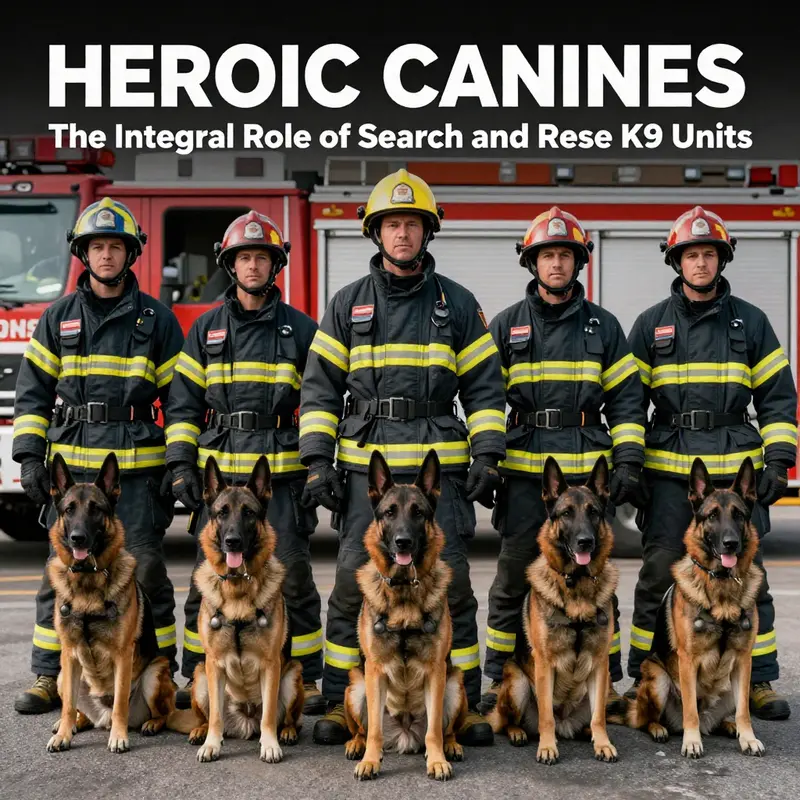
Fire departments around the world are increasingly integrating specialized Search and Rescue (SAR) K9 units into their emergency response teams. These canine squads bring unique abilities that enhance rescue efforts in situations involving missing persons, natural disasters, and hazardous environments. This article delves into the significance of K9 units within fire departments, exploring their operational roles, the integration of technology to support their efforts, and successful case studies that highlight their life-saving capabilities. Each chapter builds upon the last to paint a comprehensive picture of how these teams operate within the firefighting community and the potential they hold for public safety.
Tracking Hope from the Fireline: Inside Fire Departments’ Search and Rescue K9 Teams
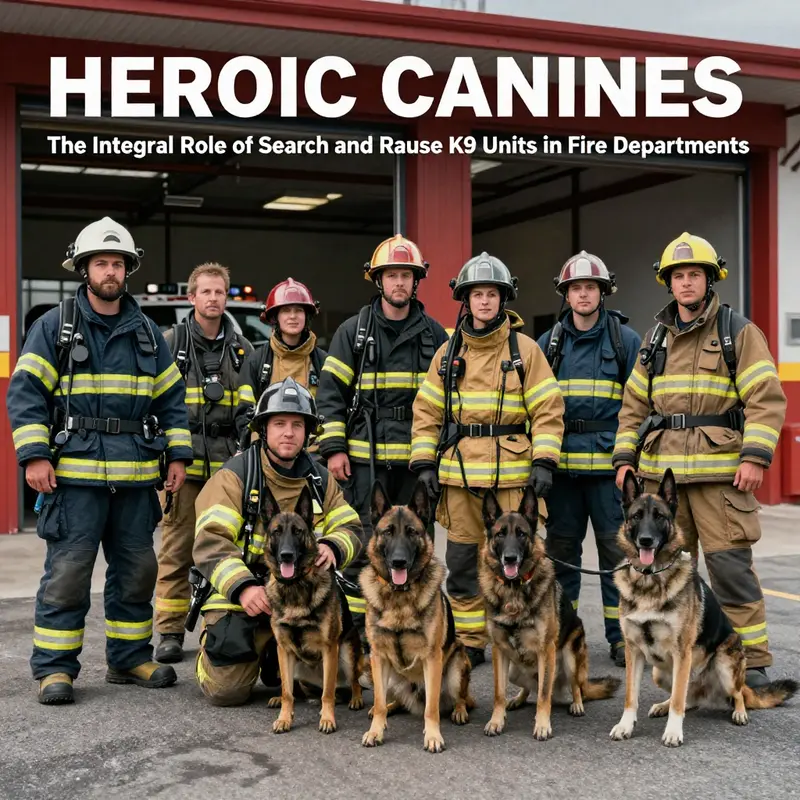
An overview of how fire departments use search and rescue K9 teams. Trained dogs extend the reach of human teams, helping locate missing people faster and safer in fires, collapses, and wildland incidents. The partnership between handlers and dogs relies on discipline, training, and clear communication. This chapter outlines training pipelines, canine selection, and the role of cross agency collaboration to improve outcomes for responders and communities.
Scent, Signal, and Teamwork: The Essential Role of Search and Rescue K9 Units in Fire Departments
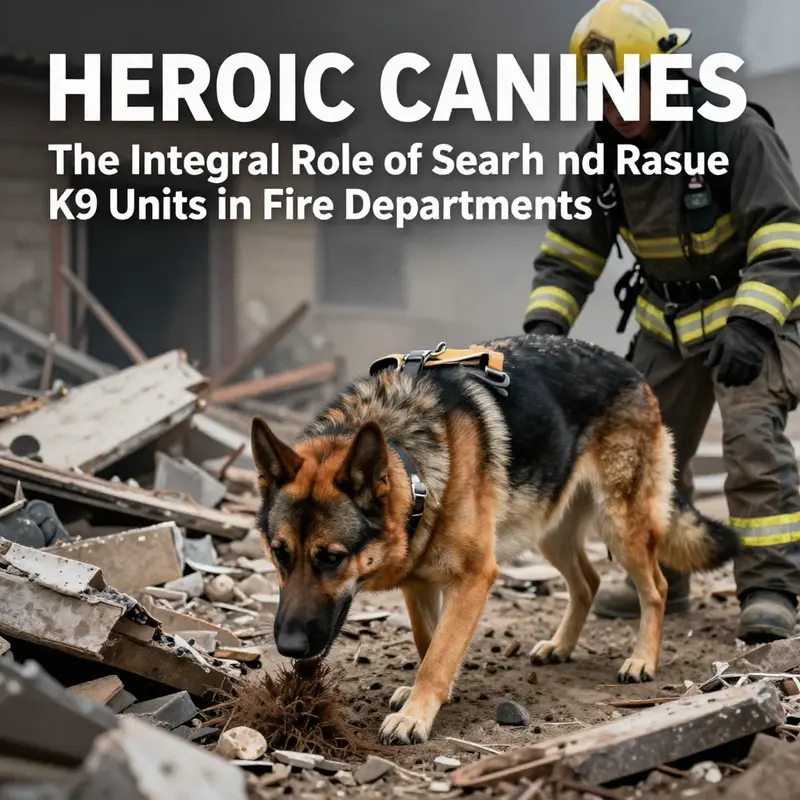
In the wider ecosystem of emergency response, fire departments carry a mission that extends beyond extinguishing flames. They are often the first on the scene in disasters, the ones who must decide where danger ends and hope begins. Within this mission, Search and Rescue (SAR) K9 units occupy a special place. Trained dogs and their human handlers work as one intricate system, each partner compensating for the other’s limits while capitalizing on a shared sense of purpose. The dogs leverage a sense of smell so refined that it can parse scents through layers of dust, water, and debris, tracing a trail that might be invisible to human rescuers. In urban ruins, wildfire smoke, snowbound forests, or a collapsed building after an earthquake, these canine teams move with a calm urgency that simultaneously reassures the public and accelerates the search process. Their work is not a substitute for human effort but a force multiplier that expands the reach and speed of response when every second counts.
Training underpins every success in SAR K9 operations. The dogs enter service as athletes of scent and stamina, but their path to readiness is not a sprint. It is a long discipline built on consistent routines, gradual exposure to varied environments, and a deep bond with a single handler. The earliest phase involves basic obedience and socialization, ensuring the dog can stay focused in chaotic settings and can distinguish between a real human scent and distracting background odors. As they advance, trainers layer specialized tasks: locating a live person under debris, following a trailing scent across uneven terrain, and performing area searches in cluttered environments where visibility is low and hazards abound. The work is cumulative. A dog might begin with simple scent discrimination in a controlled yard and progress to complex searches in simulated disaster zones that mimic the conditions of a real incident. This progression matters because it builds a dependable decision-making framework for the handler and a reliable signal for the incident commander. The dog learns to indicate a find with a practiced, consistent alert—whether it is a passive sit, a bark, or a gentle pawing motion—so that rescuers can act quickly without misinterpreting movements that could lead to wasted time or missed survivors.
The scope of SAR K9 operations stretches across environments that test both dog and human teams. In dense urban settings, the canine nose can separate a person from a clutter of rubble or debris, slicing through the noise of machinery, dust, and commotion to indicate a specific location. In forested landscapes, scent can drift with wind currents, revealing a path to a lost hiker or a missing child who may be sheltering beneath a fallen log or between rocks. In disaster zones, the volatility of the scene demands careful choreography. While firefighters stabilize structures, shore up weakened supports, and remove dangerous debris, the K9 teams sweep sections of the site to pinpoint likely survivor locations. This division of labor is not merely practical; it is a strategic design that reduces exposure to further hazards for both people and dogs. The two components of the mission—firefighters’ rapid scene safety and K9s’ precision in scent-based search—complement each other in ways that neither could achieve alone.
Across the United States and beyond, fire departments have integrated SAR K9 units into broader emergency response frameworks. In large metropolitan areas, these teams may operate under a USAR (Urban Search and Rescue) umbrella, aligning with engineers, medics, hazard-technicians, and logistics personnel to maintain a coherent incident action plan. The practice is not limited to one country; international fire services likewise deploy trained dogs for similar missions, adapting the modules of scent work to local terrain, climate, and legal frameworks. In places where terrain and population density create complex challenges, these dogs become crucial assets—the difference between a prolonged search and a decisive outcome. The value of SAR K9s is evident in examples where they helped locate survivors in hours that would otherwise become perilous or in scenarios where the environment would have prevented human rescuers from reaching certain pockets of space without substantial risk. Even as the public hears stories of dramatic rescues, the quiet efficiency of the dog-handler teams working in tandem with human teams often forms the backbone of those successes.
The collaboration between K9 teams and fire service personnel is built on mutual understanding and shared training. Firefighters bring medical knowledge, structural assessment, and the ability to operate within hazardous priorities, while K9 handlers provide expertise in scent behavior, search patterns, and canine welfare. The handler’s role is multifaceted: they guide the dog, monitor stress levels, manage fatigue, and ensure the dog’s alerts are objective and actionable. This partnership requires a culture of trust, where every member respects the limits and strengths of the other. The result is a coordinated sequence of actions that maintains safety while pursuing every plausible lead. When a team approaches an unstable pile of debris, for instance, the incident commander can rely on the dog’s signals to direct where to focus careful lifting or shoring operations. In this way, the dogs don’t just search; they help shape the entire tactical approach to the scene.
Modern fire departments have expanded their K9 programs with improvements in equipment, transport, and training scenarios. Vehicles equipped to transport dogs safely to incident sites play a critical role in ensuring the dogs arrive rested and ready to work. Secure kennels and climate-controlled compartments protect canine welfare during long shifts or while moving between sites in variable weather. The tactical reach of these teams has grown beyond the traditional ground search. Training exercises increasingly incorporate virtual simulations and staged disaster environments that challenge the dog’s scent discrimination and the handler’s decision-making under pressure. These tools enable teams to rehearse the long, patient process of search in a controlled setting before ever facing a real incident. At times, the training mirrors a game or simulation that builds familiarity with uncommon conditions—debris fields, confined spaces, or altered acoustics—so when a real call comes, the team can react with confidence rather than improvising under stress. Such preparation matters because a dog’s effectiveness depends not only on natural ability but also on a robust, ongoing program of practice and evaluation.
The human side of SAR K9 work is equally important. Handlers must maintain physical fitness and veterinary care for their partners. Regular health checks, joint management, dental care, and skin and coat maintenance are essential, as dogs in search work encounter demanding terrains and sometimes harsh weather. Mental health is part of welfare as well; exposure to traumatic scenes can affect a dog’s behavior, so teams structure rest periods, rotate deployments, and provide enrichment activities to prevent burnout. The bond between dog and handler—built on trust, shared routines, and successful outcomes—often becomes the story that underpins a department’s ability to respond to the most challenging calls. In this sense, SAR K9 units are not standalone assets but a living extension of the fire service’s ethos: readiness, resilience, and a deep commitment to saving lives.
Beyond the professional sphere, stories of resilience remind communities how intimately animals can be woven into emergency response. Household pets occasionally become heroes in their own right, drawing public attention to the value of animal-assisted rescue and mutual aid between humans and animals. A neighborhood tale from Bakersfield, where a family avoided tragedy after a dog alerted a sleeping household to danger, underscores the real-world impact of animal sentience in everyday safety. While such anecdotes do not replace formal training or professional SAR teams, they illuminate the wider cultural significance of animals in crisis response and encourage investment in training, welfare, and public education about emergency planning.
For readers seeking to explore the practical and ethical dimensions of SAR K9 programs, further reading on training standards, career pathways, and safety practices can be found in dedicated fire-rescue resources. See firenrescue.net/blog for ongoing discussions about how departments design, implement, and sustain these programs over time, ensuring that dogs and handlers remain capable partners in the field. The link is a gateway to understanding not only the technical aspects of scent work but also the supervision, wellness routines, and interagency cooperation that keep these units effective across a wide range of emergencies. This narrative of scent and signal, of trust and teamwork, is the core of why fire departments invest in SAR K9 units and why communities benefit when those units are fully integrated into the emergency response framework.
In the end, it is the quiet, methodical cadence of a SAR operation that reveals the true impact of these teams. A dog on a search path, pausing to sniff at a crack in the rubble, followed by a precise alert, can reframe a scene from risk to rescue. The handler’s composed commands, the crew’s careful stabilization, and the incident commander’s strategic oversight converge in that moment. It is not a single breakthrough but a series of small, steady steps that culminate in a successful outcome. The presence of SAR K9 units within a fire department signals more than capability; it signals a commitment to multiplying every responder’s reach, reducing risk to civilians and responders, and turning uncertainty into a tangible chance for survival.
External resource: https://www.rpd-rfd.com/saving-our-k9-heroes
Where Noses Meet Networks: The Tech-Augmented World of Fire Department SAR K9s
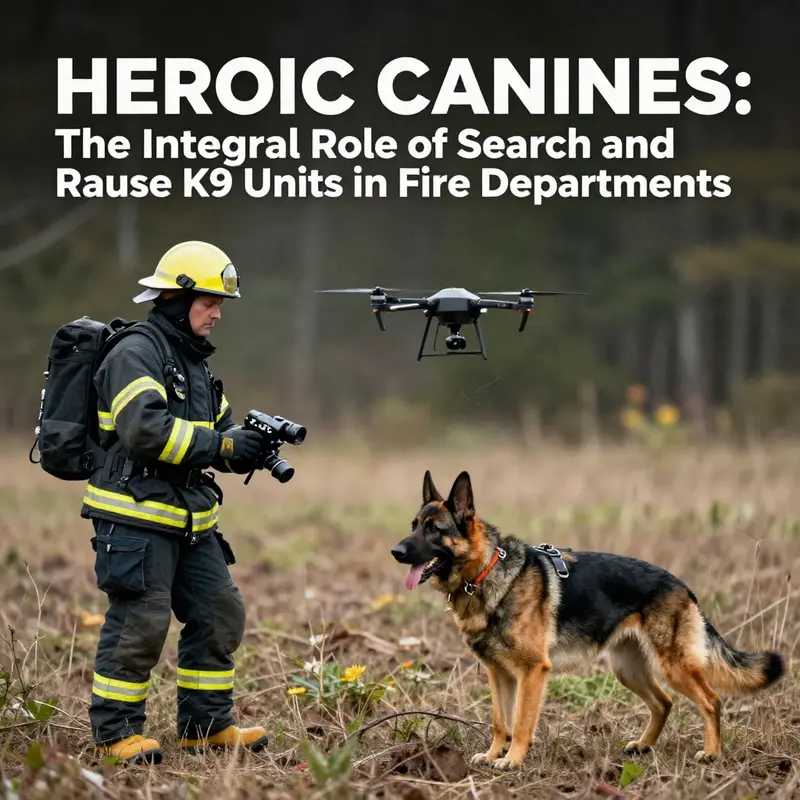
In many fire departments around the world, a canine ally is the compass in missing person searches. SAR K9 teams bring a keen sense that works across terrain and time. Their olfactory abilities cut through chaos in disaster zones or dense urban areas, guiding ground crews to survivors where human leads would be a whisper. Yet rescues now unfold in smoky or unstable environments, and the work is no longer a solo act. It is a carefully sequenced collaboration between biology and technology, a partnership in which the dog nose is amplified by networks of sensors, data analysis, and aerial reconnaissance. The result is a synthesis that uses the strengths of both to close the sensemaking gap that can slow or misdirect a search.
The enduring value of SAR dogs comes from training and their sensitivity to human scent across varied terrains. They can follow a trail through rubble, brush, or water, and they do so with a speed and focus that challenge any human. In a collapsed building after an earthquake, a dog relies on scent signatures that linger in microenvironments— pockets where a missing person sought shelter or air currents carried odors. In open landscapes, dogs traverse large areas, detecting heat and human presence in ways that can outpace foot patrols. This innate capability remains the backbone of SAR. It is the natural chassis upon which the latest technologies are grafted to create a safer faster search.
If the story stopped there it would be compelling. But the last decade has seen innovations designed to help handlers interpret what their canine partners sense, and to extend the range and reliability of the operation. The most transformative wave comes from data generated by wearables sensors unmanned aircraft and analytics. When a dog indicates a scent trail or clothing clue, real-time data from wearables environmental sensors and aerial scans can be cross matched with maps weather patterns and survivor likelihood models. The result is a more precise probability map of where a survivor could be, not just a general area. This is the essence of KHAIT, the K-9 Handler AI Teaming concept, a framework that closes the sensemaking gap between canine intuition and human decision making through AI powered interpretation. The idea is not to replace the dog with a computer but to build a collaborative loop in which sensor data predictive analytics and the dog’s behavior reinforce each other in real time. When a dog indicates a scent trail, AI can cross reference odor data with maps prior mission data and environmental conditions to forecast probable survivor locations with greater confidence. In practice this means a handler can adjust search directions allocate resources or escalate hazard controls based on an integrated readout rather than purely experiential judgment.
Wearables for dogs and handlers have become a quiet revolution inside SAR. These devices monitor heart rate temperature activity level body posture and even limb strain, offering early warnings for fatigue dehydration or overheating. The canine heart rate or respiratory patterns can spike in the presence of a scent trail or a structural hazard, signaling the handler to pause or switch approach. For humans, wearable data illuminate physiological readiness and the risk of overexertion, which matters when the search extends hours in hot dusty environments. The wearable ecosystem also includes environmental sensors that measure air quality temperature humidity and gases. When a dog’s search path intersects with a zone of degraded air or shifting structural stability, this information can prompt a rapid shift to safer search strategies or to leave the area entirely. Safety is as vital as the search outcome, because finding a survivor must not come at the cost of responders.
The integration of unmanned aerial systems and IoT expands the reach without sacrificing safety. Drones with thermal imaging and LiDAR map terrain, identify heat signatures, reveal structural irregularities, and provide live aerial context to the dog’s observations. This aerial perspective acts as a moving sensor suite that guides teams toward new search corridors while staying within safety zones. On the ground, a mesh of IoT sensors forms a network that persists even if some devices lose line of sight to the command post. The combined data stream—thermal cues, acoustic signals, scent indicators, and structural assessments—feeds a continuous situational picture that informs decisions at the agency level as well as field operator choices.
Yet every new layer must meet practical demands. In dense rubble, signal interference and power constraints challenge telemetry and data backhaul. Battery powered wearables or drones require careful power budgeting rugged hardware and resilient communication protocols. Researchers are exploring low power long range protocols to sustain connectivity across remote or damaged infrastructure. These developments are not just about longer battery life; they are about ensuring crucial cues from the dog are reliably translated into actionable information for handlers who must operate under pressure. The goal is to keep the human canine team in lockstep with the environment and with one another even as the scene changes.
To achieve this, training expands beyond obedience and scent drills. It includes scenarios where teams interpret synchronized feeds of sensory inputs. A handler learns to read the dog’s posture ear position and tail movement in conjunction with a data overlay, while a dog is conditioned to stay responsive even as distractions compete for attention. The synergy depends on trust and practice, so the training pipeline mirrors modern operations: rehearsed disaster drills, cross disciplinary drills with engineers and data scientists, and standard protocols for exchanging information across devices drones and human teams. This does not replace the dog’s skill set; it elevates it by providing a fuller palette of cues to deduce a survivor’s likely location the safest route and the moment to shift tactics.
Public examples show how these concepts translate to on the ground impact. In large urban regions, urban search and rescue tasks require response that blends planning with frontline canine work. Dense urban environments offer scent channels through stairwells elevator shafts and voids that can complicate interpretation. AI assisted interpretation helps determine whether a probable scent trail is a real survivor cue or an environmental byproduct, helping teams avoid misallocating scarce resources. In wilderness regions, SAR teams face terrain where the search radius spans kilometers. The drone layer can dramatically reduce time to a target area, after which the dog confirms or refutes the lead with speed and accuracy that human searchers alone cannot match. In all cases, the dog remains central; technology refines the dog’s impact by widening reach and sharpening decision making under pressure.
The broader implication is not about gadgets alone but about rethinking the operating model. The dog remains the versatile heart of a SAR unit, capable of delivering life saving results in constricted spaces. Technology extends the reach of that instinct. It translates a canine nose into actionable intelligence shared across incident command structural engineers and medical teams. The balance is delicate: sensors must be rugged data must be reliable and handlers must retain central authority while gaining access to richer information. When done well, technology enhances the dog’s strengths without compromising safety or the dog handler bond that underpins SAR work.
This integrated vision also raises organizational considerations. Fire departments must invest in cross training that blends canine science with data science human factors and emergency management. They must establish data governance so sensor streams AI analytics and field reports form a coherent narrative rather than a disparate set of inputs. They must commit to continual assessment because the operational context changes with every deployment. They must maintain welfare focus on canine health and well being of partners, the safety of handlers, and ethical use of autonomous tools in high stakes environments.
For readers seeking deeper context, external reading offers valuable perspectives. See the end of this chapter for a peer informed exploration of how AI sensor fusion and robotics converge in real world rescue scenarios. Within the narrative readers will also find practical reminders that technology serves people not the other way around. The handler dog dyad remains the heart of SAR, with technology acting as an amplifier of their shared capability. The future of fire department SAR K9s is not a single device or mission profile but a continuing evolution that preserves canine instinct while expanding what responders can accomplish in demanding environments.
To connect to ongoing professional development, training materials and real world exercises increasingly reflect this integrated approach. The path forward involves more than teaching the dog to follow a scent or the handler to interpret telemetry readouts; it requires a culture that can assimilate diverse streams of information into a clear defensible course of action under pressure. It means rehearsing joint drills where canine teams UAVs and human teams operate in concert rehearsing contingencies for loss of communication and refining decision protocols so that every move is justified by an evidence trail that blends smell sight and data. As departments build these capabilities, the SAR dog’s ancient sense of smell remains a constant, a natural resource that meets the digital age with resilience rather than replacement.
As this chapter closes, a note of cautious optimism is warranted. The fusion of canine prowess with intelligent networks and autonomous sensing does not merely speed rescues; it expands the scope of what is possible in situations once deemed too hazardous or too vast to cover thoroughly. More survivors can be found, responses can be matched to risk with greater nuance, and the emotional toll on responders can be mitigated by a more predictable, data informed operations tempo. The dog’s instinct and the handler’s judgment still guide the mission, but now they ride on a system that can see farther plan smarter and react faster than ever before. The result is a SAR effort that honors the dog’s legacy while embracing a future in which technology and biology work together to save lives more efficiently and safely than either could achieve alone.
For readers who want a concise entry point into this intersection of canine skill and tech enabled rescue, the journey begins with a reminder that the fire department’s SAR deploys are diverse and multi layered. In many communities dedicated canine teams operate alongside urban search units remote sensing specialists and incident command structures to orchestrate a cohesive response. The value of these teams lies not solely in their speed or scent detection accuracy but in their adaptability—the ability to switch from ground to air from scent trailing to thermal mapping and from individual lead to team consensus as the situation demands. When the narrative of SAR comes together in a single, integrated response, it is because the dog’s nose and the system’s sensors speak the same language—one that has been redefined by thoughtful design, rigorous training, and unwavering commitment to saving lives.
Nose to the Rescue: Real-World Triumphs of Fire Department Search-and-Rescue K9 Teams
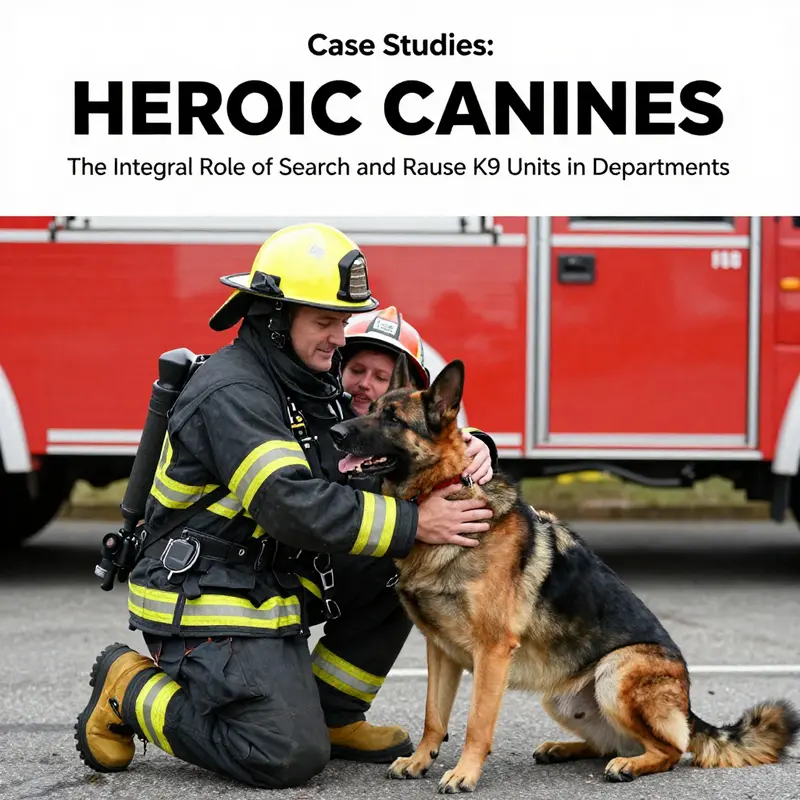
When a siren cuts through smoke and sirens carve the night, many people imagine a ladder truck and a captain barking orders. What often goes unseen is the role of a partner who cannot speak but can smell a life hidden beneath rubble, behind a wall of flames, or under the floodwaters after a storm. Fire departments around the world have built dedicated Search and Rescue (SAR) K9 units not as flashy add-ons but as core components of their life-saving toolkit. These dogs, paired with highly trained handlers, become accelerants of relief, translating the most intimate human signal—breath, skin, and scent—into a precise pointer toward those in danger. Their work rests on a careful blend of scent science, disciplined training, and a culture that treats every mission as a shared mission of safety. The result is not simply heroic moments but a systemic capability that grows stronger with each deployment, each drill, and each rescue that quietly happens in the shadows of an emergency.
Across continents and climates, the pattern is remarkably consistent. In dense urban centers, SAR dogs are trained to follow minute cues of human scent through smoke, heat, or structural instability. In rural or forested terrain, they sweep through open space with a speed that human teams cannot match, narrowing search areas in minutes and allowing firefighters to allocate scarce resources with greater precision. In disaster zones—whether after an earthquake, a wildfire, or a flood—these dogs bring a different kind of efficiency to the scene: easing the burden on crews by reducing the volume of area to be checked and by sometimes detecting signs that might be missed by visual observation alone. The case studies that follow illustrate not only what can be achieved but how K9 units integrate into the broader emergency response framework, how they must be safeguarded against the very dangers they help to mitigate, and how communities benefit when the bond between handler and dog is forged through rigorous, ongoing training.
The Los Angeles case from 2023 offers a vivid example of a high-stakes interior search in a setting where seconds count and the environment works against human senses. A multi-alarm blaze in a high-rise apartment building created a maze of smoke, heat, and collapsing elements that would have overwhelmed even the most experienced search teams without a canine partner. Max, a veteran SAR dog, relied on the strength of his sense of smell to locate a resident who was unconscious and unable to respond to verbal or auditory cues. The dog’s ability to cut through the chaos and identify a precise location inside a burning bedroom—moments before a potential collapse—transformed what could have been a protracted, uncertain search into a resolutely targeted rescue operation. The human team followed Max’s alert with a rapid, coordinated effort that delivered a life-saving intervention for a resident who might have otherwise been trapped. This isn’t merely about luck or bravery; it reflects the trained discipline of the team, the dog’s conditioned response, and the management of a hazardous scene that demands respect for both human and canine partners. It also underscores a broader point: K9 units change the architecture of a rescue because they introduce a dimension of environmental awareness that people under extreme pressure can lose sight of amid panic and noise.
In New York City, the aftermath of Hurricane Ida in 2021 showcased the adaptability of SAR dogs when traditional methods became insufficient due to widespread flooding and debris. Apollo, a disaster-focused search dog, was deployed to locate survivors in submerged or partially buried environments in Queens and the Bronx. The flooded neighborhoods created a landscape in which conventional search techniques could be slow or perilous. Apollo’s trained response—following the faintest signs of breathing or movement under debris—enabled rescuers to pinpoint a survivor beneath a collapsed garage. The moment of discovery, after a careful chain of cues verified by handlers and divers, halted the clock on a person’s exposure to dangerous conditions. The operation demonstrated how SAR K9 teams extend the reach of human responders, turning complex, waterlogged scenarios into sequences of targeted actions that accelerate extraction and increase the chance of survival even when visibility is near zero and the terrain is unstable. It also highlighted a vital collaboration—the dog’s alert is not an endpoint but the trigger for a carefully orchestrated sequence of hazard assessment, stabilizing the environment, and a staged rescue that keeps both the survivor and the responders safe.
The Houston example from 2022 adds another layer to the evolving narrative of K9 utility. An industrial fire at a chemical storage facility presented not only a physical hazard but a spectrum of potential hazards: toxic fumes, structural risks, and the possibility of hidden victims or workers missing within ventilation shafts and concealed compartments. Blaze, the K9 in this case, was tasked with perimeter searches under conditions where exposure to fumes was a constant threat to human teams. The dog’s tracking and alert helped locate a worker who had become overwhelmed by fumes and taken shelter in a ventilation shaft. The timely discovery allowed medical teams to intervene promptly, and the response likely reduced the severity of exposure for that individual. Beyond the immediate rescue, the case reinforces a principle that often guides SAR operations: dogs can provide critical information about unseen hazards, guiding responders away from danger while directing them toward places where people may be hidden. In this way, K9 units contribute to the safety of the entire operation, not just the extraction of a survivor.
Taken together, these three cases illuminate several enduring truths about fire department SAR K9 units. First, the dogs amplify human capability in environments where scent may be the only reliable clue. Their achievements are not accidental outcomes but the results of a deliberate training architecture that emphasizes scent discrimination, search patterns, and the ability to work across different terrains and conditions. Second, success is built on the partnership between dog and handler. The handler is more than a guide; they are a professional partner who interprets the dog’s behavior, manages the search strategy, and makes critical decisions about when to advance or when to pause. This relationship requires rigorous training, clear communication, and ongoing fitness—physical and mental—for both animals and humans. Third, SAR K9 units are not isolated actors but integrated elements of an emergency-response ecosystem. They work in tandem with divers, engineers, firefighters who manage structural stability, and in some cases, technology-aided reconnaissance that extends the dog’s insights into the most dangerous zones. In each scenario, the K9 unit reduces uncertainty, speeds up decision-making, and, most importantly, saves lives by enabling earlier, more precise interventions.
This integrated approach is not simply a matter of deploying a dog when a fire is happening. It rests on a comprehensive program of training, certification, and continuous learning that keeps the teams responsive to changing conditions and new kinds of emergencies. The broader takeaway from these accounts is that canines have become indispensable in the modern fire service, a fact reinforced by the ongoing expansion of USAR capabilities, collaborative operations with other agencies, and the refinement of perimeters and search plans that recognize the unique contributions of SAR dogs. The stories also remind us that community trust in these units is built through consistent, transparent performance. When the public sees a dog and a firefighter move with quiet precision through smoke or floodwater, the message is clear: the fire service is investing in every available means to protect life, and animals are a trusted and valued part of that mission.
The discussion would be incomplete without acknowledging the anecdotal reminders that animals—whether trained SAR dogs or everyday household pets—can play profound roles in saving lives. Instances like Lulu the Golden Retriever in Bakersfield, who woke a sleeping family during a house fire and thereby allowed safe escape, illustrate how a canine’s natural instincts can augment emergency response on a local level. These stories matter not only for their emotional resonance but for their practical implications: they emphasize the potential for community-wide awareness and appreciation of animal contributions to safety. They also reinforce the idea that training, preparedness, and public education about fire safety extend beyond humans to pets and service animals alike, prompting communities to think more broadly about how to safeguard every member of a household during a crisis.
In reflecting on the collective evidence, a balanced picture emerges. Fire department SAR K9 units are indeed a strategic asset with a track record of life-saving outcomes. They bring a specialized optical lens to the chaotic real world of search and rescue, translating scent into actionable intelligence at moments when every second counts. Yet their success is never isolated from the broader framework of operational readiness: relentless training, strict safety protocols, and a strong culture of teamwork between handlers, crews, and medical responders. The cases illustrate a continuum—from the meticulous, step-by-step routines that prepare a dog to work in smoke and heat, to the high-stakes, time-compressed rescues that define a career in urban or disaster response. They also remind policymakers and communities that the value of these units extends beyond dramatic headlines. It is in the steady, reliable, day-to-day ability to narrow search zones, to locate a person who cannot call for help, and to do so with the least risk to rescuers that the true measure of success lies.
The content here connects with a broader ethic of preparedness that is shared across fire departments globally. SAR K9 units embody the principle that modern emergency response is a mosaic of capabilities, each piece essential to the whole. Training standards, canine welfare, handler proficiency, and interagency collaboration all converge to produce a capability that is greater than the sum of its parts. A chapter in NFPA’s resources highlights the structured approach many departments adopt for K9 units—from selection and initial training through ongoing certifications, scenario-based drills, and post-incident reviews that feed back into improved practice. Readers who wish to explore this landscape further can consult the External Resource linked below to see how national standards and statistics frame the deployment and effectiveness of K9 teams across the country. For practitioners and researchers alike, the stories behind these deployments offer more than inspiration. They offer a roadmap for optimizing rescue outcomes in environments where human senses falter and time tightens the window of opportunity.
To connect with the practical aspects of improving responder readiness, it is worth noting that, in parallel with field deployments, supportive training structures fortify SAR capabilities. Ongoing education in fire safety, rescue techniques, and certification programs ensures that teams stay current with new protocols and evolving threats. The shared knowledge from these programs feeds back into field practice, helping to keep the dogs healthy, focused, and responsive to the demands of emerging emergencies. This emphasis on training and certification reinforces the idea that the power of a SAR K9 team rests not only in a dog’s nose but in the entire system that supports it—from pre-deployment conditioning to post-incident debriefings that extract lessons learned for future operations. The synergy of human and canine teams, underpinned by training discipline, makes SAR K9 units a durable, scalable capability for fire departments facing a broad spectrum of hazards in an ever-changing world.
For readers seeking more on the topic, the rich case histories and the broader context of fire department K9 utilization provide a meaningful basis for assessing how these units fit into a city’s or region’s overall emergency response strategy. The cases described above highlight not only the successes but also the challenges that accompany this line of work: the need for comprehensive scent work under difficult conditions, the constant management of risk to both dogs and humans, and the ongoing requirement for interdepartmental coordination that ensures every asset is used to maximum effect. As departments continue to refine their SAR programs, the lessons from Max, Apollo, and Blaze will likely inform future deployments, training curricula, and investment decisions. And as communities grow more interconnected in the wake of climate-driven disasters and urbanization, the value of having ready-to-act SAR K9 units becomes not just a matter of efficiency but a matter of ethical responsibility: to do all that is possible to locate and rescue those who cannot help themselves, when the odds are most daunting.
External resource: For a broader overview of how fire department K9 units are organized and evaluated, see the NFPA resource on Fire Department K9 Units: https://www.nfpa.org/News-and-Research/Data-and-Statistics/All-statistics/Fire-Department-K9-Units
Internal reference: For ongoing professional development resources related to fire safety training and certification, see this relevant guide: https://firenrescue.net/blog/fire-safety-essentials-certification-training/
Final thoughts
The importance of Search and Rescue K9 units in fire departments cannot be overstated. Their specialized training and natural instincts allow them to carry out tasks that are vital in life-threatening situations. By integrating modern technology and employing proven strategies, these units enhance rescue efforts, ensuring that more lives can be saved. As we have seen through various successful case studies, these canine heroes are not only enhancing the capabilities of fire departments but also fostering a profound connection between humanity and our animal partners. Their contributions exemplify a collaborative spirit that is essential for effective emergency response.