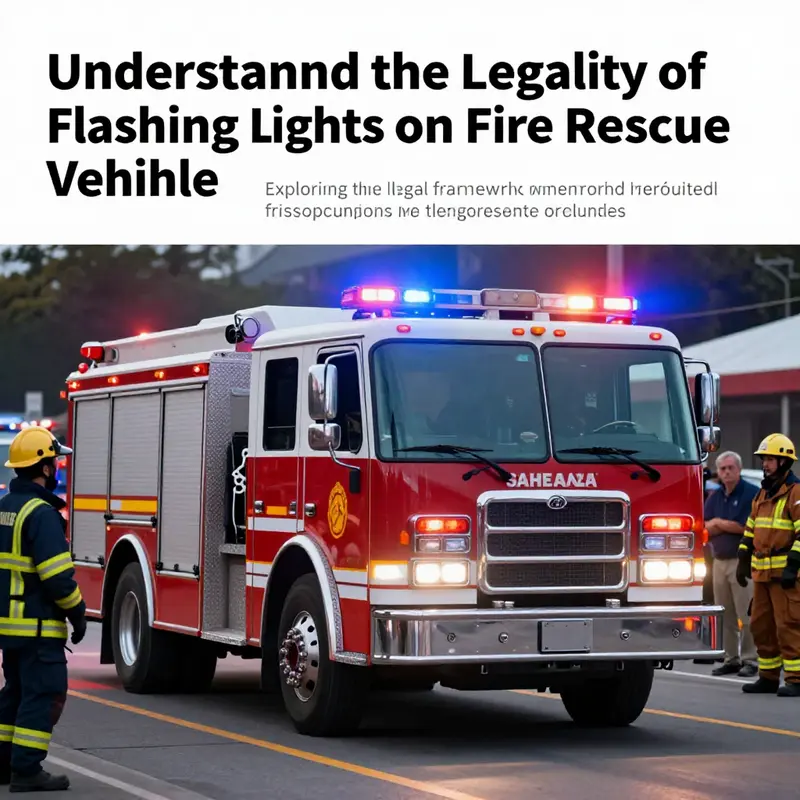
The presence of flashing lights on fire rescue vehicles has become synonymous with emergency response, serving a crucial role in alerting civilians and ensuring safer navigation for responders. However, questions often arise regarding the legality of these flashing signals. This article delves into the legal aspects governing fire rescue vehicle lights, clarifying misconceptions while providing insights for individual car buyers, auto dealerships, and fleet managers. Each chapter will address unique facets of this topic, illuminating the importance and legality of these lights in emergency contexts.
Bright Lines on the Road: The Legal Reality Behind Fire Rescue Flashing Lights
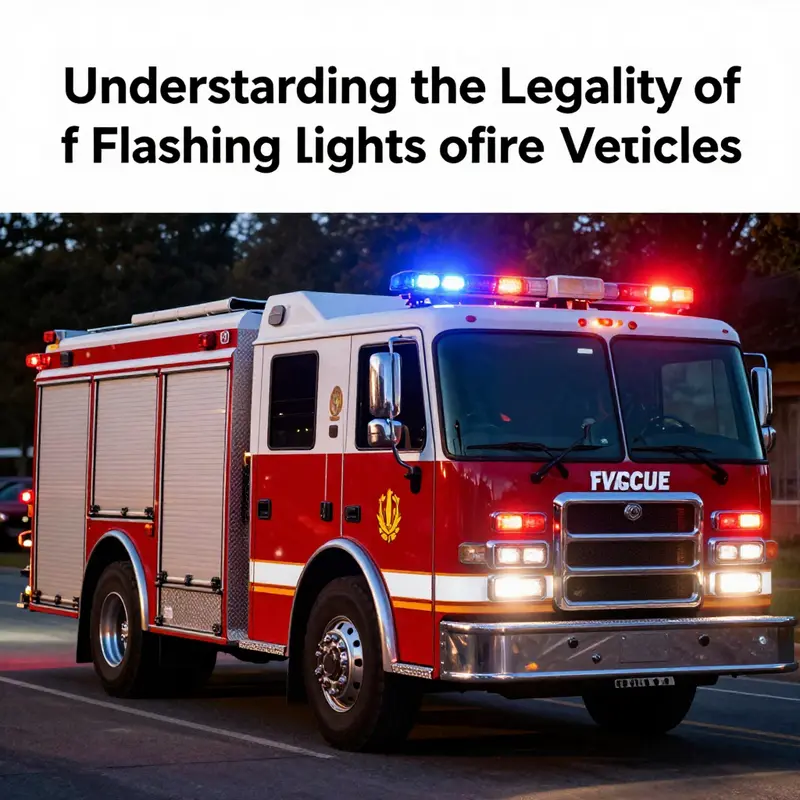
On a quiet stretch of road, a siren wails and a fire engine rounds the bend with flashing red lights slicing through the night. The scene is dramatic, but the law behind those lights is not theater; it is a carefully calibrated framework designed to protect the public and enable rapid, decisive action for those in danger. For many readers, the first and simplest question is whether it is illegal for fire rescue to have flashing lights. The answer, once you go beneath the surface, is not only no; it is yes in one sense and absolutely required in another. Flashing lights are not a cosmetic feature but a legal instrument that signals urgency, signals priority, and, in doing so, helps save lives. To understand why, we must trace how the legal architecture around emergency lighting has evolved, how it functions in practice, and how it shapes the daily duties of firefighters, paramedics, and the communities they serve.
In a state like Washington, the law makes this relationship explicit. RCW 46.37.184 specifies that red flashing lights on fire department vehicles must be in operation when the vehicle is on emergency status. This is not an optional adornment; it is a codified authorization that also imposes operational expectations. The statute serves multiple purposes at once. It creates a predictable signal that other drivers recognize, not only as a cue to yield but as a signal that the responding vehicle is engaged in a life-safety mission. It also sets boundaries: the lights are used in defined circumstances, during genuine emergencies, and are regulated by who is allowed to activate them and under what conditions. The addition of rear-facing blue lights in certain jurisdictions underscores a broader principle—that emergency lighting is a layered system designed to convey information to every road user about direction, priority, and the evolving status of a response.
This legal architecture sits atop a broader, interstate and international tapestry of regulations. Across the United States and in many parts of Europe, fire engines, ambulances, and police cars carry specific color combinations and patterns of flashing lights, chosen for maximum recognizability and minimum confusion. The intent behind these standards is not merely to declare that the vehicle is in distress but to orchestrate movements on crowded roads with as much certainty as possible. The flashing lights become a language that every driver understands, translated through local statutes, regulations, and guidelines. The language is standardized yet adaptable, reflecting differences in climate, road design, and traffic behavior. In practice, this often means red and blue are used in various arrangements, with red typically signaling the engine’s urgent passage and blue often signaling a public safety function. However, this is not a universal rule; some regions still rely more heavily on red alone, while others may use amber in conjunction with primary emergency colors in specific scenarios, all with the shared aim of clarity, predictability, and safety.
The legal scaffolding also encompasses who may speak those lights into existence. Authorized personnel—trained firefighters, paramedics, and law enforcement officers—are empowered to activate emergency lighting while operating an emergency vehicle. Unauthorized use, even with the best intentions, can carry penalties because the system depends on disciplined adherence to protocol. The risk is not simply legal jeopardy; it is the potential for miscommunication that could misdirect drivers, delay critical care, or create unsafe conditions for responders on the scene. For this reason, many departments emphasize not only the mechanical operation of lights but the ethical and legal rationale behind their use. They train crews to deploy lights in ways that optimize safety for bystanders and responders alike, recognizing that the lights are a protective measure as much as a signal of urgency.
Technology has pressed those legal norms into new shapes. LED advances and smart lighting systems have allowed lights to be brighter, more energy-efficient, and more durable in a wider range of weather and traffic conditions. Yet, with greater brightness comes greater responsibility. Regulators and standard-developing bodies have responded with brightness and flash-pattern standards to reduce distraction, minimize the risk of triggering seizures in sensitive individuals, and prevent disorientation during complex operations. Some jurisdictions impose restrictions on high-intensity strobe patterns in residential areas or during low-visibility conditions, balancing the need for visibility with the risk of alarm or confusion. The regulatory conversation has thus shifted from “can we use flashing lights?” to “how can we use flashing lights most safely and effectively under a given set of circumstances?”
Within this evolving landscape, fire rescue departments shoulder a heavy burden of compliance, not only to avoid penalties but to preserve public trust. The legal expectations extend into daily practice: when responding to a call, personnel are trained to power up the lights in a manner consistent with the severity of the incident, the road environment, and the presence of other responders. They are trained to deactivate lights when they reach the scene if the emergency parameters no longer justify their use or once the vehicle has completed its critical transit. In other words, the lights are not a badge of authority to be flashed at will; they are a tool used with discipline and restraint. The overarching goal is to ensure that the emergency response can proceed as quickly as possible while maintaining the safety of the public, the crew, and the incident itself.
A chapter of this story, often overlooked, concerns the alignment of lighting with training and ethics. It is here that the linked, practical education of emergency personnel becomes essential. To understand the moral dimension of this tool, consider how a well-designed training program frames the purpose of emergency lights. They are, first and foremost, a means of saving lives by facilitating rapid, safe passage through traffic and by signaling active danger to others. They are not a show of force or a convenience for the crew. This ethical frame is reinforced in ongoing professional development and certification programs, such as the Fire Safety Essentials Certification Training, which emphasizes the responsible use of safety tools in service of the public good. The intention is clear: the lights exist to protect life and property, not to escalate risk or to claim unearned priority. When practiced with that discipline, the flashing lights become a trusted part of the community’s safety fabric, a predictable mechanism by which the public can respond appropriately to an emergency.
As readers reflect on these layers—the law, the technology, the training, and the ethics—it becomes evident why the simple question of legality is incomplete. The question that truly matters is how legality translates into practice. Washington’s RCW 46.37.184 confirms that the red flashing lights on fire department vehicles are mandatory in emergency status, a rule that supports immediate traffic clearance and rapid arrival at the scene. This is complemented by regional allowances for blue rear-facing lights, which help communicate not just urgency but the type of responder and the direction of travel with greater clarity in complex traffic scenarios. The practical effect is that the public is better protected when these signals are used properly; drivers understand when to yield, pedestrians understand where danger exists, and responders understand the path ahead. The legal framework, then, is not a constraint that limits action; it is a framework that channels action toward safety, speed, and accountability.
Still, it would be incomplete to present this as a monolithic global directive. Jurisdictional variation matters. While many places share the broad principle that emergency vehicles have priority on the roadway, the specifics—what colors are permitted, where they can be mounted, what flash patterns are allowed, who can activate them, and under what conditions—vary to reflect local traffic cultures, road infrastructure, and public expectations. This is why professionals must maintain current knowledge of the regulations that govern their own jurisdictions. And it is why the standards set by national bodies, such as guidelines promulgated by safety and transportation authorities, play a crucial role. They provide a reference point from which state or provincial rules can be adapted without sacrificing safety or predictability. In practice, the governance of flashing lights is a dynamic conversation between law, technology, and real-world driving conditions.
From a public perspective, the visibility and predictability of emergency lights influence not only driver compliance but trust in the system. When lights are used properly, the public experiences a sequence of signals that are clear and consistent: a vehicle is in motion, responding to an emergency, and others should yield. When misused, the signals can become confusing or irritating, undermining the very safety they were designed to enhance. This is why penalties for misuse—ranging from fines to license consequences—exist in many jurisdictions. The consequences are not merely punitive; they serve a preventive purpose, deterring improper use that could endanger both the responders and the general public. The legal system thus acts as a guardian of the delicate balance between speed and safety, ensuring that the urgency conveyed by flashing lights does not devolve into recklessness.
For readers seeking practical assurance about what is permitted and what is prohibited, it is helpful to recognize the role of official guidance beyond statutes. National guidelines and standards help harmonize regional rules, offering a common language that can be adapted locally. In addition, departmental protocols provide the day-to-day instructions that connect statute to street-level action. This is the living interface of law and life‑saving service: officers and firefighters converting pages of law into the precise choreography of lights, sirens, and stops that protect people in moments of peril. It is a discipline that relies on clear rules, disciplined execution, and continuous education—where the flashing lights remain a tool for safety rather than a symbol of novelty.
In weaving together these strands, this chapter aims to deliver a grounded, nuanced answer to the simple question: is it illegal for fire rescue to have flashing lights? The answer, grounded in law, ethics, technology, and practice, is nuanced. In most places, the use of flashing lights is not illegal; it is required under emergency status. The specific color schemes, placements, brightness, and patterns are bounded by regulatory frameworks designed to protect everyone on the road. The lights are a legal instrument that enables rapid response, with a built-in system of checks—authorized operators, defined conditions, and deactivation protocols—to prevent overreach. Taken together, the law does not merely permit flashing lights; it codifies a balance between the urgency of emergency response and the everyday right of the public to safe travel. This balance is the reason why flashing lights have become a defining element of modern emergency services and a symbol of the continuous commitment to protect life and property in the most critical moments.
For readers who want to explore the practical dimensions further, practical training resources such as the Fire Safety Essentials Certification Training provide a bridge between regulatory theory and on‑the‑street performance. This kind of program reinforces the ethical framework and operational standards that ensure lights perform their lifesaving function without introducing new hazards. In a broader sense, the conversation about flashing lights is not simply about legality; it is about reliability, predictability, and the public’s confidence in their emergency responders. As traffic patterns evolve and technology advances, the legal landscape will continue to adapt. Yet at its core, the flashing light on the fire apparatus remains a clear and essential signal—a bright line that guides, protects, and saves.
External reference: for a comprehensive overview of emergency vehicle lighting regulations and standards, see the National Highway Traffic Safety Administration (NHTSA) resources on emergency vehicle lights and sirens, which provide national context to the state and local rules that shape how fire rescue teams operate on the road. https://www.nhtsa.gov/vehicle-safety/emergency-vehicles-lights
Final thoughts
In conclusion, it is clear that the use of flashing lights on fire rescue vehicles is not only legal but required by law during emergency responses. This practice is vital for promoting public safety and ensuring the efficient navigation of emergency personnel. Understanding these regulations helps reinforce the legal frameworks that support emergency services, benefiting not just responders but the communities they serve.