
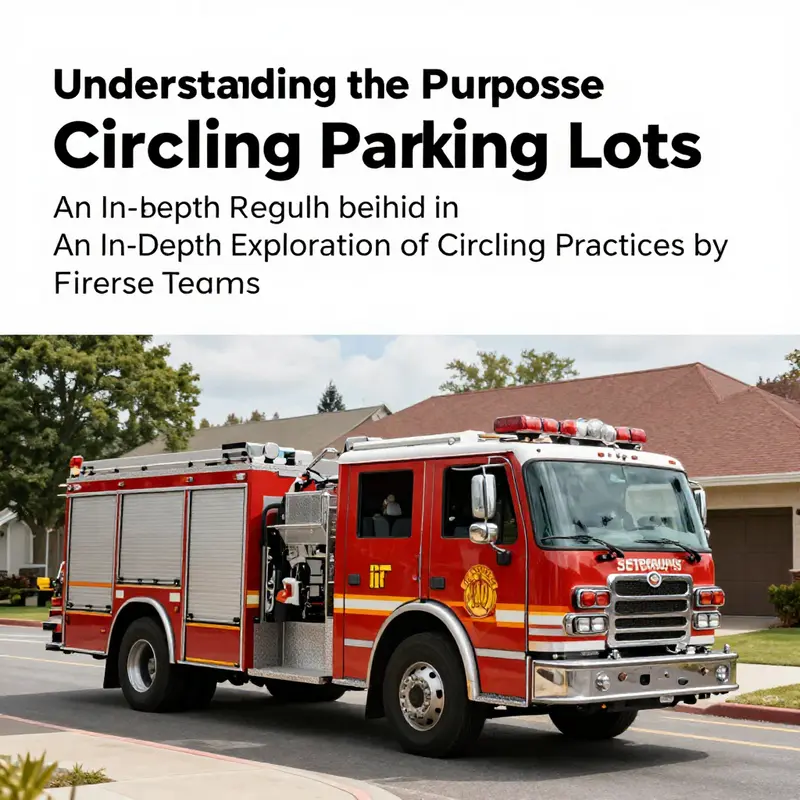
When fire and rescue vehicles circle a parking lot, it often raises eyebrows and provokes questions. Why do they appear to be driving in circles instead of rushing to the scene? This seemingly unnecessary action is, in fact, a critical component of their operational protocol. This article examines five key reasons as to why these vehicles traverse a scene rather than entering blindly. Through exploring hazard assessment, operational tactics, access challenges, and strict adherence to safety protocols, we aim to illuminate the rational strategies behind this practice. Each chapter will provide insight into how these measures protect not only first responders but also those they aim to assist. Join us as we unpack this pivotal aspect of emergency response efforts.
Circles of Safety: Perimeter Rounds and Fireground Hazard Assessment
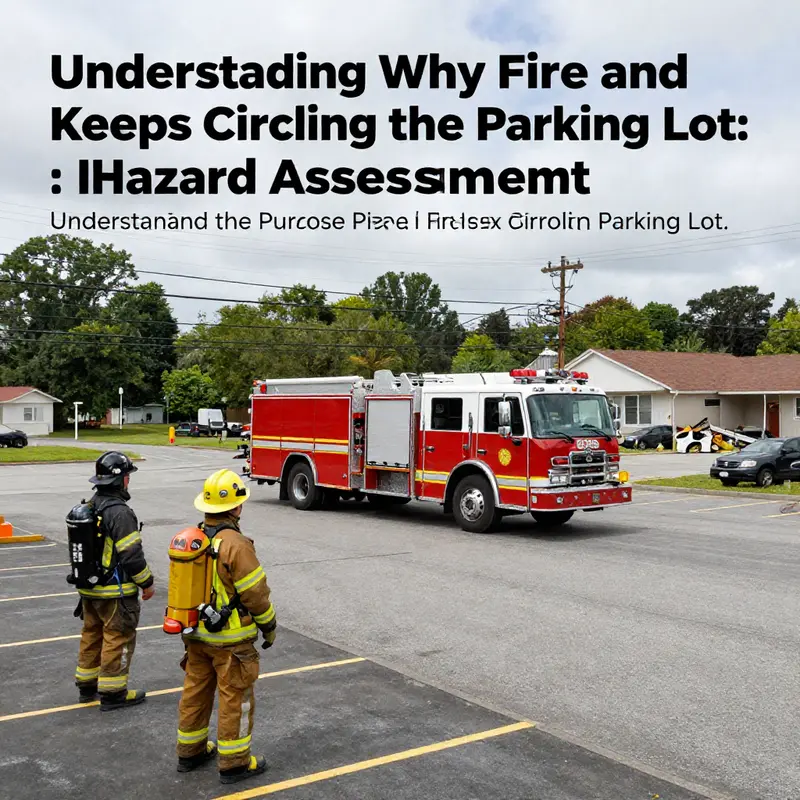
On arrival the initial moments often feel like a swirl of urgency and noise. Yet among the most deliberate actions a crew takes is a slow circuit around the area before entry is attempted. This perimeter round is a deliberate, disciplined hazard assessment. Circling is not a luxury of time; it is a core method for transforming a chaotic moment into a controlled decision making process. The loop is the early grammar of situational awareness that keeps responders and the public safe while guiding tactical choices that will unfold inside and around the building.
The first principle is safety through visibility. From the exterior, responders gain a vantage that a single approach cannot offer. A few meters of distance can reveal downed power lines sparking along a curb, a leaking fuel odor, or a vehicle whose position could become a trap for a large fire engine maneuvering into the site. The perimeter acts as a living filter; it helps responders separate likely hazards from those that are less obvious but dangerous. This is a visual sweep, a reconnaissance with purpose, designed to reduce the chance that a sudden rear attack or a collapsing facade will catch teams off guard. The parking lot becomes a testing ground for risk, not merely a staging area.
With hazards narrowly defined, the next loop expands into size up and strategy. The initial pass yields a real time picture of fire behavior, the likely spread path, and the structure’s potential vulnerabilities. The responders look for signs of hidden fire or superheated pockets behind walls, the direction of smoke traveling, and wind indicators that might push flames toward openings or across vulnerable routes. They measure entry points, exits, and the best lines of attack, all while the clock ticks. The perimeter loop also helps identify where to position equipment and personnel to maximize efficiency. For instance, identifying hydrant locations or the closest water sources becomes crucial when time is of the essence and a direct line to the street may be compromised by parked cars, debris, or temporary roadway congestion. A well timed pass around the exterior often clarifies where to place the ladder truck or where to stage additional units so they can respond without bottlenecks.
Another essential purpose of that looping pattern is to check access and confirm clearance. Even when a driveway seems open, misaligned vehicles or oddly parked cars can create a narrow channel that large fire apparatus cannot pass through. By circling, crews verify that the primary access route remains passable and that they can maneuver safely once they are inside. It is a practical antidote to assumptions. The reality on the ground often contradicts what a quick glance might suggest. The circling act becomes a preemptive clearance check, a guard against the moment when a trapped engine cannot turn or a bulky stack of hoses cannot be laid out because of a single vehicle blocking the path. The circle thus operates as a barrier against chaotic misalignment that can occur in a crowded area, reinforcing the discipline that access must be kept open for life saving work that follows.
Beyond physical safety, the perimeter loop serves to steady command and control. In the middle of a chaotic scene, the Incident Commander must maintain a clear mental model of where everyone and everything is and where the danger zones lie. Circling the area helps build that model, not only for the IC but for the entire crew. It reduces the cognitive load by providing a predictable pattern: move, observe, update, move again. This cadence helps prevent confusion as responders and bystanders converge on the site, and it minimizes the risk that someone from outside the team will stray into a zone of risk. A controlled perimeter helps keep people on the outside where they belong and within sight where they can be moved or redirected as the incident evolves. The result is a more orderly response, where resources can be distributed with deliberate purpose rather than ad hoc improvisation.
The practical value of perimeter circling is reinforced by formal safety protocols that govern many departments. A standard element is the safety sweep or scene walk around, a pre entry ritual that ensures the area has been scoured for secondary hazards. The benefit of such a ritual is clear: it creates redundancy in hazard detection. What one look might miss, a second pass can catch, particularly if wind shifts or structural changes occur as operations begin. This is not simply a precaution but a strategic step in incident planning. It aligns with a broader field of practice seen in high rise firefighting drills and other complex environments, where methodical reassessment at the boundary of the scene anchors safer, more reliable interior work. The value of adhering to these practices forms the backbone of a culture that prioritizes safety, predictability, and professional discipline.
The looping approach also supports the tactical logic of fire behavior prediction. Observing from the exterior, crews can infer how heat and smoke will travel once interior operations commence. Where will temperatures rise and pressures build? Which walls are likely to fail under heat? How might the intervention at one point alter conditions elsewhere? The answers to these questions often unfold in real time, as the wind shifts, as doors are opened, or as occupants who have sheltered in place begin to move. The circle acts as a low risk, high value means to collect intelligence about evolving conditions. It is a kind of weather report inside the hazard landscape, with responders constantly updating the forecast as conditions change. The better the forecast, the safer the route in, the more controlled the entry, and the more effective the intervention will be.
Within this framework, training and professional development emerge as the glue that keeps perimeter circling purposeful and proficient. The most effective teams treat the circle as a shared diagnostic tool, a common language that translates experience into action. This is reflected in the emphasis many departments place on safety focused education, including formal certifications and ongoing practice. The habit of walking the boundary is not a one off measure but a cultivated skill that improves with repetition and reflection. For responders, the ability to translate a perimeter read into a tactical plan where to stage, how to deploy lines, and when to advance or retreat depends on a deep reservoir of rehearsal, not luck. It is why communities invest in robust training programs, drills, and cross disciplinary exercises that mirror the complexity of real incidents. In that sense, the parking lot circuit is more than a tactical routine; it is a pedagogical loop shaping judgments under pressure and building the confidence to act when seconds count.
To anchor this discussion in a broader professional context, consider the resources that guide hazard assessment and scene management beyond local practice. The National Fire Protection Association provides guidelines that frame how hazard assessment should be conducted at the scene, offering a shared standard that supports consistent decision making across agencies. Such standards are invaluable in urban operations where the density of structures, people, and vehicle movements adds layers of complexity to every incident. The parking lot circle, in its quiet methodical way, embodies that standardization: a measurable, observable boundary within which risk is managed and outside of which the public remains protected as responders work to stabilize the situation. For readers seeking deeper formally recognized guidance, the NFPA resources offer a structured view of how hazard assessment translates into action on the ground. See the official guidelines for standardized hazard assessment protocols in urban firefighting operations at https://www.nfpa.org/.
This disciplined practice also intersects with public facing expectations. People watching from the street may wonder why the responders seem to go in circles. The answer lies in a commitment to safety and precision, not bravado. The circle communicates a professional intent: we are not recklessly charging into danger; we are mapping it, isolating it, and preparing the most informed, least intrusive route to intervention. It is a language of caution that, when enacted correctly, reduces risk to the public and to the responders themselves. The parking lot becomes a microcosm of the larger cityscape, where every movement is a test of risk versus necessity and every loop is a step toward clarity in the fog of an emergency.
For those who want to explore how these concepts translate into practical readiness, working through a training lens can be illuminating. Practical drills emphasize not only the mechanics of turning a wheel but the mental discipline of keeping a dynamic perimeter intact while operations proceed inside. The focus is on building a shared mental model what one crew sees on the exterior shapes what another crew does inside, and the loop becomes a collaborative instrument rather than a solitary maneuver. To reinforce the human element behind the circle, consider engaging with training resources that highlight responsibilities, decision points, and the teamwork required to keep every loop productive and safe. And when you want to connect practice to learning, a resource like Fire Safety Essentials Certification Training can offer a structured pathway to deepen understanding of these critical concepts: https://firenrescue.net/blog/fire-safety-essentials-certification-training/.
In sum, the recurring circling around a site during an emergency is a deliberate, multi faceted practice rooted in hazard assessment, access verification, scene control, tactical planning, and professional discipline. It translates a volatile moment into a controllable sequence of observations and decisions, a sequence that ultimately determines whether responders can reach the interior safely, protect bystanders, and bring the incident to a focused, effective resolution. The site is not a backdrop; it is a critical stage where the first, most essential work of risk reduction begins, and where every loop contributes to a safer, more capable response. The practice embodies a granular commitment to safety that scales from the smallest drill to the largest urban incident, and it remains a cornerstone of modern firefighting and rescue operations.
null
null
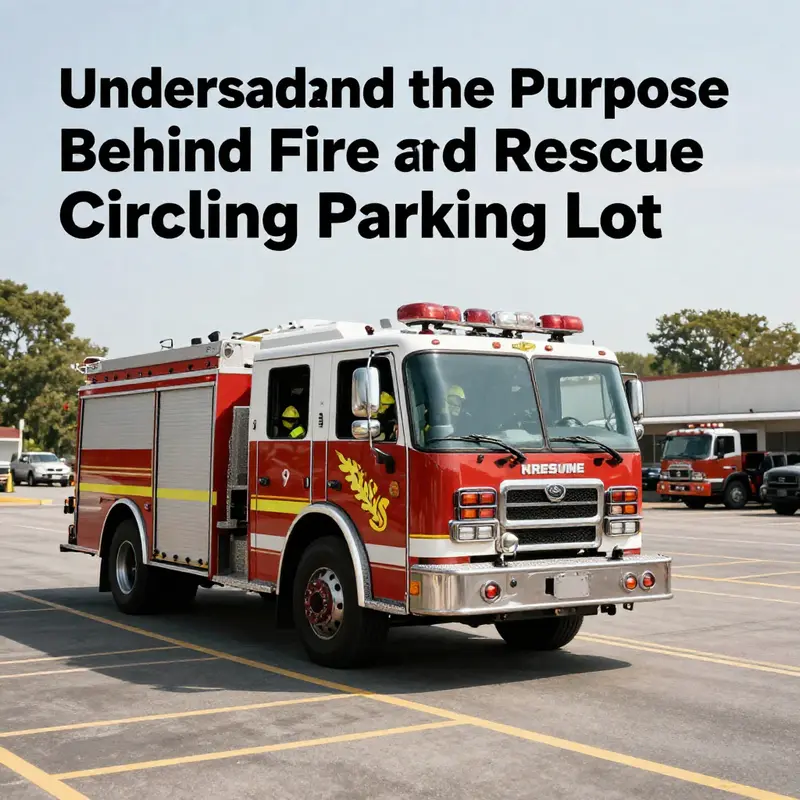
Circling to See: How Fire and Rescue Read Parking Lot Geometry Before Entering an Emergency
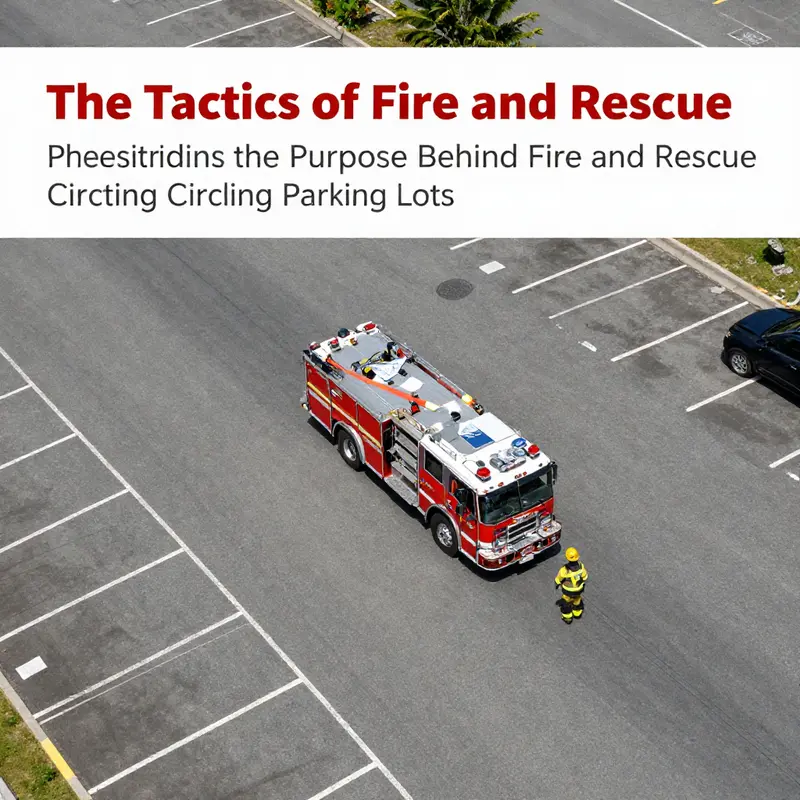
When alarms crackle through a city, the first moments of a response are not simply about moving fast; they are about moving with purpose through a space that can either hinder or save lives. Fire and rescue teams often begin with a deliberate, rhythmic circuit around a parking lot before committing to a scene. From the outside, it may look like circling for show or routine, but this motion is a carefully choreographed safety sweep. It is a critical, real-time assessment of the ground beneath their feet, a perimeter check that translates a complex environment into a plan responders can execute with confidence. The parking lot—whether a compact urban lot, a sprawling shopping center annex, or a multi-level garage—presents a unique blend of challenges: tight turns, angled parking that narrows lanes, pedestrian corridors, and a host of potential hazards that can evolve in seconds when a fire starts or a vehicle becomes a threat.
The first pass around the perimeter serves a fundamental safety purpose: to confirm that the immediate environment is clear of hazards before any entry is attempted. This is not a mere formality; it is a pause that allows crews to visually scan for downed power lines, unstable structures, leaking fuels, and vehicles that might block access. In many incidents, what looks like an open space on a map can hide a line of parked cars, a pallet, or an oversized SUV that creates an obstacle for a ladder or a heavy pump apparatus. Incomplex layouts or crowded lots, those obstacles can become life-threatening bottlenecks if not identified and accounted for before the first nozzle is charged. The perimeter sweep, then, becomes a safety net that protects both responders and bystanders, ensuring there is a clear line of retreat and a safe corridor for equipment placement.
Beyond hazard identification, the circling motion evolves into a rapid scene assessment and tactical planning stage. The initial circuit is an information-gathering exercise that translates spatial realities into actionable strategy. Firefighters look for the source of heat, smoke behavior, and potential fuel sources. They chart likely access points into buildings, entranceways for occupants needing rescue, and hydrant locations or water sources that might otherwise be obscured by vehicles or landscaping. In a modern parking environment, this phase also includes evaluating charging stations and electrical infrastructure that could influence extinguishment tactics. A 2025 study on electric vehicle parking lots in large shopping centers underscores how charging operations can alter risk profiles, calling for contingency planning that anticipates battery heat, venting needs, and safe distances for responders from high-energy components. Circling thus becomes risk forecasting in motion: what appears calm from a distance may reveal critical constraints up close, and the window to adapt may be shorter than a single breath.
Once perimeter safety and general awareness are established, the circle transitions into a more precise check of access and maneuverability. This is where the practical geometry of the space comes into view. Large lots often feature a mix of open aisles, drive-through lanes, and cross-traffic zones that can transform even a simple entry into a labyrinth. Circling helps confirm that the primary access route, the path most engines must take to reach the fire or rescue entry point, remains unobstructed. It also verifies that turning radii, clearances, and turnaround spaces accommodate heavy apparatus without requiring reverse maneuvers that could endanger occupants or responders. The issue of obstructed access has long haunted emergency responses. Improperly parked cars, vehicles backed into spaces, or misaligned loading zones can reduce the width of a critical passage to a few inches. By inspecting these possibilities from the outside, crews avoid mid-incident gridlock and preserve the option to deploy ladders, hoses, or payload devices with minimal repositioning.
A third, equally important function of the circling phase is to prevent confusion and maintain control amid chaos. In emergencies, many teams arrive simultaneously from multiple directions. Bystanders, other responders, and even by accident, casual drivers can crowd the scene, creating additional hazards or blocking essential routes. The initial circle gives Incident Command a fuller picture of the environment, enabling a coordinated layout of resources and a clear separation of zones. In effect, circling functions as a strategic reset: it moves the team away from a tightly packed, potentially dangerous site and toward a controlled overview from which orders can be issued and adjustments made without escalating risk. This overhead perspective is crucial when smoke begins to obscure ground-level details or when sounds from different activities—air, water, or power-related—start competing for attention.
Safety protocols provide the framework that gives these instincts their legitimacy. Many departments require a formal safety sweep or scene walk-around before personnel and equipment advance into a hot zone. This is not a ritual; it is a standardized procedure designed to identify secondary hazards that may threaten later stages of the operation. A walk-around might reveal a gas line or a compromised structure that demands rapid isolation, or it might uncover weak floors above an open parking level that could fail as temperatures rise. Adherence to these steps safeguards the entire operation and reinforces a disciplined, predictable sequence of events. The discipline around circling and walk-arounds helps prevent a cascade of miscommunications that can hurt both responders and the people the responders seek to protect.
The chapter’s discussion of circling gains further texture when viewed through the lens of evolving parking environments. Modern lots are not static backdrops; they are dynamic ecosystems where the risk profile shifts with the presence of electric vehicles and charging stations. The 2025 research into EV parking lots within large shopping centers emphasizes that charging infrastructure can influence fire behavior and response. Batteries may experience thermal runaway, and charging equipment adds electrical hazards that require specialized awareness and tactics. Fire teams must balance aggressive entry and rescue with precautions around energized equipment, ensuring that the initial perimeter assessment remains vigilant about new sources of heat and potential re-ignition. In practice, circling becomes a flexible diagnostic tool, capable of adapting to the changing threat landscape as responders assemble a plan for fire suppression, rescue, or containment.
Layout complexity further shapes how responders apply what they learned during the circle. Open-sided car parks, for instance, pose distinct challenges and opportunities. In the United Kingdom, a 2025 evaluation by twelve fire services of open-sided car parks developed in line with Approved Document B highlighted how design standards influence egress paths, smoke movement, and firefighting access. The circling phase helps verify that the chosen approach aligns with these design expectations: can hoses reach the interior without firefighting lines becoming trapped by parked vehicles? Will smoke be able to vent through the open sides without creating dangerous downdrafts on personnel? These questions, raised during the initial perimeter review, guide subsequent decisions about where to position the apparatus, where to stage water supplies, and how to coordinate with building occupants who may be evacuating from multiple levels.
Preparedness remains the through line connecting theory to practice. The Xianning Municipal Fire and Rescue Department’s drill on January 6, 2026, demonstrated how simulations for high-rise residential buildings and complex structures sharpen command and on-site response capabilities. While the drill focused on different contexts, the underlying principle is universal: rehearsal makes real-time decisions more reliable. In parking environments, drills help responders internalize the feel of the space—the way wheels bite on concrete, the way smoke swirls through a carport, and the cadence of turning movements required to align a ladder or stern pump with a building entrance. Regular practice expands the crew’s mental map of possibilities, so circling transitions from reconnaissance to rapid deployment with fewer delays or second guesses.
At its core, circling a parking lot is not a ritual of thoroughness divorced from action. It is a deliberate integration of fire safety engineering, situational awareness, and practical maneuvering. It respects the geometry of the space, acknowledges the realities of EV technology and modern charging layouts, and upholds strict safety and coordination protocols. When fire and rescue teams complete the loop and move inward, they do so with a plan that is more than a guess. They bring with them a working map of the site, sculpted in real time by the perimeter sweep and the evolving tactical picture that follows. This approach helps ensure that occupants have the best possible chance of escape, that responders can reach them quickly and safely, and that the structure and surrounding environment suffer the least possible harm.
For readers seeking practical grounding in safety fundamentals that underpin these practices, a related resource on fire safety training offers broad context about the core competencies that support disciplined responses in crowded or complex environments: Fire Safety Essentials Certification Training.
As the field evolves, the insistence on integrating design standards, drills, and ongoing research into everyday practice becomes more pressing. The recent emphasis on EV-related hazards and more nuanced crowd and vehicle management in parking facilities demonstrates that circles around a lot are more than a preface to action. They are a strategic, safety-check sequence that translates a space’s geometry into a concrete, defensible plan for life-saving work. This chapter thus treats circling not as a curious habit but as a fundamental component of a disciplined emergency response, a bridge between situational awareness and decisive action, and a reminder that the geometry of a place can shape the outcome of a crisis.
External reading: https://www.researchgate.net/publication/391754355Studyofindoorparkinglotplanningforelectricvehiclesthrough_fire
Circling for Safe Access: How Urban Parking, Hazards, and Shelter Design Shape Fire and Rescue Maneuvers
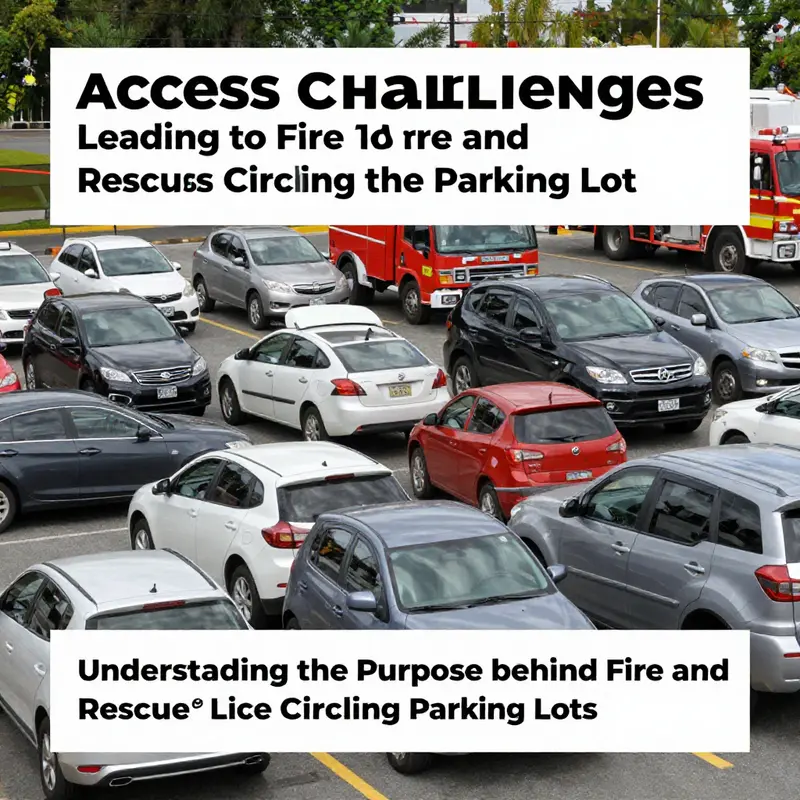
When people watch a fire response from the outside, they often see the engines appear to circle a parking lot, tracing the perimeter before anyone steps onto a scene. To the untrained eye, it might look like indecision or excess caution. In practice, that looping motion is a disciplined, critical phase of incident management. It is how responders transform a chaotic, high-stakes situation into a manageable set of actions that protect the public and preserve the efficacy of the response. Circling serves multiple intertwined purposes, all aimed at reducing risk and increasing the odds of a successful outcome. It is the bridge between arriving at the edge of danger and entering with a strategy that has already accounted for hazards that cannot be seen from a single point of view.
The first purpose is safety through comprehensive hazard assessment. Fire and rescue teams must confirm the area is free of immediate threats before they physically commit to a site. Power lines may lie across a sidewalk or a tree-branch structure may be compromised; fuel, chemicals, or unknown substances could be leaking at low levels that become dangerous when disturbed by equipment. By moving around the perimeter, crews gain a visual sweep of the risk landscape, sensing subtle cues that a single, stationary approach would miss. This is not curiosity; it is risk management on the scale of minutes and inches. The circle also helps identify unstable features—the way a driveway narrows, where a storefront awning might fail, or where debris could shift with wind and heat—so that the team does not step into a trap once the first lines are stretched and the ladder is positioned.
Second, the initial pass is a planning exercise, a mental map of the scene before actions begin. From the arc of their approach, officers and engineers can pinpoint how the fire might extend, where the hydrants are located relative to the building, and which entrances or stairways will become the most efficient routes for personnel. The arc is especially important in dense urban venues where multiple structures meet a single block, where access points can be hidden behind parked cars or storefronts. The circle becomes a reconnaissance workout, translating a street-level view into a scalable plan for equipment placement and entry sequencing. In this sense, the circle is a moving brief, updating the command team with each pass as variables shift with movement, wind direction, and the evolving fire behavior.
Third, the circle checks for obstructions and ensures access for large apparatus. In many cities, the most stubborn barrier to a timely entry is not the fire itself but the environment: illegally parked vehicles that block lanes, vehicles angled in ways that squeeze a corridor too narrow for a ladder truck, or parked cars that create blind spots for operators maneuvering into driveways or along curbs. In major urban contexts such as Beijing and Shanghai, the research shows that parking scarcity and illegal parking have long compromised fire lanes, turning what should be a straightforward approach into a nerve-wracking game of inches. The circle becomes a diagnostic, confirming that the primary access route remains viable under load and that corridors remain passable for the unit that will soon carry crucial equipment and water. This is not a minor concern; it is a matter of ensuring that a response team can actually reach the fire or incident site without contending with gridlock or misaligned gates.
Fourth, circling helps prevent confusion and maintain control in the face of chaos. A calm, methodical sweep around the periphery gives the Incident Commander a clear lens on the entire operating area. It discourages bystander or responder drift into the danger zone and helps ensure that all subsequent actions align with a clean, shared situational picture. The circle also accommodates rapid replanning: if a hydrant is found to be blocked, if a side door is only accessible through a back alley, or if a rescue path is revealed through a new vantage point, the command team can recalibrate in real time rather than improvising under pressure. In short, the circle is a safeguard against disconnect between what the team thinks is happening and what is actually happening on the ground.
The urban case studies embedded in the research illuminate how these principles play out in practice and why the circle is often essential long before any fluid dynamics or fire fuels enter the conversation. In the urban planning context of Beijing and Shanghai, limited parking and the persistence of illegal parking create persistent, predictable choke points in access routes. The consequence is a longer, more complicated entry path, even for incidents that begin in a single alley or storefront corridor. The circle, therefore, is not a ritual of hesitation but a strategic adaptation to the built environment. When the primary access lane is blocked or the geometry of the street narrows, the circle becomes a means to reestablish a safe and efficient line of march toward the scene. The lessons from these early 2020s observations underscore why responders must cultivate not only speed but also spatial literacy—the ability to read a street as a living map that changes with weather, traffic patterns, and urban design.
Beyond the technicalities of access, the Palisades and Eaton fires of January 2025 foreground a parallel domain of challenge: evacuation dynamics, shelter accessibility, and the capacity of holding facilities under peak conditions. Even when shelters exist, traffic congestion and nearby street constraints can stall evacuation and complicate ingress to safety zones. The research sketches a nuanced picture: urban traffic not only delays arriving units but reshapes the sequential flow of residents moving to safety, the way streets funnel or bottleneck evacuees, and how quickly shelter inventories are activated. The structural layout of residential buildings—stairwell orientation, lobby configurations, and the distribution of exits—also feeds into the risk calculus. If a building’s design slows people down or channels them into congested egress routes, rescue operations must account for longer durations in the window between alarm and safe arrival at a shelter. The net effect is a broader operational footprint: the fire engine circles not only to access the site but to understand how people can and will move away from danger as conditions evolve.
These threads—access feasibility, scene assessment, and evacuation logistics—are not isolated concerns. They combine to shape one overarching objective: to maintain clear, executable accountability during a crisis. As the circle reveals, a successful arrival is not enough if the path to the danger zone is obstructed, if a hydrant is found to be too far from the building, or if a shelter cannot absorb a surge of evacuees in a reasonable time frame. A well-executed circle translates into a robust plan. It informs where to park and how to set up the apparatus so that deployment is immediate, not delayed by avoidable obstructions. It also provides a critical pause—an opportunity for the Incident Commander to confirm that all moving parts are aligned before operations move from assessment to action.
From a policy and training perspective, these dynamics invite a set of practical responses. First is the imperative to optimize urban space planning around fire routes. This means clearer delineation of fire lanes, better enforcement against illegal parking, and more deliberate design of street geometry to ensure wide, predictable corridors for large vehicles. Second is a strengthened enforcement regime that deters parking in zones designated for emergency access. When these behavioral guardrails are reliable, the circle can proceed with greater certainty and fewer abrupt adaptations mid-mace. Third is a renewed emphasis on emergency response system resilience, including shelter placement and capacity planning that reflect real-world peak conditions. When planners map out places of refuge, they must account for the rhythms of urban traffic, the distribution of housing densities, and the capacity of transit-like routes that can carry evacuees efficiently if roadways are compromised. The goal is not merely more shelters, but more accessible, well-distributed shelters that can absorb an actual surge in need without creating new bottlenecks.
In practice, these insights should inform training as well as policy. The discipline of scene safety—how responders approach a potentially hazardous zone, how they validate access points, and how they coordinate a multi-agency response—must be grounded in the realities of crowded urban environments. Training that emphasizes the circle as a deliberate, data-informed step helps responders maintain composure, anticipate complications, and adapt quickly without losing sight of safety or mission objectives. For practitioners seeking to deepen their understanding of formal, standards-based training for critical-response roles, consider the foundational resources available in Fire Safety Essentials Certification Training, which provides a framework for disciplined, safety-first thinking that underpins the kind of scene-walk and perimeter checks described here. Fire Safety Essentials Certification Training.
Taken together, the evidence from urban access challenges and the lived experience of recent fires demonstrates that the circle around a parking lot is more than a precaution. It is a diagnostic, a map, and a rehearsal rolled into one. It prepares responders to answer a series of essential questions before any entry occurs: Is the path inside the perimeter truly passable for the equipment we require? Are there hidden hazards that could jeopardize operators or bystanders? How will the surrounding streets and shelter infrastructure affect our overall reach and speed? The answers shape every subsequent step—from securing water sources and establishing a defensible zone to coordinating victims and evacuations with minimal risk of cross-traffic or miscommunication. And while no single intervention can erase the complex challenges of dense urban life, a thoughtful, practiced circle can significantly reduce the gap between alarm and action, turning potential gridlock into a controlled, adaptable response.
For those seeking a closer look at the systemic challenges that frame these operational realities, a recent arXiv study provides an broader, data-driven context on capacity and access during large urban fires. It highlights how uneven spatial distribution of shelters, infrastructure gaps, and blind spots in emergency planning can magnify risk when conditions worsen. The study reinforces the message that urban resilience hinges on proactive design, strict enforcement of access regulations, and a resilient, adaptable emergency response framework that treats the perimeter as a primary instrument of safety, precision, and speed. External reading: https://arxiv.org/abs/2506.04321
Circling the Lot: Fire and Rescue Protocols for Safe, Thorough Parking-Area Scans
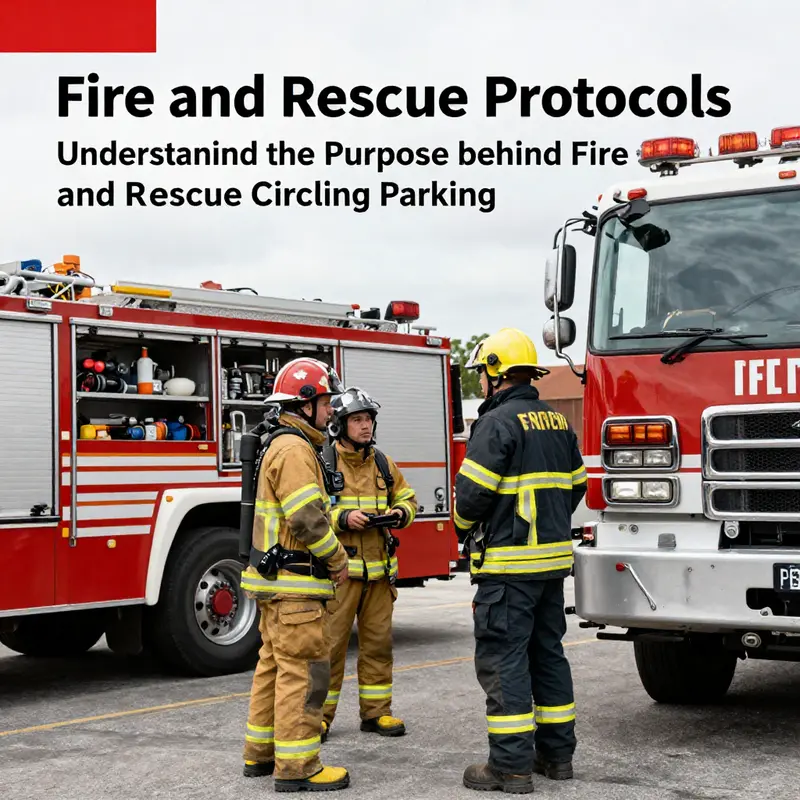
When a fire and rescue unit arrives at a parking lot or a similar open-area scene, the instinct to circle and sweep the surroundings is rarely a sign of hesitation. It is a calculated, disciplined practice rooted in safety, strategy, and situational awareness. What looks like a simple drive in circles is, in truth, a carefully choreographed prelude to action. The crew uses the loop around the periphery to convert a jumble of impressions into dependable, actionable knowledge. Every pass is a chance to recalibrate risk, map access routes, and protect both responders and bystanders from the evolving threats that attend many emergencies. This practice is not improvised; it is a key element of a broader safety culture that treats the scene as a living environment, one that can change in an instant as vehicles move, weather shifts, or new hazards appear.
The first and most obvious reason for the circular approach is hazard identification before entry. The lot itself may hide dangers that are invisible from the curb. A downed power line, a leaking fuel source, or a vehicle that could ignite with the wrong spark—all of these are part of the mental checklist that forms during the initial circuit. Firefighters walk the perimeter in their minds as they move, letting eyes and instinct guide a more formal assessment. The objective is simple yet decisive: confirm that the area is free of immediate, fatal risks before placing personnel and equipment in a position where failure to recognize danger could become a crisis. This is not about paranoia; it is about a disciplined precaution that keeps responders out of harm’s way while they stabilize the scene for others.
Beyond danger spotting, the circling pass acts as a strategic briefing for tactics. The loop provides a panoramic view of the scene’s layout—where the entrance and exits lie, which structures may shelter or complicate access, and where hydrants or water sources are most likely to be located. In a parking facility or a similar environment, these details are not obvious at a single glance. A ladder apparatus must reach upper floors; hose lines need clear, unobstructed paths; and staging areas must be chosen to minimize congestion. The initial circle helps identify the best angles for advancing teams, how to position the equipment for rapid deployment, and where to place a command post that can observe the evolving picture without becoming part of it. The process is as practical as it is perceptive: a moment to convert wide-angle observations into a precise, executable plan.
Access and egress form a second, equally vital reason for the circling maneuver. Parked cars, often positioned at unusual angles or with headlights facing the wrong way, can unintentionally create pinch points that impede the largest apparatus. Even a driveway that seems wide enough can lose its effectiveness once a ladder truck or a heavy pump arrives. Circling the area from multiple angles gives the crew confidence that the primary access routes are truly clear and that large vehicles can maneuver without crossing paths with bystanders, other responders, or parked vehicles that have shifted during the incident. It is a practical safeguard against entrapment—both for the responders who must move equipment and for any civilians who might be in the vicinity and unaware of the turning dynamics required for safe passage.
A third motive lies in reducing confusion and preserving command during chaotic moments. Emergencies are inherently disorienting; the first responders must create order from the initial chaos. The loop around the scene creates a visual, shared frame of reference for all participants. It helps the Incident Commander maintain situational awareness, coordinate resource deployment, and prevent cross-traffic or miscommunication that could compromise the response. In a scene where people may drift into danger zones, the act of circling reinforces controlled movement and clear boundaries. The practical effect is a calmer, more predictable operation where every move is intentional rather than reactive. This is a core facet of modern incident management, where control of the scene directly influences outcomes for both victims and responders.
Safety protocols deepen the rationale for circling as well. Departments frequently codify a pre-entry “safety sweep” or “scene walk-around” that resembles a structured, methodical inspection rather than a casual reconnaissance. The emphasis extends beyond the nearest hazard to encompass secondary threats that might evolve later in the incident. Gas leaks, structural weaknesses, or shifts in the environment can transform a scene from dangerous to deadly within moments. By tracing the area in a controlled loop, crews create a safer, more predictable sequence for casualty care, ventilation decisions, and aggressive fire control. The extended inspection is not a luxury; it is a safeguard that aligns with a duty to protect the public as well as the responders.
In sum, circling a parking lot or similar environment is not a whimsical ritual. It is a deliberate, essential step in the choreography of exception handling—an approach that blends cautious inspection with strategic planning, ensures safe access, preserves command, and upholds safety protocols. The practice translates to fewer injuries, swifter stabilization, and more effective deployment of resources when every second counts. It is a disciplined form of situational intelligence, an earned capability that improves with experience and training, and a testament to the way modern fire and rescue operations think about risk as something to be managed, not merely confronted.
The value of this approach has gained formal recognition in research across fire services. A round-robin study conducted by a consortium of twelve UK fire services investigated open-sided car parks and the risks they pose during emergencies. The study underscores circling as a critical element of fire safety strategy, illustrating how a controlled, multi-angle sweep improves hazard detection, access planning, and overall scene management. It ties the practical routine to an evidentiary basis, reinforcing the conviction that a deliberate loop around the perimeter is a professional necessity, not a decorative gesture. The work aligns with established safety regulations, including the Approved Document B (ADB) of the Building Regulations, which provide a framework for assessing and mitigating risks in parking facilities. The researchers emphasize the Safety Sweep concept: a comprehensive scan that looks beyond the obvious, identifying secondary hazards and ensuring robust, adaptable responses when conditions evolve.
For responders, this is not about following a trend but about honoring a core obligation to safety and effectiveness. The ripple effects of a thorough circling pass extend to all facets of the operation: better tactical placement, more reliable hydrant access, fewer bottlenecks during movement, and clearer channels of command for everyone involved. It also supports a broader culture of preparedness—one in which even the very first impression of a scene becomes a coherent, actionable plan rather than a random series of decisions. The circle, then, is a practical embodiment of discipline in action: a way to translate perception into protection, moment by moment, pass by pass.
The emphasis on safety and procedural rigor is echoed in training resources that emphasize core competencies for responders. Within the profession, continuous learning about scene safety, risk assessment, and incident command is essential. This focus mirrors the content highlighted in fire safety training resources, which stress not only technical skills but the importance of maintaining margins of safety through deliberate, repeatable practices. In this light, the circling of a parking lot becomes a visible symbol of professional maturity—a sign that responders approach every scene with a plan, a map, and a measured pace that honors the complexity of real-world emergencies. The method helps bridge the gap between instinct and procedure, ensuring that each action is grounded in evidence, experience, and a commitment to public safety.
For readers seeking a practical entry point into this mindset, the idea of a pre-entry safety framework can be explored through focused training resources that stress essential safety concepts. Fire safety essentials certification training offers guidance on core practices and the decision-making processes that underpin safe scene management. This training reinforces the lesson that the circle around a parking area is more than a routine check; it is a structured, knowledge-based practice that improves outcomes when confronted with the unpredictable realities of an emergency. By internalizing this approach, responders develop a reliable mental model for how to translate what they observe at the perimeter into precise, timely actions inside the scene.
External reference for deeper context: the UK government’s round-robin study on fire safety in open-sided car parks provides a rigorous, evidence-backed backdrop for why such circling matters in practice. See the detailed findings here: the UK government’s round-robin study.
Internal link for further reading on training foundations is embedded here: fire safety essentials certification training. This resource anchors the discussion in concrete professional development that supports the careful, methodical mindset demonstrated in the circling protocol. When readers look to understand how theory translates into field performance, that training serves as a practical touchstone for recognizing why the perimeter walk-around is as essential as the tools carried by the crew. The cycle of observation, planning, and execution that begins with circling the lot becomes a foundation for confidence and competence on every call, in every environment, and under every condition a responder might face.
Final thoughts
The practice of fire and rescue teams circling parking lots serves multiple critical functions, from ensuring hazard assessments to providing a tactical overview of an emergency site. Each time they circle, they gather vital information that significantly impacts the effectiveness of their response. This article sheds light on the structured reasoning behind what may appear to be a simple maneuver. By appreciating these operational nuances, stakeholders, including individual car buyers, auto dealerships, and small business fleet buyers, can better understand the complexities involved in emergency response and the need for adequate access and planning in our communities.