
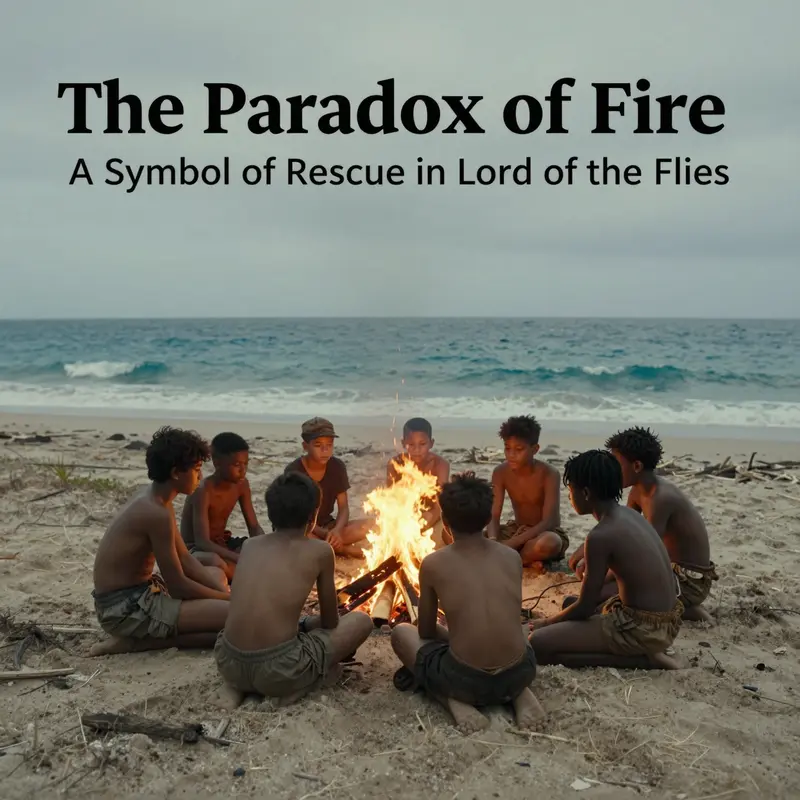
In William Golding’s Lord of the Flies, fire transcends its role as a mere source of light and warmth, emerging as a complex symbol of hope and destruction. This multifaceted symbol embodies the boys’ initial connection to civilization and their desperate quest for rescue. Each chapter of this exploration will dissect how fire represents both the hope of returning to society and the descent into savagery. It will delve into the irony of rescue achieved through destructive means and illuminate the dichotomy of fire as both a beacon of civilization and a harbinger of chaos. Understanding these themes not only enhances the reading of Golding’s work but offers insights into the subtleties of humanity’s struggle between civilization and primal instinct.
Beacon and Barricade: Fire as Rescue and the Fragile Thread of Civilization in Lord of the Flies
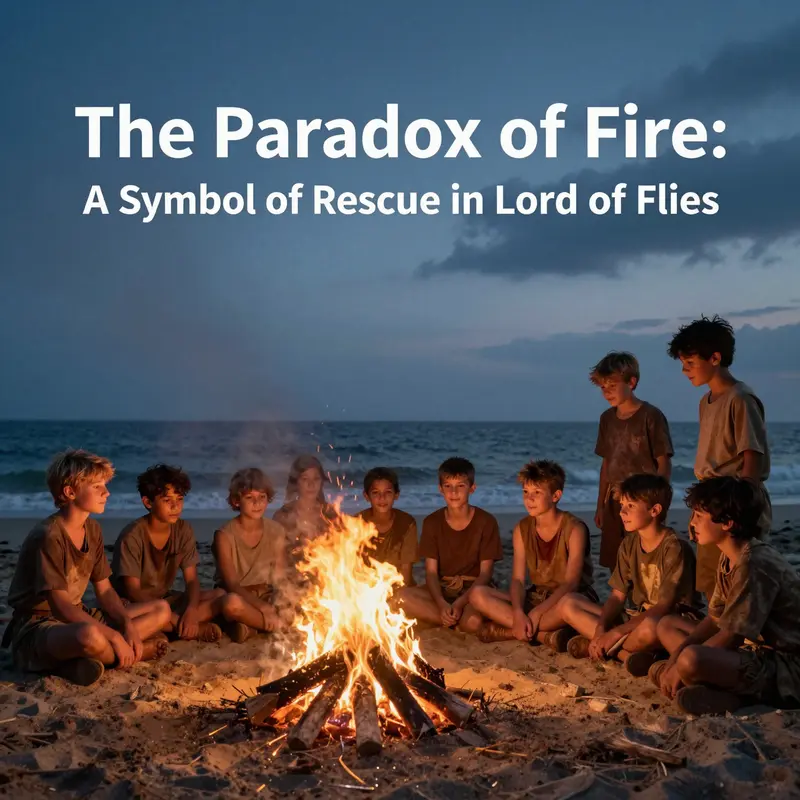
Fire in Lord of the Flies arrives on the island as a practical tool and quickly becomes a living symbol, a beacon that links the boys to the order they left behind and to the possibility of rescue. The very act of kindling a signal fire on the mountaintop embodies a stubborn faith in the outside world—an implicit promise that civilization is still within reach if they can keep the flame alight. Early on, Ralph presents the plan with a pragmatic clarity: the smoke will travel to passing ships or planes, the glimmer in the distance will not only guide help but validate the boys’ attempt to recreate the social order they have left behind. This is not merely a physical beacon but a moral signal as well. The fire marks a boundary, a threshold between the known world of adults and the uncertain, potential world of the island. Its glow on the dark slope becomes a tangible hope that adult supervision, restraint, and law can be reassembled, piece by piece, through disciplined collective action. The image of smoke rising toward the heavens carries with it the possibility that their voices might be heard, their desire for return acknowledged, and their humanity recognized by strangers who pass overhead. The fire thus functions as a living contract with civilization, an emblem of responsibility that invites both cooperation and attention from the outside world. In this sense, the opening pages crystallize a central tension: the flame is not just heat or light; it is the material evidence of a collective vow to remain recognizable as human in a moment when fear and loneliness might otherwise erode that identity.
As long as the fire is kept burning, the boys are tethered to a shared purpose. The practice of maintenance—feeding the flame, watching for embers, tending the shelter built around the blaze—becomes a rhythm that binds them into a community. The smoke curling into the sky becomes a visible marker of their joint agency. In the narrative, this link to civilization is not merely symbolic; it is functional. The flame requires coordination, patience, and mutual accountability. Each boy’s role in stoking the fire reinforces the sense that they are capable of governing themselves, at least for a time, and that their survival depends on this fragile social contract. Critics who read the fire as a thin thread to the adult world have pointed to moments when the blast of duty and duty’s demands reveal the strain of living up to expectations placed upon oneself from afar. The fire thus emerges as a practical tool and a social ritual—the exact kind of signal that civilization uses to preserve itself in the absence of formal institutions. The boys’ early discipline about the signal fire maps onto the broader moral map of the text: order is precarious, but it is not impossible, so long as a community chooses to act in concert rather than in isolation. Within the text’s moral economy, the flame is more than sustenance for warmth; it is the visible inscription of a vow to be found, to be rescued, and to be redeemed through collective effort.
Yet the flame is not a one-note symbol. Its glow embodies a double function that becomes clearer as the island narrative intensifies: fire as rescue beacon and fire as instrument of control. Ralph insists on its centrality because it anchors the boys to the possibility of rescue and to the memory of a world that expects them to keep promises and uphold standards. Jack, by contrast, is captivated by the more visceral warmth of the hunt and the heat of spectacle—an energy that does not wait for the slow, patient signals of civilization. His leadership reorganizes the boys around appetite and power, and the fire’s daily ritual begins to waver. The discipline that sustained the flame—countless small acts of care, the habit of looking outward, the sense that a larger audience is watching—begins to fray. The smoke still rises, but its message grows murkier. The fire loses its clarity as a rescue signal and becomes a reminder of risk. If the boys do not attend to the flame, the fire’s very purpose dissolves into a chorus of competing desires. This drift—the shift from communal responsibility to fragmented impulse—maps onto Golding’s larger inquiry into how fragile the human order is when confronted with fear, hunger, and the seduction of power. The fire’s meaning thickens from a straightforward sign of civilization into a measure of the group’s cohesion and the depth of their collective resolve.
The narrative reaches a crucial hinge when a moment of neglect is not a mere lapse but a rupture in the boys’ social contract. A passing ship could have seen the smoke and altered the course of their fates, yet the fire is extinguished at a moment when it would have mattered most. The scene acts like a cruel microcosm of the entire island drama: a thin thread connecting the boys to the adult world—an image LitCharts later emphasizes in its analysis—snaps because fear, impatience, and the lure of power override duty. The catastrophe is not merely a practical failure; it signals a moral turning point. The group’s hope depends on the flame, and when the flame dies, the hope shrinks to a dim ember. In the absence of a reliable signal, the boys confront the possibility that rescue might not come, not because they are beyond help, but because they have chosen to treat help as a byproduct of their own immediate desires. The scene invites readers to consider the fire as a hinge between two modes of being: the adult world that expects order and the island’s primal present that excites fear and amusement in equal measure. The fire, momentarily, becomes a measure of the boys’ willingness to stay human under pressure. The conquistador-like thrill of power cannot sustain the flame; discipline must be chosen and renewed again, every day, with every ember kept burning. In a sense, the flame reveals the moral architecture of the boys’ society: it reveals who they are by showing what they are willing to protect, and it reveals what they fear by exposing the speed with which fear can erode communal effort.
If the flames once served only to attract rescue, they gradually reveal another truth: rescue itself is a moral act as much as a physical one. The fire’s management becomes a test of character. The boys’ willingness to attend to the flame, to feed it and guard it, mirrors their willingness to care for one another and to resist the temptations of coercive power. When Ralph asserts the primacy of the signal fire, he also asserts a belief in the possibility of restoration—of a return to the human order they once knew. The element of hope embedded in the flame grows and contracts with their choices. The flame is a visible memory of the social state they inhabit, and its burning strength is a litmus test for their capacity to cooperate, to delay gratification in pursuit of a shared goal, and to subordinate personal desire to a collective aim. As the boys drift toward savagery, the fire’s light becomes harder to read, its direction less confident. Yet even as the flame dims, its existence continues to haunt their decisions, a reminder of the world that could be regained if they could master themselves as surely as they master the flame. The fire’s paradox remains intact: it is both the path to salvation and a witness to civilization’s fragility. The narrator’s quiet irony lies here—the same instrument capable of calling rescue is inseparable from the impulses that threaten to erase what rescue presumes to preserve. The fire embodies this paradox, a living emblem of civilization and its possible collapse, a reminder that salvation and destruction can share the same shimmering surface.
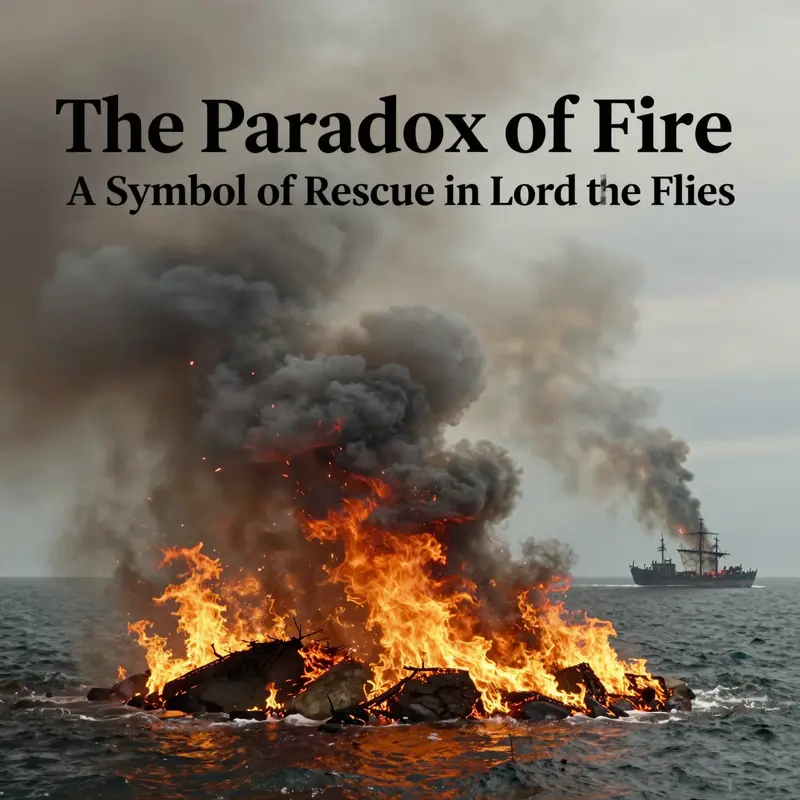
The island’s final blaze, set not by chance but by the hunters who have embraced the tribe’s feral appetite, crystallizes the paradox in a brutal, unforgettable way. Jack’s group lights a vast conflagration to smoke out Ralph, to eradicate the last symbol of order the island houses. The flames send heat into the night, turning the island into a furnace of fear and spectacle. In this moment of intensifying violence, the smoke writ large across the sky would seem to promise doom rather than rescue. Yet Golding’s irony is not only tragic but precise: the very blaze aimed at destroying the last vestige of civilized restraint becomes the beacon that draws a naval ship to the shore. The ship’s arrival interrupts the boys’ ceremony of descent with a blunt, external verdict that civilization has not vanished, even if it feels endangered. The rescue is not the triumph of savagery; rather, it is the universe’s reminder that the flame remains a call, a call that can be heard even when the human heart has wandered far from its original purpose. The fire’s final function is not to save the boys through their own ingenuity alone, but to illuminate the truth that rescue, when it comes, is often outside the island’s own borders. The author uses this ironical twist to press home a larger claim: civilization is not guaranteed by the presence of a flame, but by the stubborn, collective choice to sustain it despite fear, temptation, and the lure of power. The smoke that drifts toward the distant sea becomes a quiet rebuke to those who would mistake mere destruction for vitality. Rescue arrives not because the flame has been kept burning in isolation, but because the social body that kindled it has not wholly forgotten the obligation to be found, to be saved, and to remain human.
Reading the fire’s arc through this lens clarifies why the symbol remains so central to the novel’s argument about civilization and humanity. Fire is not a single, stable symbol but a dynamic sign that shifts in meaning as the boys shift in moral stance. In the early chapters, it embodies communal discipline, shared hope, and the belief that a world beyond the island’s shore exists beyond the horizon. In the middle chapters, it tests that faith, revealing how easily fear and appetite can erode the social contract. In the end, the ironies multiply: the same flame that once promised rescue becomes the very instrument through which rescue is signaled, not by the boys’ own steadfastness alone but by the outside world’s insistence that some bonds of civilization endure. The fire thus embodies a profound paradox at the heart of Golding’s inquiry: the possibility of salvation is always contingent on a fragile human willingness to care for others, to keep faith with a code of conduct, and to resist the seductive pull of power—even when the light of that code flickers. In that sense, the flame is both a message and a mirror. It is a message to the outside world about where the boys are and what they need, and a mirror held up to the island’s inhabitants, showing what they are willing to sacrifice to remain who they are. The fire’s role as signal and symbol is not simply about rescue; it is about truth—the truth of whether civilization can endure when it confronts fear, hunger, and the human appetite for domination. It is a test of whether a group of boys can transform a fragile flame into a lasting beacon or allow the blaze to burn away the very thing that makes them human.
For readers seeking a concise critical thread, this trajectory highlights how fire operates as a unitary symbol with multiple, interlocking meanings. It begins as a practical plan to rejoin the human world and ends as a difficult meditation on how much of that world remains when fear governs choice. The line between rescue and ruin is drawn, not by fire alone, but by the human decisions that shape how the fire is tended, interpreted, and deployed. The result is a narrative that never loses sight of fire’s double nature: it can illuminate and preserve, or it can trap and consume. The island’s saga closes with a haunting sense that the flame’s power lies less in the flame itself than in the moral posture of those who wield it. The fire’s light exposes both the longing for rescue and the danger of what we become when we mistake heat for humanity. In this light, the flame is more than a tool or a trigger for plot; it is a living argument about what it means to remain human when the world seems to forget you exist.
External resources illuminate this nuanced interpretation of the fire symbol. For a critical reading of the fire symbol in Lord of the Flies, see the analysis provided by LitCharts: https://www.litcharts.com/lit/lord-of-the-flies/fire-symbol. And for a practical bridge to real-world concerns that echo the novel’s themes, consider how modern fire safety training and certification shape our approach to collective responsibility and safeguarding lives. A relevant point of contact in this regard can be found through the concept of ongoing professional development, such as the material found at the internal resource about the vital role of fire safety certificates in your career journey, which emphasizes how disciplined, collaborative action underpins safety and resilience in real communities. the vital role of fire safety certificates in your career journey
Smokes of Hope, Ashes of Pride: Fire as Rescue and Descent in Lord of the Flies
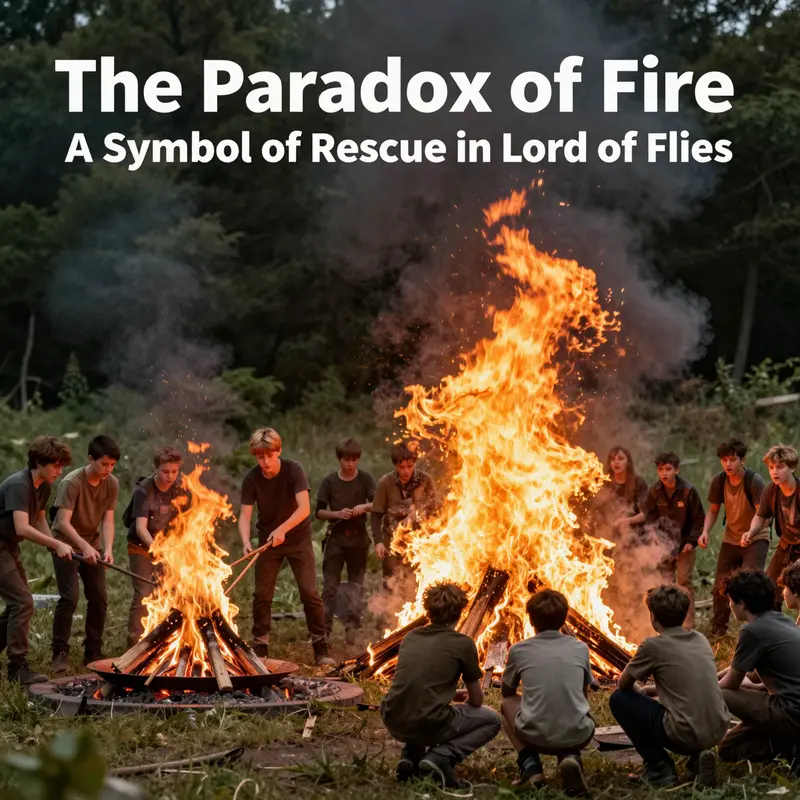
Fire in William Golding’s Lord of the Flies does not wear a single face. It begins as a practical tool and a bright thread connecting a group of stranded boys to the world they left behind. Yet the flame swiftly accrues layers of meaning, morphing into a stubborn symbol of civilization’s frailty and, at moments, a weapon that can annihilate. To watch fire in this novel is to watch a moral weather system unfold: a beacon that draws ships and, in another turn, a smoke signal that reveals the island’s burned heart. The arc is not simply about whether rescue is possible; it is about what rescue would require of those who seek it. It asks us to consider whether the impulse to preserve a link to society is stronger than the impulse to shape a new order, and what happens when fear, power, and hunger override the commitments that bind a community together.
From the opening pages, the signal fire is inseparable from the boys’ longing to return to the orderly world they know. Ralph, who emerges as the voice of structure and organized cooperation, treats the fire as a lifeline. He understands that the flame is not merely a source of warmth or light; it is a public pledge to the outside world. It is a banner they send up into the sky, a direct appeal for rescue. The practical imperative is wrapped in a moral one: “We’ve got to keep the fire going… It’s the only way we’ll be rescued” becomes not only a logistical command but a creed. In this moment, fire becomes the tangible link between the boys and civilization. It is the physical manifestation of their collective will to preserve the past and the future, a portable reminder that they are not wholly abandoned to the island’s private weather of fear and appetite.
The fire’s dual function—signal and shelter for the hope of return—sets the stage for a more complex meditation on the fragility of social order. The flame invites rescue and invites accountability. It requires cooperation, restraint, and shared purpose. The boys must manage it, decide who feeds it, when it burns, and how long. Fire, in this sense, becomes a test of character. It asks whether the group can sustain a communal project even when appetite and anxiety sprint ahead. In the early chapters, the flame is a rallying point that binds the boys to a shared mission. The glow on the horizon becomes a mute promise that civilization remains accessible, that the world beyond the island still matters. The moral energy of the fire is rooted in the belief that human beings are capable of harnessing power for collective good, even in a moment of crisis.
Yet the flame’s magic is double-edged. As the boys’ minds turn toward hunting, and as leadership fractures into competing visions—Ralph’s insistence on order, Piggy’s insistence on memory and prudence, Jack’s appetite for dominance—the fire’s glow begins to flicker with conflicting meanings. The same flame that once symbolized hope becomes a test of loyalty. When the group’s attention drifts away from signaling for rescue, the fire begins to fade into the background of the island’s daily struggles. The moment the fire dies out, the consequences are immediate and painful. A passing ship happens to be near enough to see smoke, but not the crucial signal fire that could have invited it closer. The ship’s preference for speed over safety, its oblivion to the nuanced signals of stranded boys, becomes a stark counterpoint to the boys’ own misreadings of their situation. The guilt is not abstract; it lands on Ralph’s shoulders and, more piercingly, on Jack’s, who begins to measure his authority not in rescue but in the display of power. In that single lapse—the fire going out—the novel makes palpable the cost of a civilization that cannot maintain its own flame.
The shift from rescue to ritual violence marks a turning point in the symbolism of fire. The flame’s purpose expands: it becomes a tool of fear rather than a beacon of safety. The hunters’ fire, originally meant to cook meat and provide warmth, also trenches deeper into the savage ritual life of the tribe. The island is no longer just a stage for a test of governance; it becomes a theater for the enactment of primal desire. The boys’ connection to civilization is supplanted by a different flame—the one that feeds the tribe’s hunger and fuels their sense of belonging through dominance and fear. It is not a mistake that the flames rise more vividly when the hunters gather, when the rules that once tethered them to a shared identity loosen, and when the thrill of the kill overrides the fear of the unknown outside the island’s edge. This is the point at which fire ceases to be a rescue beacon and begins to resemble a costly, dangerous rite that binds the group to a descending logic.
In this darker phase, the island’s state of alarm is less about whether help will arrive and more about how much of themselves the boys are willing to burn away in order to possess power. The fire turns into a symbol of the tribe’s might and the distance from the world’s moral compass. The dead calm of the early chapters gives way to the raw pulse of survival instinct. The boys’ discipline erodes as the flame becomes a tool of control. The children who once spoke of rules now speak in terms of domination and fear. The fire’s presence deepens the sense that civilization is not a mantle that can be casually worn and discarded; it is a discipline that must be reaffirmed through deliberate action and mutual trust. The narrative thus asks a difficult question: is civilization merely the absence of violence, or is it the daily practice of restraint, shared responsibility, and the care of something larger than oneself? The fire encodes the tension in a stark, nonacademic form, turning abstract questions of morality into something scorched and visible.
The novel’s crucible comes when Jack’s tribe deliberately kindles a much larger blaze to hunt Ralph. The fire’s transformation into a weapon is chilling because it exposes how quickly a tool of rescue can be repurposed as a mechanism of terror. The island burns, and the smoke climbs into the sky with a terrible irony: the same smoke that could have summoned rescue now roars as a signal of destruction and fear. The paradox is core to Golding’s larger argument—that the veneer of civilization is exquisitely delicate and easily undone by fear, power, and the lure of imminent gratification. The destruction is not merely physical; it is a purge of the social fabric that had sustained them, a purge enacted through flame. Yet in the very moment when the smoke announces catastrophe, it also announces salvation: a passing naval officer, drawn toward the signal, interrupts the youths’ rites of violence and interrupts their self-erasure with a sudden, harsh reminder of an external world that still judges and still rescues. Here, fire contains its richest irony. What nearly destroys them becomes the signal that redeems them—an emblem of how fragile and contingent rescue remains in a landscape where human beings choose to forget the past even as their survival is tethered to it.
The final rescue is not a triumph of virtue but a recognition of the thin line between civilization and chaos. The naval officer’s arrival interrupts a ritual of fear and power with a practical, almost banal, reminder of reality. He does not praise the boys’ cleverness or their capacity for reform; he simply notes their appearance and the fact that they have survived at all. Yet the officer’s presence also reclaims a sense of moral order, offering the possibility that rescue does not erase responsibility. The boys’ journey with fire becomes a case study in how quickly the human impulse toward civilization can be compromised and how precarious the flame of civilization remains when tested by greed, fear, and appetite. The final smoke of the island is a residue of both catastrophe and hope—a reminder that the world beyond the beach still watches, even when the human heart forgets. The fire thus embodies a paradox that Golding returns to like a refrain: civilization is not guaranteed; it is earned, tended, and defended, often under pressure that reveals what we are capable of when fear tightens its grip on the human will.
In this sense, fire in Lord of the Flies is not merely a symbol of rescue or destruction. It is a moral instrument, a test of allegiance to a shared project, and a stark mirror of the boys’ inner weather. The flame tests the group’s capacity for cooperation and restraint; it tests the leader’s authority, the loyal bond between friends, and the collective memory that keeps a society from dissolving into chaos. The flame’s arc—bright beacon, flickering doubt, roaring purge, final rescue—maps the novel’s central claim about human nature. It suggests that the possibility of rescue always exists, but its realization depends on a fragile consensus about what to save, whom to save, and how to live with the consequences of one’s choices. The fire thus becomes Golding’s most lucid parable of civilization: it is both the instrument by which we reach beyond the island and the instrument by which we may burn it all away, a reminder that human beings carry within them both rescue and ruin, bound together by the flames they choose to tend.
For readers seeking a closer academic lens on the symbolism of fire, see the British Council’s exploration of Lord of the Flies’ fire symbolism: https://www.britishcouncil.org/learning/english-literature-lessons/lord-of-the-flies-fire-symbolism. And to reflect on how these themes connect with real-world responsibilities around fire safety and communal resilience, consider resources on fire safety training and the role of certified practice in safeguarding communities: Fire Safety Essentials Certification Training.
null
null
Beacons and Infernos: The Dual Fire in Lord of the Flies
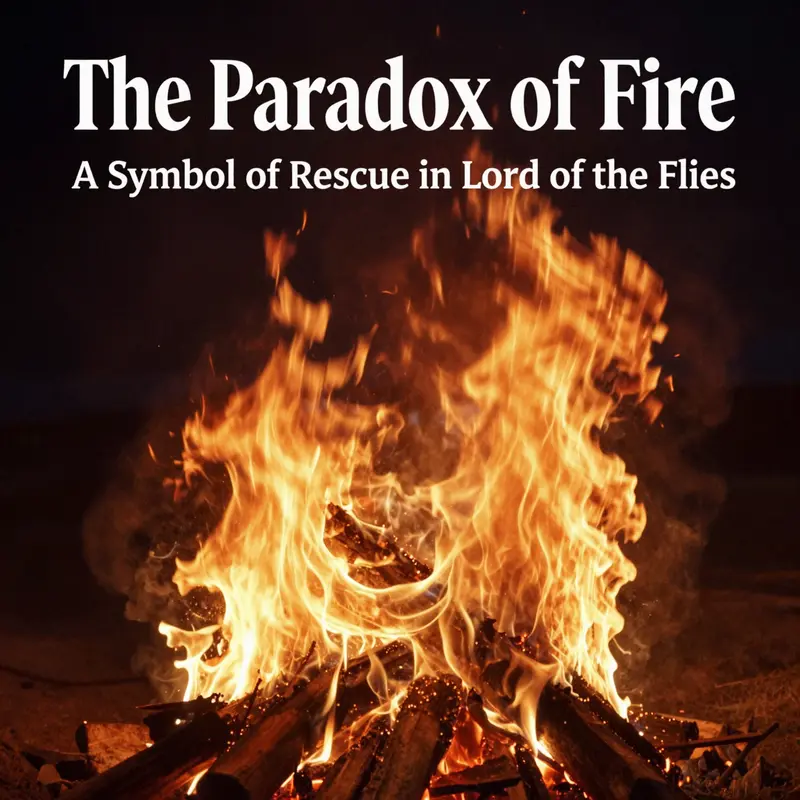
Fire in Lord of the Flies is more than a plot device; it is a living symbol that tests civilization and reveals primal impulses. The initial fire is a practical tool for rescue and warmth, a beacon that promises help from beyond the island. It represents order, cooperation, and rational planning as the boys learn to divide tasks: tending, feeding, and guarding the flame. Piggy’s glasses become the instrument through which civilization makes fire possible, linking sight, knowledge, and the fragile line between civilization and savagery. However, as Jack and the hunters grow powerful, the fire’s function shifts from lifeline to weapon; the chase for meat turns the flame into a spectacle that feeds pride and fear rather than rescue. The island burns during the final pursuit, and the conflagration reveals the thin line between civilization and chaos; yet the smoke also draws rescue, in a cruel irony. The naval officer arrives not because the beacon was kept perfectly but because the boys’ own destruction created a signal for help. The fire therefore embodies a paradox at the heart of Goldings inquiry: civilization depends on discipline and restraint, but danger and appetite can transform the same flame into a tool of salvation and destruction. In the end, the fire offers a sober meditation on human nature: light can guide, but only if kept under conscious control, and this chapter invites readers to reflect on how communities signal for aid while preserving their moral compass.
Final thoughts
In Lord of the Flies, fire serves as a potent symbol, encapsulating the dual nature of humanity’s struggle between the civilized and the savage. While it initially embodies hope and rescue, the boys’ abandonment of this symbol reflects their descent into chaos. Ironically, the destructive fire ultimately facilitates their salvation. Through this exploration of fire’s symbolism, readers gain deeper insights into the themes of civilization, savagery, and the inherent complexities within human nature, culminating in a powerful reminder of what unites and divides us.