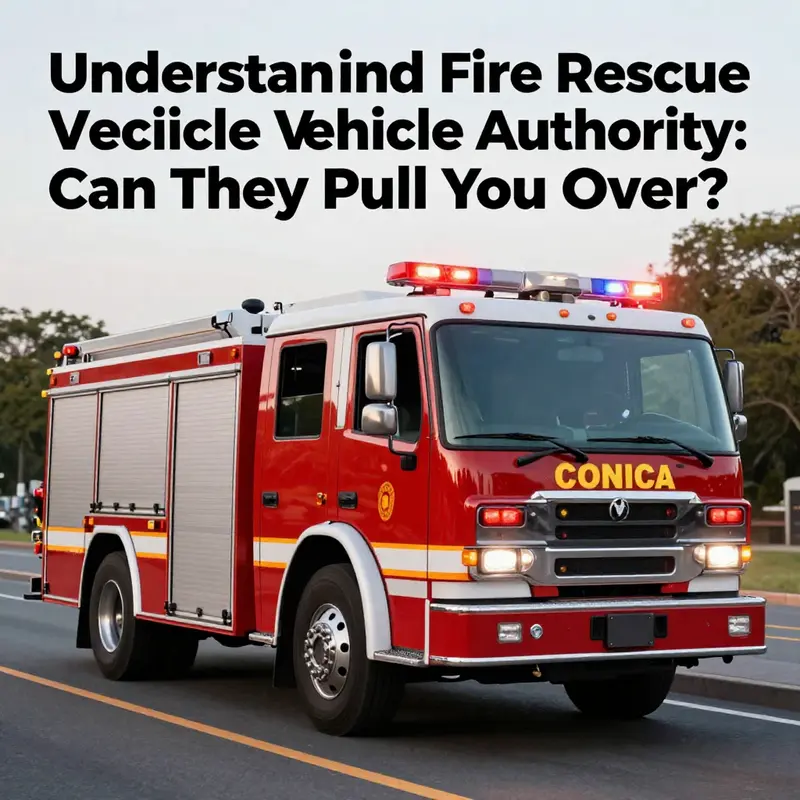
The interplay between fire rescue vehicles and traffic laws often raises questions among drivers, particularly regarding the authority of these vehicles when it comes to traffic violations. Fire trucks and engines, while vital for emergency response, do not possess the legal power to pull over drivers for infractions. However, understanding the obligations that drivers have when encountering these vehicles is crucial for public safety. This article will explore the limitations of fire rescue authority, the legal responsibilities of drivers when responding to emergency signals, and the potential consequences of failing to yield. By delving into these aspects, we aim to provide comprehensive insights for individual car buyers, auto dealerships, and small business fleet buyers.
When the Siren Speaks: The Real Limits of Fire Rescue Authority and Why They Cannot Pull You Over
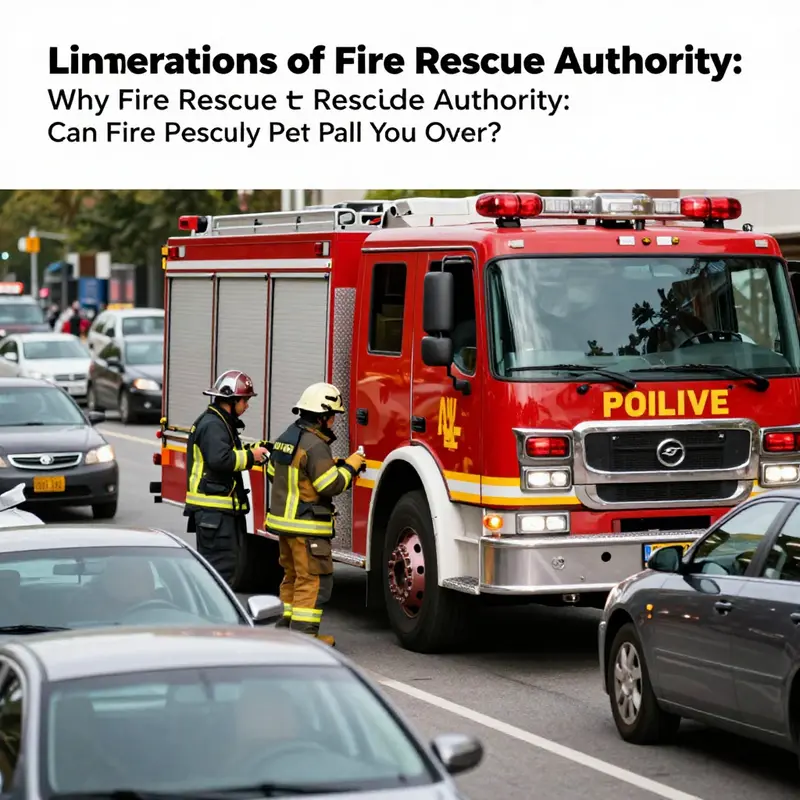
A common scene on any crowded artery or quiet suburban street can provoke a question that feels almost canonical: can a fire rescue vehicle pull you over for a traffic violation? The instinct is to imagine the red-and-gold engine stopping a car in the same way a police cruiser might. Yet the reality is more nuanced. Fire rescue teams are central to public safety, but their authority does not extend to issuing traffic fines, pulling vehicles over, or enforcing standard traffic laws in the way police do. This chapter unfurls that distinction with care, tracing the legal boundaries, the practical responsibilities on the road, and the subtle interplay between different public safety roles that keeps streets functioning when urgency demands the loudest response. It is a story of jurisdiction, procedure, and public trust, where the roar of a siren is a signal of danger, not a license to punish.
To understand why fire rescue cannot pull you over, one must first separate the roles of emergency response from the powers of law enforcement. Fire rescue personnel are trained and empowered to fight fires, perform rescues, and oversee fire safety. Their mission is to preserve life and property in fire-related and other life-threatening scenarios. They inspect facilities for fire code compliance, ensure access to life channels, and act as first responders to medical emergencies, hazardous incidents, and natural disasters. The authority to issue traffic citations—enforce traffic laws, stop vehicles for violations, levy fines, or arrest for traffic offenses—falls to law enforcement agencies. In China, as in many jurisdictions, the formal framework assigns those duties to police under the Road Traffic Safety Law. The practical implication is straightforward on the ground: you should never expect a fire rescue vehicle to pull you over for a ticket, because that is not part of their statutory remit.
But this separation is not a sop to bureaucracy; it is a carefully designed balance that serves public safety more effectively. When a fire truck or other emergency vehicle appears with flashing lights and a siren, the immediate safety expectation is to yield. Drivers are legally obligated to move to the side of the road and come to a complete stop if it is safe, letting the emergency vehicle pass. This obligation is not about punishment; it is about ensuring that responders reach the scene quickly, with unobstructed access and a clear path to those in danger. The precise duty to yield varies by jurisdiction, yet the central principle—clear the way for life-saving response—remains consistent across many legal systems. The fire rescue vehicle may be a mobile command post at a fire scene, a rescue unit at a vehicle crash, or a rapid response unit to a medical emergency. In each case, the primary objective is not to police the traffic but to reach the site of danger as efficiently as possible.
In the Chinese context, the delineation is sharpened by a formal acknowledgment of which agencies can enforce which rules. The Road Traffic Safety Law designates police as the enforcers of traffic laws, with authority to issue penalties, conduct stops, and manage violations. Fire rescue agencies, meanwhile, operate under public safety mandates that emphasize access and prevention rather than punitive enforcement. This is not merely a question of jurisdictional pride; it has practical consequences for how incidents unfold, how bystanders respond, and how resources are deployed in the aftermath of an emergency. For instance, if a vehicle is illegally blocking a fire lane, a fire rescue unit has the authority to document the violation and notify the owner to move the vehicle promptly. If the owner refuses, the matter may be escalated, and law enforcement may become involved to effect a tow or to issue penalties. In this sense, fire rescue acts as a public safety partner that helps preserve access to critical infrastructure, rather than a stand-alone enforcement body.
This nuanced division becomes clearer when we look at a typical sequence of events around an accessible incident. A fire rescue team arrives on scene; they need a clear lane to reach the fire or assist in rescue operations. The first concern is to secure the area and ensure that the path is open for emergency vehicles. If a vehicle is illegally parked in a fire lane, firefighters will document the violation and notify the owner, requesting immediate relocation. This is not a punitive action by fire rescue; it is a safety measure aimed at preserving access to life-saving routes. If the owner resists or refuses to move the vehicle, the response shifts toward cooperation with police or traffic management authorities to remove the obstruction legally. Emphasis here is on safety, not punishment, and the logistical choreography is designed to minimize delays to life-saving operations while maintaining legal due process.
The enforcement hierarchy thus becomes a collaborative ladder. Fire rescue identifies and documents safety violations that could hinder egress for life-saving operations. Police or traffic management authorities take on the enforcement role, leveraging their statutory authority to impose penalties or to tow a vehicle that remains obstructive. This arrangement reflects a broader public-safety logic: each agency concentrates on its core competencies, while coordinating with others to address overlapping concerns. The consequence for drivers is straightforward: if you are drawn into a violation related to a fire lane or blocked access, you could eventually face penalties, but the initial contact and documentation originate with fire rescue, not police. The intent of this system is to improve outcomes, not to create a punitive firefight between agencies during a crisis.
Beyond the procedural mechanics, there is a deeper ethical undercurrent about how public safety is exercised in real time. Fire rescue teams train to tread carefully around traffic, maintain situational awareness of the roadway, and coordinate with police to manage the scene safely. They learn to balance urgency with restraint: to prevent harm by arriving swiftly, yet to avoid creating new risks by driving aggressively or overstepping jurisdictional boundaries. For drivers and bystanders, this means recognizing that the siren is a signal of imminent danger and not a signal of authority to exercise power over a citizen. The presence of flashing lights is a call to yield, not an invitation to deflect responsibility. The moment you see an emergency vehicle approaching, the question you ask should not be about whether a fire rescue can fine you but rather about how you can contribute to a safe and efficient transit for those who are rushing toward danger.
This behavioral reflex—yielding to emergency vehicles—has to be grounded in public safety education as well as legal clarity. National guidelines and official resources help to codify these expectations. The National Highway Traffic Safety Administration, for example, offers guidance on how drivers should respond to emergency vehicles in various situations. These guidelines, while not binding in the same way as a country’s core traffic laws, provide a baseline for understanding the correct driver response across different jurisdictions and traffic contexts. They emphasize the need to move promptly to the right-hand edge and come to a complete stop when possible, allowing emergency responders to pass safely. What these guidelines underscore is a universal priority: speed for responders should not come at the expense of public safety, and drivers have a crucial role to play in creating that safe corridor.
When we zoom in on the Chinese framework, the explicit limitation on Fire Rescue Authority—no power to issue traffic tickets or to pull vehicles over—becomes more than a bureaucratic footnote. It signals a deliberate design in which emergency responders focus on rapid intervention and safe access. It also clarifies for drivers where accountability lies when a violation affects an emergency response. If a driver blocks a fire lane or fails to yield when a rescue vehicle is approaching, the responsibility for addressing that behavior and penalizing it rests with the police and traffic authorities. This distribution of duties helps prevent confusion during high-stakes moments and ensures that each agency operates within its legal boundaries while cooperating toward a common public safety objective.
For readers seeking a practical sense of how this coordination plays out in the field, consider the everyday routines of fire safety operations. Fire rescue teams routinely coordinate with police to secure perimeters, manage traffic around a scene, and liaise with traffic control devices that may be temporarily altered to facilitate a safe passage. The ability to do so hinges not on the power to issue fines but on a shared commitment to safety and on established protocols that delineate when police intervention is appropriate. In effect, the fire rescue authority acts as a catalyst for faster access while the law enforcement authority provides the necessary regulatory teeth to address violations when a scene is compromised. It is a collaborative dynamic born of necessity—the urgency of emergencies paired with the rule of law designed to prevent abuse and preserve citizen rights. The outcome is not a dramatic power struggle but a measured, layered approach to public safety where each actor does what it does best, and where the public learns to respond with the calm efficiency that emergencies demand.
To further understand the operational reality, it helps to reflect on the kinds of violations that fire rescue might encounter in the course of routine safety duties. Indeed, beyond the dramatic scenes of a burning building or a multi-vehicle crash, the fire department’s role includes fire safety inspections and the protection of life channels—clear routes that vehicles must not obstruct. If a vehicle is found illegally parked in a fire lane, the fire department will document the offense as part of its safety inspection and, where applicable, request the owner to move the vehicle immediately. The purpose is to maintain accessibility to critical zones and to keep the roadway clear for rapid deployment. Only when the owner refuses does the process escalate to police involvement for enforcement, which can include penalties or towing. This sequence is not an example of overreach; it is a testament to the layered infrastructure of public safety that recognizes the distinct but complementary strengths of different authorities. It is also a reminder to drivers that compliance with fire lane rules is not negotiable, even as the immediate focus remains on the life-saving mission at hand.
The broader implication of this framework concerns public trust and civic responsibility. Citizens rely on emergency responders to save lives, and they rely on police and traffic authorities to uphold the rules that keep roadways orderly and predictable. When a fire rescue unit flashes by, the correct public response is to yield gracefully and avoid creating a new hazard in the act of yielding. It is not about deference to authority in the abstract; it is about safeguarding the integrity of the emergency response itself. A well-ordered roadway allows fire rescue teams to reach scenes more quickly, which can translate into saved lives and reduced property damage. Conversely, a driver who ignores the yield imperative endangers responders, bystanders, and the very people the system seeks to protect. In short, the authority to pull you over is not a tool of fire rescue because their job is not to police traffic. Their power lies in prevention, response, and safety compliance, while penalties for violations are the province of law enforcement.
As readers consider their own driving habits, a practical takeaway emerges: understanding the boundary between fire rescue and police helps reduce confusion and increases safety at the moment of crisis. It also clarifies what drivers should do when confronted with conflicting signals on the road—when an emergency vehicle approaches with lights flashing and sirens blaring, the safest move is to slow, signal safely, and pull over to the side in a controlled manner, allowing the emergency vehicle to pass. If you are uncertain about the correct behavior in a specific scenario, local guidelines and official handbooks provide the most reliable guidance, and they reinforce the universal principle of yielding to life-saving operations. This clarity is not a matter of bureaucratic precision alone; it is a practical framework that protects responders and the public alike when seconds matter most.
For readers seeking a concise, actionable path to deepen their understanding of safety training that underpins these responsibilities, there is a resource that speaks directly to the foundational concepts of safety culture, readiness, and response. It outlines how individuals can build a learning pathway that supports not just compliance, but proactive safety leadership in everyday life. See Fire Safety Essentials Certification Training for a practical starting point that complements the legal and procedural explanations discussed here. Fire Safety Essentials Certification Training
In reflecting on the interplay of authority, responsibility, and public safety, it is important to recognize that the system is designed to minimize harm through collaboration. Fire rescue teams bring speed, specialized rescue skills, and a focus on access; police bring enforceable authority, penalties, and formal processes for addressing violations. When functioning optimally, the result is a roadway where emergency responders can move unimpeded, violations are addressed with appropriate sanctions, and ordinary drivers learn, through repeated exposure to safety norms, to respond calmly and correctly to the presence of an emergency vehicle. This is not a narrative of conflict but a narrative of alignment—of different agencies aligning their duties to protect lives and property.
The external dimension of this topic also matters. While country-specific laws and regulations differ, the underlying principle remains widely shared: emergency responders must be allowed to perform their duties with the least possible hindrance, and drivers must respond in ways that support rapid, safe intervention. It is worth noting that the precise rules governing this interplay are not merely academic; they shape everyday behavior, street design, driver education, and the tempo of urban life during crises. The public safety architecture is thus a living system, continually reinforced by training, policy, and on-the-ground practice. In that sense, the question “can fire rescue pull you over?” is not only about a single authority; it is about the collaborative ecology that turns emergency response into a reliable public good.
For readers who want to explore the broader procedure and the legal framework in more detail, the official guidance from national safety bodies, along with country-specific statutes, can provide a deeper dive. In the Chinese context, the Road Traffic Safety Law clearly delineates enforcement responsibilities and outlines the process by which violations are investigated, documented, and adjudicated. While fire rescue cannot impose penalties, their role in documenting and flagging safety-critical violations—such as blocking fire lanes—serves as an essential mechanism to preserve access and uphold safety standards. In practice, this means a clear, predictable sequence: detection, documentation, notification, and escalation to police or traffic management authorities if necessary. The result is a disciplined but flexible system designed to minimize harm and preserve life when every second counts.
To close this exploration, it is helpful to return to the core insight about authority and the road: fire rescue is not police. Their power is not to pull you over or issue fines; it is to respond, rescue, and safeguard fire safety and access. The policing of traffic violations remains the purview of law enforcement. When these roles operate as designed, the road becomes a safer space for everyone—responders, drivers, pedestrians, and bystanders alike. Understanding this distinction helps demystify the drama of the emergency scene and clarifies how citizens contribute to public safety simply by knowing what to do when a siren approaches. Yielding promptly, moving safely aside, and avoiding obstruction of life-saving routes are small acts with substantial impact. In the end, the siren is a signal of danger, and the correct response from every driver is to cooperate with that danger, not to test the limits of agency and authority. The public safety ecosystem depends on that cooperation, and it depends on the shared recognition that some powers are reserved for those who enforce the rules, while others are dedicated to saving lives when the rules cannot prevent harm in the first place.
External reference: Fire Rescue Bureau: Understanding the Role of Fire Departments in Public Safety. https://www.12350.gov.cn/zhengce/zhengcefabu/202601/t20260118_10947.html
Siren, Not a Ticket: Understanding the Rules When Fire-Rescue Vehicles Pass
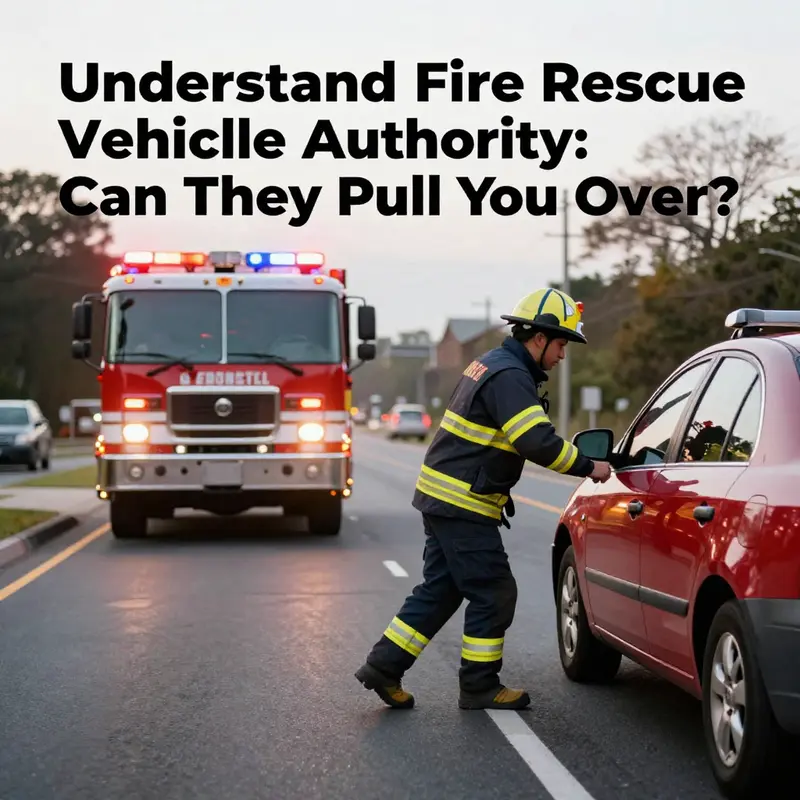
When people ask, can a fire rescue pull you over, the quick answer is no. Fire engines and other rescue vehicles are not police officers. They lack the statutory authority to issue traffic tickets. Yet misunderstandings about what you must do when a fire truck or an ambulance approaches can lead to dangerous situations and even costly penalties. The core idea is simple: emergency response vehicles with lights and sirens demand your attention and your safe cooperation. They do not pull you over in the sense of handing you a citation; they require you to yield, slow down, and move aside to let them pass. This distinction matters because the failure to yield can become the basis for a police stop and a traffic violation in the eyes of law enforcement, even though the vehicle that initiated the encounter is not the officer issuing the ticket. The practical takeaway is clear: know when a fire-rescue vehicle can alter your behavior, and understand why those responses exist beyond the impulse to avoid a fine. The goal is public safety, not punishment, and the rules reflect that aim.
The practical reality of emergency driving rests on two pillars: visibility and predictability. When a fire-rescue unit activates its siren and flashing lights, it signals the need for other road users to make space and to do so in a manner that minimizes risk to everyone on the road. In most jurisdictions, the law recognizes that these vehicles may operate with explicit exceptions to standard traffic rules to fulfill their mission. This exception does not apply to ordinary drivers who simply want to speed past a siren; rather, it applies to the way drivers respond. The responder moves quickly and decisively through traffic, and motorists must respond with equal decisiveness to clear the path. This cooperative dynamic is what keeps responders and the public safe during high-pressure emergencies. The National Highway Traffic Safety Administration emphasizes predictable responses to emergency vehicles as part of broader road-safety principles, a reminder that compliance is about safety first, not about curbs and penalties. For many readers, the most helpful way to understand this is to examine concrete legal contexts and then translate them into everyday driving habits.
Within the United States, the exact rules can vary from state to state. A well-studied example is found in Washington State’s Revised Code RCW 46.61.035. This law spells out the status of authorized emergency vehicles, including fire engines and ambulances, and the degrees to which they may disregard ordinary traffic controls when responding to emergencies. It is not that emergency vehicles are granted unfettered license to break rules; rather, they receive a special permission to navigate complex traffic scenes while still prioritizing safety. The language of the code centers on the concept that when an emergency vehicle approaches with audible or visual warnings, other drivers must yield the right of way. The statute underscores an essential principle: emergencies demand fast, clear, and coordinated action from every road user. The legal framework is designed to ensure that responders arrive quickly and that the risks of delay, confusion, or collision are minimized.
For the non-emergency driver, the most important obligation is to yield the right of way. This obligation begins at the moment the siren becomes audible or the lights become visible. The driver should begin to slow gradually and prepare to move aside. On multi-lane roads, the typical guidance is to shift toward the right-hand side and to escape to the farthest possible lane away from the emergency vehicle. If there is no safe place to move, the driver should come to a complete stop, allowing the emergency vehicle to pass with minimal delay. The procedural clarity offered by these steps is vital because it reduces the likelihood of abrupt moves that could create a hazard for other drivers or pedestrians. In practice, yielding is more about anticipatory driving than about reacting at the last moment. It requires scanning ahead, signaling intent, and executing a controlled deceleration that preserves space for the approaching unit and for other vehicles that may still be adjusting to the situation.
The legal obligations extend beyond the act of yielding. They attach consequences to non-compliance that can affect a driver’s license, insurance, and even freedom, depending on the severity and context of the violation. Fines are a common consequence for failing to yield or for delaying an emergency vehicle. Points on a license can accumulate and influence insurance premiums or, in the most serious cases, driving privileges. These penalties reflect the public safety imperative embedded in emergency response law. It is not about punitive measures for boredom or inconvenience; it is about creating predictable outcomes during moments defined by urgency. Officials emphasize that penalties exist to reinforce predictable behavior, reduce the risk of collisions, and safeguard both the responders and the driving public.
Public safety considerations extend beyond the act of yielding. The rule set includes explicit cautions: avoid obstructing or delaying emergency responders by weaving through traffic or attempting to shadow the emergency vehicle forward. Even seemingly well-intentioned maneuvers can impede the passage of responders or conceal the scene from other drivers and pedestrians. Drivers should also be mindful of “move over” laws that require changing lanes or slowing down when approaching stationary emergency vehicles with lights flashing. In many states, these statutes complement the yield requirements, creating a broader safety envelope that governs how traffic should behave near responders. The result is a layered approach to safety: yield, slow, move away, and, crucially, give responders the space they need to operate.
The practical implications for daily driving are straightforward but often overlooked. In a city corridor, listening for the siren and scanning for flashing lights should trigger a rapid yet measured response. Look for a safe exit path that maintains a buffer zone around the emergency vehicle. If you are in a lined-up traffic flow, you may be required to switch lanes to create a clear corridor. If you are at a stoplight, you should prepare to stop and then stop in a way that does not trap the responder in your line of sight. The key is to remain calm and recall the steps: slow down, yield, move to a safe lane, and come to a stop when necessary. The momentary pause, though it may feel inconvenient, is a crucial investment in public safety. It gives paramedics, firefighters, and other responders the space to work, and it protects other road users from sudden, unpredictable actions.
For readers who want to connect these ideas to practical training, there is value in building a mental library of best practices and then internalizing them through formal education. Training in fire safety, emergency response, and traffic-stopping procedures strengthens both individual judgment and collective response. It creates a shared standard that reduces ambiguity when seconds count. You can find foundational resources on fire safety and certification training that help build this knowledge base. For instance, the Fire Safety Essentials Certification Training provides practical guidance for those who want to understand the broader safety framework in which emergency responders operate. This resource is designed to equip learners with core competencies that support safe driving around responders as well as safer engagement with the post-emergency scene. Fire Safety Essentials Certification Training. Integrating this kind of training into personal or organizational safety programs helps ensure that the public, drivers, and responders share a common operating picture when emergencies arise.
The legal discussion above sits within a larger framework of traffic safety and public service. It is not enough to know that you must yield; you should also understand the intent behind that requirement. Emergency vehicles respond to situations that are often unpredictable and time-sensitive. A fire truck may need to navigate through a dense cluster of vehicles to access a scene where lives hang in the balance. In such contexts, the ability of every driver to respond quickly and correctly can determine outcomes. This reality underscores why the rules governing emergency vehicle operation emphasize predictability, not punishment. When drivers act with foresight—slowing down early, signaling intentions, and moving to the far lane—the whole system works more efficiently. Responders reach the scene faster, casualties receive aid sooner, and the risk of secondary incidents decreases. Public education efforts, therefore, should focus on fostering this shared sense of responsibility rather than on lay explanations that only complicate the issue.
A broader takeaway from the Washington RCW example, and from the general guidance offered by safety agencies, is that the rescue landscape is a shared space. Fire engines, ambulances, and other authorized emergency vehicles operate with unique authorities, but they rely on ordinary drivers to participate in the mission safely. The dynamic is a partnership in which the public extends the responders space, and responders, in turn, communicate their needs clearly through audible and visual warnings. This partnership is built on consistent expectations and practiced behaviors. It does not require perfection from every driver, but it does demand attention and deliberate action when the siren or lights appear. The goal is to prevent delay, minimize risk, and preserve the ability of dispatchers to direct resources precisely where they are needed.
From a legal and practical perspective, there is also value in recognizing the limits of the concept of being pulled over. If a driver is stopped by a police officer for failing to yield, the event is not a function of the fire-rescue vehicle performing its mission. The officer’s interaction centers on traffic enforcement, not on the rescue vehicle itself. The distinction matters because it clarifies why the question of whether a fire-rescue vehicle can pull you over is a misunderstanding of how traffic laws are applied in emergencies. The officer’s role in enforcing traffic rules remains the same, regardless of the presence of an emergency vehicle nearby. The public’s duties do not vanish when a rescue unit is on the move; instead, they multiply in importance as the potential consequences of inaction increase.
In sum, the encounter with a fire-rescue vehicle is a test of driving judgment under pressure. It tests your ability to balance urgency with safety, speed with caution, and compliance with common-sense caution. The rules governing these encounters exist not to frustrate drivers but to ensure that every vehicle on the road contributes to a safer, more reliable response when lives are at stake. The myth that a fire-rescue unit can pull you over for a traffic violation hinges on a misconception: that the rescue operation and traffic enforcement operate in the same legal sphere. They do not. Yet they are connected by a shared aim: minimizing danger on the road and ensuring that those who respond to emergencies can do so efficiently and with as little friction as possible.
For readers seeking additional guidance on the human and procedural side of these encounters, it can be helpful to reflect on the training that emergency responders undergo. Training emphasizes situational awareness, clear communication, and the discipline to adjust actions in real time as traffic patterns change. This training supports the expectation that drivers will do their part to yield and to create a corridor for the responders, even when it requires a moment of patience or a lane change that seems inconvenient in the moment. The end result is a safer road environment where emergency personnel can perform critical tasks with a minimized risk of harm to themselves and to the driving public. Keeping this in mind helps to reframe the encounter from a potential confrontation into a coordinated effort for collective safety.
Ultimately, the question can fire rescue pull you over is answerable with a clear boundary: not in the sense of a traffic citation, but in the sense of legal obligations and public safety duties. When you encounter an emergency vehicle with its lights and siren active, your responsibility is to yield the right of way, slow down, and move aside if it is safe to do so. If the situation requires it, come to a complete stop to allow the vehicle to pass. Your actions in that moment influence the efficiency of the response and the safety of everyone on the road. The specifics of how you should respond can depend on where you are, which state you are driving in, and the exact configurations of your roadway. But the principle remains universal: cooperation is essential when seconds count. And the better you understand the rules, the less anxiety you will feel when you hear a siren in your rearview mirror.
For readers who want to explore practical, state-specific guidance beyond the Washington example, official resources such as the Washington State Department of Licensing provide comprehensive information about emergency-vehicle rules and the broader regulatory framework. Engaging with these official resources helps translate the general principle into concrete actions you can take in your daily driving. If you would like to learn more about training and preparedness that reinforces safe responses around emergency vehicles, consider exploring the Fire Safety Essentials Certification Training resource as a starting point to build the knowledge that underpins these important behaviors.
External resource: For authoritative guidance and specific procedures related to emergency vehicle laws, refer to the National Highway Traffic Safety Administration. You can visit their official site at https://www.nhtsa.gov to access guidelines, best practices, and public safety resources that support safe interactions with emergency responders on the road.
Yielding to Fire Rescue Vehicles: Why It Matters
When you hear a siren or see flashing lights, you are not just watching for a rule you are protecting lives. Fire rescue vehicles have a mission to reach emergencies quickly, but they do not issue tickets. Drivers are required to yield by law and by safety, slow down, move to the right if possible, and stop to let the vehicle pass. The rules vary by location, but the core idea is universal: clear a path while remaining careful and predictable. Yielding reduces risk for responders, patients, and bystanders, and it preserves the momentum needed to save lives. Practicing calm, scanning for pedestrians and cyclists, signaling intentions, and avoiding sudden maneuvers helps everyone stay safe. If you cannot move to the right, slow down and allow the vehicle to pass with caution, then rejoin traffic at a safe distance. Being prepared and informed about local regulations makes it easier to respond correctly when urgency is real.
Final thoughts
In conclusion, while fire rescue vehicles are essential for public safety and emergency response, they do not have the authority to pull over motorists for traffic violations. However, drivers are legally obligated to yield the right of way when such vehicles are responding to emergencies. Understanding these nuances not only promotes adherence to traffic laws but also enhances overall community safety. Remaining informed about the responsibilities and legal implications can help reinforce the cooperation required between the public and emergency services.