
The establishment of the first modern fire station rescue in Shanghai in 1866 marked a pivotal advancement in urban safety and firefighting strategies in China. As we delve into this history, we uncover profound implications for emergency response capabilities, the evolution of firefighting technologies, and the enhanced societal resilience that emerged thereafter. Each chapter will illuminate distinct yet interrelated aspects of this foundational moment—its historical significance, the subsequent technological advancements, and its far-reaching societal impacts.
Shanghai’s First Rescue Stations: Birthplaces of Modern Urban Firefighting in China
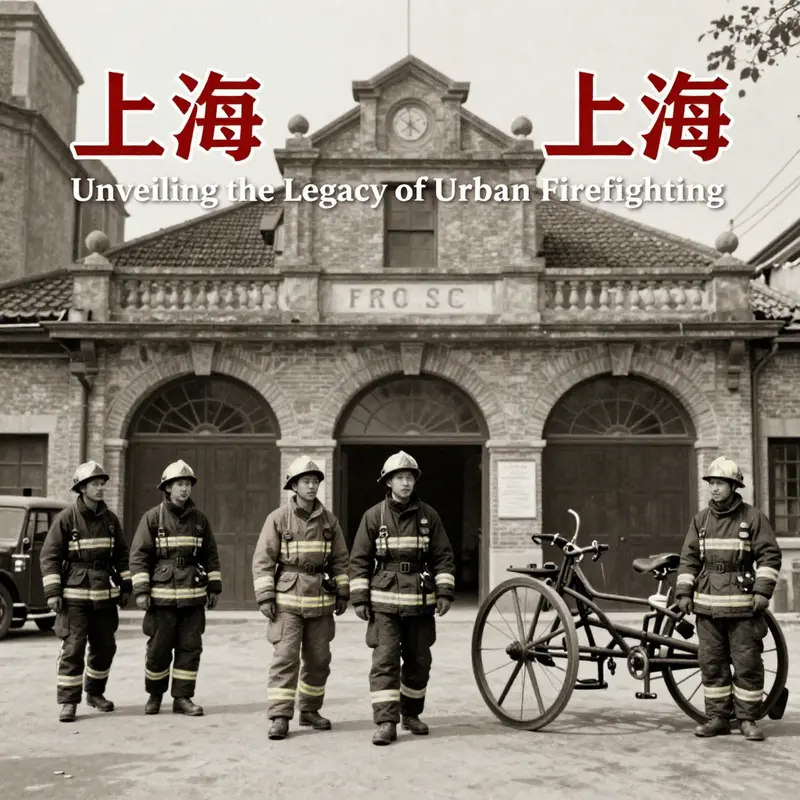
Shanghai occupies a unique place in the history of firefighting in China. The city’s rapid transformation into a modern port and commercial center during the nineteenth century created pressures that traditional, informal fire responses could not meet. Dense construction, mixed materials, and expanding foreign settlements multiplied the risk and frequency of urban conflagrations. In response, the earliest organized fire units emerged here. Those early units were more than emergency crews. They were experiments in civic organization, municipal responsibility, and technological adaptation. They showed how a city could convert private concern into public service, and they left a physical and cultural imprint that survives in Shanghai’s streets and institutions today.
Those formative efforts were not a single founding moment. Instead, they unfolded as a sequence of local initiatives that gradually hardened into municipal institutions. Among the first formal organizations was the Shenjiawan Fire Brigade, established in Hongkou. Local records place its roots well before the 1860s, with foreign residents and concession authorities creating a volunteer force to protect their quarters. Accounts identify Shenjiawan’s origins as early as 1852, making it one of the earliest formal firefighting groups in modern China. This volunteer model reflected the early character of the concessions: autonomous, community-driven, and pragmatic. Volunteers brought buckets, hand pumps, and determination. Their work mattered, but it also encountered limits as urban density and commercial stakes grew.
A complementary milestone came in the mid-1860s, when Shanghai’s fire services began shifting from volunteer efforts to municipal control. The Shanghai First Fire Brigade, founded on July 20, 1866, represents a key transition toward a modern, municipal department. Organized with structured roles, equipment procurement, and official oversight, it symbolized how municipal power could harness and professionalize volunteer energy. By 1867, elements of these early brigades were absorbed into the Public Works Department. This transfer marked a turning point. Firefighting became not only a community obligation but a city responsibility, funded, staffed, and managed with public accountability. The arrival of municipal control established standards for training, response, and logistics. It set expectations that emergency services would be reliable and city-operated.
One physical artifact captures this transformation more clearly than any other: the hexagonal watchtower at the Hongkou station. Built in 1888 and rising 34.2 meters, the tower served as an early detection system. From its observation deck, watchmen could spot smoke and flames across a five-kilometer radius. In an era before electronic communications, the watchtower was the city’s eyes. It enabled faster alarms and more coordinated responses. The structure itself blends Western engineering principles with local needs. Its hexagonal form and height reflect practical considerations: a stable vantage point that maximized visibility in a dense urban fabric. The tower stands as a material symbol of Shanghai’s transition from fragmented responses to systematic prevention and detection.
Beyond towers and brigades, these early stations developed social and civic roles. During the January 28 Incident of 1932, when foreign forces attacked Shanghai, the Shenjiawan Fire Brigade transcended firefighting. Station crews organized shelters, provided medical assistance, and aided evacuations. They even assisted military maneuvers by helping troops cross flooded areas. These moments demonstrate that fire stations functioned as multipurpose civic hubs. They delivered relief, preserved life, and maintained a semblance of order when conflict threatened to unravel the city. Their responses strengthened bonds between firefighters and residents. Those bonds helped shape a civic identity rooted in public service and collective resilience.
The technological trajectory of Shanghai’s fire services is equally revealing. The museum housed at the Hongkou station preserves artifacts that track equipment evolution. Among its holdings is the nation’s first domestically produced fire engine, dating to 1932. It represents a technical leap from hand pumps and horse-drawn apparatus to mechanized vehicles. The engine’s presence at the museum links image to innovation: it shows how Shanghai adapted global advances in fire technology to local circumstances. Over time, the standardization of tools, the introduction of motorized vehicles, and improvements in hydrant networks changed how firefighters worked. These changes reduced response times and expanded the range of emergencies teams could handle. They also signaled Shanghai’s willingness to invest in infrastructure that supported public safety at scale.
The institutional memory preserved at the Shanghai Fire Museum—now housed within the historical Hongkou station—also captures an important social history. More than 20,000 artifacts, records, photographs, and uniforms trace a lineage of continuous service. These objects tell stories about the daily lives of firefighters, the hazards they faced, and the communities they served. They reveal changing expectations about public order, municipal capacity, and professional identity. Through these artifacts, visitors can trace how firefighting evolved from a patchwork of concession-driven units into an organized, citywide system. The museum thus performs a dual function. It conserves technical history while nurturing civic memory.
Urban planning and station placement were part of that institutional maturation. Early fire stations were strategically positioned near dense population centers, main road arteries, and water access points. These factors influenced response times and operational effectiveness. Over decades, planners refined their approach. They used population density, road networks, and hydrant coverage to determine station locations. Modern analyses suggest Shanghai needs roughly 150 stations to provide comprehensive coverage. That estimate reflects both technological advances and enduring principles. Good station placement still depends on access and proximity. Today’s planners inherit the logic used by nineteenth-century municipal officials: where people live and move is where emergency services must stand ready.
The story of Shanghai’s fire stations is also a mirror of the city’s international character. Early fire brigades were often initiated by foreign residents within the concessions. As a result, early equipment, organizational models, and architectural forms bore international influences. Western engineering and administrative practices blended with Chinese social realities. This blend is visible in station architecture, in operational protocols, and in the hybrid culture that emerged. While foreign influence was significant, Shanghai’s firefighters and municipal authorities adapted ideas to local needs. Equipment designs were modified for Chinese urban textures. Training regimes were localized. That adaptive approach allowed Shanghai to absorb innovations without losing sight of local constraints.
Continuity is a final theme that matters. While some original structures no longer stand, the Hongkou station is recognized as one of the oldest continuously operating fire stations in China. Its lineage links present-day firefighters to their nineteenth-century predecessors. This continuity matters because institutions that endure across crises accumulate practical knowledge. They refine techniques and preserve tested protocols. They carry forward cultural norms about duty, courage, and public accountability. For residents, such continuity provides reassurance. It anchors public expectations about safety and the city’s ability to respond in moments of crisis.
The legacy of Shanghai’s first rescue stations extends beyond local history. These institutions helped define modern Chinese urban governance. They modeled municipal ownership of essential services. Cities across China learned from Shanghai’s approaches to organization, training, and equipment. The shift from volunteer brigades to public departments offered a replicable formula: centralize authority, professionalize staff, and invest in infrastructure. That formula remains central to how modern cities manage risk.
The Hongkou station’s evolution into a museum and an active rescue station captures an important balance. It preserves memory while maintaining operational readiness. Visitors encounter artifacts and stories, while firefighters continue routine patrols and training. This coexistence honors heritage without freezing it in the past. It also makes history a living resource for training and public education. Exhibits inform residents about fire prevention and illustrate how everyday choices affect safety. Training programs housed near the museum combine historical lessons with modern techniques. That pragmatic use of history demonstrates how institutions can learn from their origins while adapting to new risks.
Shanghai’s experience also points to the human dimensions of firefighting. Early brigades relied on volunteers who risked their lives for neighbors. As municipal systems emerged, firefighters became salaried professionals, but the ethos of service persisted. Stories from the 1930s and later decades contain recurrent themes: courage under fire, improvisation when supplies ran short, and improvisation when conditions were extreme. These narratives are not just heroic anecdotes. They shaped recruitment, training, and public trust in ways that endure.
Finally, the physical sites associated with these early rescue stations deserve attention. The intersection of Haining Road and Wusong Road, where the modern Hongkou Fire Rescue Station stands, is more than a location. It is a palimpsest of urban memory, where nineteenth-century concerns intersect with contemporary life. The watchtower, the museum galleries, and the active bays for modern engines form layers of time. Residents moving through that intersection pass a living archive. Their daily routes cross a civic narrative that began with humble volunteers and matured into a disciplined municipal service.
Shanghai’s early rescue stations thus answer the question about where the first fire station rescue was established in China with nuance. The region’s earliest, volunteer-based brigades took root in places like Shenjiawan in Hongkou. The formalization and municipalization of firefighting arrived in the 1860s with the Shanghai First Fire Brigade and subsequent absorption into public departments. Together, these developments created a model of urban fire protection that combined vigilance, technology, and civic responsibility. The Hongkou station stands as a testament to these processes. It remains both a functioning rescue station and a repository of memory, bridging past practices with present needs.
For anyone seeking to understand the origins of modern firefighting in China, Shanghai offers a concentrated case. Its history shows how urban risk, civic initiative, and municipal governance combined to produce enduring institutions. The city’s watchtower, engines, and museum collections are not relics to admire only. They are lessons in adaptation, coordination, and public service. They remind us that fire stations are more than buildings. They are nodes where a city’s capacity to protect life and property is organized, practiced, and preserved.
Read more about the training tower and its role in firefighter preparedness in this piece on firefighter training tower dedication: firefighter training tower dedication.
Source: Shanghai Fire Museum
https://www.shmuseum.org.cn/zh/hongkou-fire-station-history/
From Shanghai 1866 to a Skyward Command: The Evolution of Urban Firefighting Technology
In the crowded harbor city of Shanghai, the night of July 20, 1866 carried more than the scent of tar and timber. It marked the founding of what would become a cornerstone of urban resilience: the first modern fire brigade in a Chinese city. The Shanghai First Fire Brigade stood as a deliberate departure from ad hoc flame chasing toward an organized, trained, and disciplined response. The original fire station itself may not endure in the built environment today, yet its organizational DNA—clear ranks, standardized equipment, and a mission that prioritized saving lives and protecting dense communities—echoes through every modern engine bay and incident room in Shanghai and across China. The creation of this brigade did more than extinguish flames; it institutionalized a culture of preparedness, incident command, and continuous improvement that would shape firefighting for generations. It also established an enduring pattern of city duty that other urban centers would soon mirror, a pattern born in the same period when steam power began to push people and machinery into new scales of risk and response. The early success of the Shanghai unit was not merely in its ability to fight fires but in its demonstration that urban hazards could be anticipated, organized, and mitigated through professional practice rather than improvisation alone. The significance of that moment grows when we trace the arc of how firefighting technology, tactics, and organizational culture evolved to meet a city s evolving needs, from wood frame streets to high rise skylines to complex industrial landscapes, all while preserving the human core of the mission: protect lives and communities with courage, skill, and information accuracy.
If one reads the coastal chronicles of Shanghai in the late 19th century, it is clear that the city s response to fire hazards was a microcosm of a broader shift in public safety. In the days when the first brigade was newly formed, the firefighting craft depended on visibility, physical endurance, and communal knowledge. Firefighters learned to read smoke and flame as a language of danger, to position hoses and ladders with the precision of a practiced choreographer, and to coordinate under the pressure of time. The early organizational forms—station houses, apparatus bays, and a chain of command—were the scaffolding upon which later technological innovations would be hung. Not long after the Shanghai breakthrough, the second fire brigade in the same district, informally known as a machine team, began to emerge as a complement to the first. This rapid expansion of capacity illustrates how a city confronted with growing urban density and more complex hazards built an enduring infrastructure for risk management. The geography of Shanghai, with its winding alleys and dense blocks, demanded a firefighting approach that could translate a street level emergency into a rapid, cross-disciplinary operation that could mobilize people, equipment, and information at scale.
As decades rolled forward, the world of firefighting began to move from manual exertion toward mechanization and, eventually, digital coordination. The transition was not a single leap but a layered ascent. Engine technology progressed from hand pump and horse or steam powered devices to motorized pumps, enabling crews to carry greater volumes of water with greater speed. The equipment itself expanded in sophistication: better protective gear, more efficient discharge nozzles, and ladder systems capable of reaching higher elevations as urban architecture spiraled upward. Yet even as engines grew more capable, the core principle endured: firefighters must work closely with a robust system that brings together people, equipment, and information in a timely, reliable way. The story of Shanghai s early brigades invites us to see this evolution as a local microcosm of a global pattern: the ongoing effort to marry the physical with the informational, the tangible with the strategic, and the brave with the data that supports clear, informed decisions.
Into the 20th century and beyond, firefighting began to incorporate electronics, communications, and disciplined training as everyday elements of practice. Radios, command posts, and standardized incident reporting started to reframe how crews prepared for a blaze and how incident command could maintain cohesion across multiple units and agencies. The Shanghai Municipal Fire Department, along with its peers in other major cities, refined its own procedures to manage complex scenarios that included industrial hazards, crowded urban centers, and a growing awareness of environmental and public health implications. The city s evolving safety agenda reflected a broader global shift toward professionalization: formalized training curricula, certification pathways, and continuous skill development became non negotiables for those who carried the heavy responsibility of protecting lives and property. It is within this long arc—from a single brick fire station to a networked, data aware, multi platform capability—that the modern ethos of firefighting emerges: it is less about heroic acts performed in isolation and more about the orchestration of talent, technology, and timely information in service of a safer city.
The early foundations laid in Shanghai were not static monuments but living, adapting systems. As urban form transformed—skyscrapers rose, industrial facilities multiplied, and transportation networks grew dense—the demands on firefighting changed accordingly. The modern era has brought a convergence of three transformative threads. First, the use of unmanned aerial platforms has become standard practice for rapid reconnaissance. In wildland and urban fires alike, unmanned aerial vehicles provide a vantage point that humans cannot easily achieve. They can survey large zones quickly, map the spread of heat, and identify hotspots with thermal imaging. This early warning and real-time situational awareness have become indispensable to commanders who must make thousands of milliseconds but remain grounded in sound judgment and safety protocols.
Second, the integration of autonomous robotic systems has begun to supplement human crews in environments that are too dangerous, too toxic, or too unstable for direct human operation. Autonomous rescue robots, designed to navigate unstable structures, assess gas levels, and deliver water or other suppressants under constrained conditions, shift the risk calculus of an operation. In a contemporary emergency response, such platforms can relay real-time thermal imagery, temperature distributions, and location data of personnel to a central command through high reliability networks. The shift from purely manned to hybrid force structures does not diminish the importance of human judgment; rather, it expands the toolbox available to responders and, crucially, protects lives by reducing exposure to harm.
Third, there has been a quiet revolution in how information is captured, shared, and acted upon. Advanced sensor systems embedded in equipment, integrated command software, and city wide data platforms enable coordinated action across multiple teams and jurisdictions. The result is a smarter, faster, and more resilient response. The city s own evolution mirrors this trend toward a future that valorizes both courage and computation, a synthesis that becomes visible in every high rise, every industrial complex, and every neighborhood activity where firefighting knowledge makes a difference.
This contemporary frame bears repeating in light of Shanghai s 1866 origins. The brigade that began as a disciplined, location bound unit has matured into a networked, technology enabled force that still honors the core principles of training, leadership, and teamwork. In practical terms, that means crews now operate with access to real time weather data, structural temperatures, and hazard maps that are continually updated as an incident unfolds. It means command centers can see through walls and across blocks via secure, multi channel communications, guiding scattered units with precise instructions and shared understanding of risk. It means the city s fire service can anticipate the consequences of a blaze, not simply react to it, and can coordinate with other essential services to minimize disruption to the public. In short, the arc from the first modern station rescue to modern fire suppression is not merely about greater power and new gadgets. It is about a culture of continuous improvement in which experience informs design, design informs training, and training translates into safer, more effective operations on the ground.
For the Shanghai Fire Department and for urban fire services worldwide, this continuity matters. The earliest brigades were built on a social contract between fire protection and the cities they served. Citizens expected that a brigade would arrive quickly, act decisively, and return home safely. Today, that contract remains but is fulfilled through a broader set of capabilities: precise incident command, risk based decision making, and the deliberate integration of cutting edge sensors, aerial networks, and autonomous tools. The municipal reform programs that have accompanied these advances reflect a recognition that safety must be engineered into urban life, not merely chased after once danger has struck. In Shanghai and other coastal metropoles, this understanding has produced a durable sense that fire protection is a shared enterprise—a blend of public responsibility, professional discipline, and technological ingenuity designed to keep pace with rapid urban change.
The narrative of Shanghai s first fire station rescue also offers a broader invitation to think about future trajectories. If early firefighters learned to translate simple observations into action, today s responders must translate streams of data from diverse sources into timely, humane decisions. The most effective tools are those that augment, not replace, the human repertoire: the intuition born of experience, the discipline of training, and the courage to act when others cannot. The most enduring innovations, likewise, are those that help a crew protect life and property without increasing risk to the responders themselves. That is why the ongoing modernization of the city s fire services—its sensors, its comms, its small mobile and autonomous support units—remains anchored in the same core purpose that gave birth to the first brigade in 1866.
The relationship between historical origin and modern practice is not a simple arithmetic of progress. It is a conversation across time about how a city reshapes itself in the face of danger, and how its life saving institutions adapt to new possibilities without losing sight of the human element at the heart of emergency response. In Shanghai, that conversation has been long and continuing. The original station, with its modest footprint and clear lines of duty, gave rise to a system that now embraces a spectrum of capabilities that would have seemed fantastical to its founders. Yet the underlying ethos remains recognizable: a disciplined, well led, and constantly learning organization that treats every fire as a test of readiness and every success as a reminder of responsibility. As the city continues to grow and as the threats it faces become more complex, the fire service will likely extend its reach through further integration of analytic insight, sensor fusion, and even more capable unmanned systems. Each advancement will be judged not solely by its technical prowess but by its ability to reduce harm and to preserve the ordinary lives that an extraordinary blaze might threaten.
Within this continuum lies a practical truth. The first modern fire station rescue established in Shanghai did not merely set a precedent for one city; it established a way of thinking. It suggested that urban risk could be understood, anticipated, and managed through a coherent system that brings together people, process, and technology. The modern era has demonstrated that this system can be expanded and enriched without losing the essential humanity of firefighting. When every flight path of a UAV, every sensor reading, and every autonomous maneuver is aligned with trained judgment and clear command, the same ambition that animated the Shanghai brigades more than a century and a half ago remains intact: to protect life, to safeguard communities, and to maintain the confidence that a city can face its darker hours with competence and hope. For readers tracing the lineage from the first rescue station to today s smart deployments, the through line is not a single invention but an ongoing, collective enterprise—a testament to human resilience, organizational learning, and the unyielding belief that safety can be built into the urban fabric through thoughtful design and steadfast courage.
As we look forward, the story invites us to imagine further iterations of practice in which data literacy, cross agency collaboration, and adaptive field technologies expand the circle of protection beyond traditional boundaries. The Shanghai experience offers a template for other cities aiming to chart similar progress: invest in disciplined training and leadership; cultivate and integrate new sensing and communication capabilities; and maintain a central ethic that every tool ultimately serves the people most at risk. In this light, the first fire station rescue in Shanghai can be read not as a historical footnote but as a living origin story for a modern, resilient city widely recognized for its commitment to safer streets, safer buildings, and a safer future for all who inhabit its complex, evolving landscape. For practitioners and policymakers alike, the chapter from 1866 to the present serves as a reminder that urban safety is a moving target, one that demands steady investment, thoughtful adaptation, and an enduring trust between the city and the people who stand ready to protect it.
For readers seeking broader context on modern firefighter training and safety culture, see firenrescue.net/blog/.
External note for further technical context: a modular imaging and communication pod designed for aerial platforms demonstrates how real time visual and thermal data can be shared securely with ground teams, turning aircraft into mobile command hubs and extending reach into hazardous zones. This approach highlights the ongoing convergence of military grade sensing concepts with civilian emergency services, a trend that is reshaping the capabilities and safety of urban firefighting in cities like Shanghai and beyond. External resource: https://www.sinab.com.au/innovation/phoenix-pod-emergency-services/
From Steam to Strategy: Shanghai’s First Fire Station and the Birth of Modern Urban Safety
In 1866 Shanghai saw the birth of a modern fire service that would reshape urban safety. The Shanghai First Fire Brigade established on July 20, 1866, introduced a formal structure for emergency response and a disciplined approach to fire suppression. This chapter traces how a single station became a cornerstone of a city’s resilience and how its legacy informed future planning.
The early brigade combined new steam-powered pumps and standardized equipment with an emerging ethic of organized rescue. It set in motion a networked system where proximity, speed, and training translated into lives saved and property protected. As Shanghai expanded, a second unit—the Hongkou Brigade—emerged to extend coverage, illustrating how multiple stations together could create redundancy and reduce response times.
Modern planners continue to study these origins to optimize current networks. Spatial models and traffic-aware dispatch strategies echo the lessons learned from the first stations, reminding us that safety infrastructure must be both technically capable and administratively coherent. The Shanghai story demonstrates that resilience grows from disciplined organization, continuous training, and a willingness to adapt to changing urban realities.
Final thoughts
The establishment of the first modern fire station rescue in Shanghai set a precedent for urban firefighting and safety protocols in China and beyond. It represents not only a significant historical milestone but also highlights the importance of technological evolution and community engagement in the fight against fires. Understanding this legacy encourages a continued commitment to enhancing urban safety practices, ensuring that the lessons learned from the past inform effective strategies for the future.