
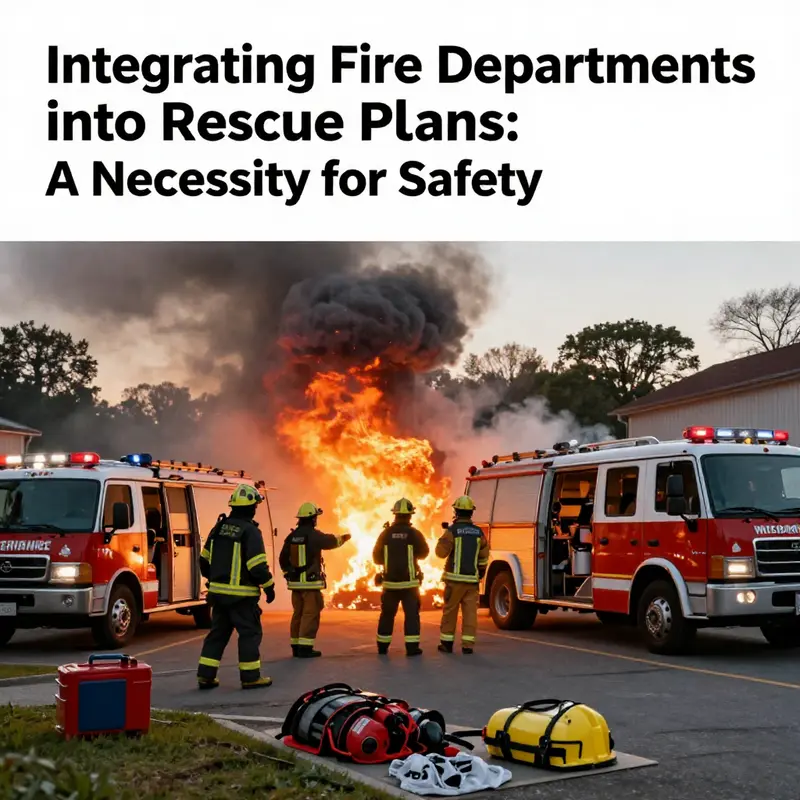
In any emergency situation, the role of the fire department cannot be overstated. Their expertise is critical not only in extinguishing fires but also in coordinating rescue operations. This article delves into the inclusion of informing the fire department within a rescue plan, emphasizing its importance. The chapters explore the significance of notifying fire services, the legal frameworks and guidelines governing this requirement, operational protocols for seamless collaboration, and real-life case studies that underscore the fire department’s pivotal involvement in rescue scenarios. Each section builds on the importance of integrating fire services effectively into emergency plans to ensure community safety.
The Vital Link: How Prompt Fire Department Notification Shapes a Rescue Plan

The moment a plan begins to take shape is the moment a rescue plan must decide who to call first. In most serious emergencies, informing the fire department is not a courtesy or an afterthought but the central hinge on which effective response turns. It is the point where policy, procedure, and practice converge to transform a potentially chaotic incident into a coordinated operation with a clear aim: to save lives, protect property, and stabilize the scene with authority and speed. This perspective is not a casual assertion but one grounded in contemporary guidance and real-world practice. A 2026 national notice on the National Fire Rescue Science and Technology Program underscores that local fire rescue brigades are responsible for organizing and reporting project applications, reinforcing the formal and ongoing role of fire services in planning. That stance is echoed in critical infrastructure contexts where the Emergency Response Plan for Civil Transport Airports requires explicit consultation with local government disaster relief agencies, including fire departments, thereby embedding fire service input at the design stage of resilience. The implication for any rescue plan is direct: if you expect a plan to perform when it matters most, you must incorporate the fire department from the outset and keep its channels open and precise throughout the life of the plan. The practical trajectory from alert to action hinges on a reliable information arc—from the first oral report to the subsequent written documentation, and from that moment to the arrival of a coordinated, multi-agency response on the ground. Such a trajectory is not a rigid ritual but a disciplined workflow that recognizes the fire department as the nerve center of emergency response, able to interpret risk, marshal resources, and guide operation across varied environments, from crowded venues to sprawling facilities. The research materials describe a lucid sequence: a report is made within minutes, a detailed written record follows within an hour, and the fire department mobilizes with appropriate units, instruments, and leadership to push the response forward. This sequence is not merely procedural; it is the mechanism that reliably translates information into action, and action into safety outcomes for people and property alike. In practical terms, informing the fire department triggers a cascade of capabilities that a plan without such notification cannot replicate. The fire department provides rapid access to incident command structures, specialized rescue teams, and knowledge of local hazards, building layouts, and egregious risk patterns. Its involvement ensures that the response aligns with established command protocols, reduces the likelihood of miscommunication, and fosters a unified approach to evacuation, entry, and hazard control. This is particularly salient in environments with complex vertical circulation, where the timing of a door-to-stairwell strategy, a lift shaft approach, or a controlled smoke management plan can determine whether occupants survive a deteriorating incident. The inclusion of fire services is thus not only a matter of capability but of appropriate, disciplined governance over a dynamic and dangerous situation. The centrality of fire department input also manifests in how a plan treats information as a strategic resource. The level and quality of data supplied to responders shape the entire decision-making process: when and where to deploy units, what gear to bring, how many personnel are required, and whether specialized teams—such as urban search and rescue, rope rescue, or hazardous materials units—need to be staged in advance. The reporting framework outlined in the sources highlights essential data points: the time of occurrence, precise location, scope of impact, fire intensity, the presence of trapped individuals, and the current status of the incident. These elements are not trivia but the very metrics that determine the incident’s classification and the corresponding seniority of on-scene leadership. A well-formed report allows the fire department to tailor a response that minimizes exposure to both victims and responders, ensuring that the most appropriate mix of resources is delivered to the field at exactly the right moment. Without these details, responders may overbuild a response for a situation that is simpler than anticipated, or they may underreact to a developing crisis, risking lives and escalating damage. The act of prompt notification also activates a robust chain of command that transcends any single agency. The district duty office, upon receiving the initial fire report, is expected to notify other crucial units, thereby synchronizing the involvement of public security, health, transportation, and emergency management. In high-stakes scenarios, this synchronized entry is the difference between a well-orchestrated response and a fragmented one. The fire department, in this system, serves as the point of integration—a hub through which information is filtered, interpreted, and disseminated to partners who can contribute unique capabilities. This architectural feature of contemporary rescue planning is essential because modern emergencies rarely confine themselves to a single hazard. A building fire may simultaneously threaten structural integrity, elevator systems, electrical networks, and occupant safety; a complex airport incident may involve evacuation, air traffic disruption, chemical hazards, and medical surge. The fire department’s role as a central coordinator helps ensure that each thread of the response—fire suppression, rescue, medical care, security, and traffic management—follows a harmonized script rather than competing agendas. The technical dimension of informing the fire department is also essential in how it connects with building systems and the people who operate them. For instance, the Five-Way Communication System for elevators demonstrates that the fire department acts as a critical link among five parties: the trapped person, the machine room, the maintenance company, the property management team, and the fire department itself. This arrangement is not merely about communication; it is about the coordination of actions that must be precise and timely to effect a safe rescue. The fire department’s oversight ensures that elevator rescues proceed with attention to structural stability, power isolation, and the potential for entrapment in other shafts or floors. The impact of such integration reaches beyond technical rescue operations to the realm of incident command, where decisions about staging areas, access points, and the sequencing of tasks depend on high-quality information and clear leadership. In this sense, informing the fire department is an act of strategic governance that aligns people, procedures, and gear around a single, shared objective: saving lives with speed and precision. This approach resonates with national directives that advocate for large-scale inspections and drills at venues characterized by high risk, crowding, or multifunctional use. When planning for major hazards, the capacity to conduct rigorous exercises and to audit readiness hinges on the fire department’s collaboration and its role as an expert advisor during both planning and execution. Even the more constrained contexts—small towns, municipal offices, or localized street corridors—benefit from a disciplined expectation that the fire department will be engaged early and that reports will be both timely and detailed. The Nanli Street Office Fire Accident Emergency Rescue Plan offers a concrete example: after a fire occurs, an oral report must be delivered immediately to the district government’s duty room and relevant departments, followed by a written report within one hour. The plan also sets a target for arrival: responsible fire department officials should be on scene within thirty minutes to coordinate rescue operations. These explicit timeframes are not bureaucratic niceties; they are care plans that translate into faster action, better situational awareness, and more effective use of resources. They reflect a fundamental truth of emergency response: information is powerful when it is timely and accurate, and the fire department is the most reliable conduit for turning information into coordinated action across multiple actors with complementary skills. The narrative above is not a theoretical ideal but a practical standard that has proven its value in practice. When a rescue plan treats informing the fire department as the starting line, it creates an adaptive, scalable framework that can respond to a range of incidents—from brief flare-ups in a mechanical room to multi-agency crises in crowded urban centers. It acknowledges the fire department as a partner whose experience with hazard assessment, access control, ventilation, and on-scene safety is indispensable to a safe and effective operation. This perspective also clarifies why training and drills are essential complements to policy. A plan may state the requirement to notify the fire department, but it is training that ensures the notification is accurate, complete, and actionable. Regular exercises help demonstrate how the initial data translate into concrete actions, how command posts are established, and how information is shared with other agencies without delay. Training thus reinforces the habit of precise reporting, the discipline of timely updates, and the confidence to escalate when conditions demand it. For practitioners seeking a practical route to strengthen this dimension of planning, there is a rich repository of resources and standards that emphasize preparation and readiness. A concrete starting point is to engage in Fire Safety Essentials Certification Training, which offers robust guidance on reporting protocols, incident command principles, and interagency coordination. This resource, linked here for convenience, helps ensure that the people who draft, review, and execute rescue plans internalize the behaviors that make notification to the fire department both reliable and effective. The guidance is not merely about compliance; it is about building a culture that values rapid, accurate information and the leadership needed to act on it. The overarching takeaway is clear: a rescue plan that systematically includes informing the fire department is not just about triggering a response. It is about shaping a culture of readiness, one that recognizes the fire department as a primary partner rather than a distant authority. It is about constructing a shared mental model among all stakeholders so that when the alarm sounds, there is no time wasted debating who should lead, what data must be collected, or which line of authority should prevail. Instead, there is a common understanding of roles, a common standard for information quality, and a common commitment to action that happens with speed and clarity. In the end, the rescue plan becomes a living instrument whose power derives from the confidence and trust it cultivates among the people who must execute it. When information flows swiftly to the fire department, and when that department responds with the full weight of its training and resources, the whole operation gains coherence, predictability, and moral authority—the capacity to protect life when it matters most. The chapter’s narrative thus reinforces a fundamental truth of emergency planning: informing the fire department is not a mere step in a checklist. It is the essential connection between knowing what is happening and doing what needs to be done to save lives, safely and effectively. As policy documents and field plans converge in this regard, the practice stands as a practical imperative that strengthens the entire emergency response ecosystem. Internal link note: for readers seeking deeper insight into training that supports this critical step, the Fire Safety Essentials Certification Training page offers a concrete, actionable path to build the competencies described above within your organization or jurisdiction. See Fire Safety Essentials Certification Training. External reference: https://www.nfpa.org
Informing Fire Services as a Core Principle of Rescue Planning

A robust rescue plan treats informing the fire department as a fundamental design requirement, not a bolt-on notification. When a detection system triggers an alarm, the plan should specify who initiates contact, what data is transmitted, and how that data is interpreted by a human in the fire service command center. This clarity reduces miscommunication, cuts response times, and anchors action in shared situational awareness.
From a lifecycle perspective, informing fire services is integral to design, construction, operation, and maintenance. International and national standards emphasize reliable interfaces between on-site systems and emergency responders, including not only sensors and alarms but the channels, protocols, and personnel responsible for communicating information. The result is a direct, auditable link from hazard detection to the field response, with explicit definitions of data quality, custody, and timing.
Procedures should define the escalation path if the first contact fails or if conditions evolve. They should specify the exact channels—direct line, radio, digital feed, or a combination—and clarify roles for facility managers, security staff, and maintenance teams in keeping those channels open, even during outages. Training and exercises translate these requirements into practice, aligning terminology, confirming alarm hierarchies, and validating communications under stress.
A critical consideration is governance: who verifies information before it is shared, who maintains the data chain of custody, and how after-action reviews feed continuous improvement. Because fire service involvement depends on timely, accurate information, plans must address privacy, safety, and regulatory constraints while prioritizing rapid, reliable access to relevant data.
In short, informing fire services is not a one-off step but a core capability that shapes a rescue plan’s effectiveness. When planners treat the fire department as a partner from the outset, plans become more actionable, more trustworthy, and better able to deliver rapid, coordinated responses in real emergencies.
Seconds, Signals, and Seamless Coordination: Embedding Fire Department Notification in Rescue Plans for Safer, Faster Outcomes

In the crowded space where risk and response collide, a rescue plan that relies solely on internal teams is a plan that limits outcomes. The fire department is not a peripheral asset in an emergency; it is a central partner whose expertise, equipment, and on-the-ground authority can transform a chaotic incident into a controlled, multi-layered operation. The question “can a rescue plan include informing the fire department?” finds a definitive answer in practice and policy: yes, and it should. In fact, the most effective plans treat notification as a deliberate, integrated step rather than a reactive afterthought. The logic is simple and data-supported. When a rescue plan anticipates the fire service’s involvement, it aligns objectives, accelerates actions, and elevates safety across life-saving priorities, hazard mitigation, and resource management. This chapter threads together the operational discipline of incident command with the procedural clarity that ensures the fire department is not merely alerted but fully engaged from the first moments of an incident.
At the heart of coordinated rescue is the Incident Command System (ICS), a structured approach that begins with a thorough size-up by the designated Incident Commander. The size-up is not a single moment but a continuous, evolving assessment of the scene. It identifies immediate priorities, notably life safety, then hazard mitigation, and finally resource allocation. When a rescue plan explicitly calls for notifying the fire department, the size-up expands to include the perspectives and capabilities the fire service brings. Fire personnel carry ladders, ventilation tools, water supply expertise, and specialized knowledge about structural collapse, hazardous materials, and high-risk environments. Their input can recalibrate life-safety priorities in ways internal teams cannot achieve alone. An action plan emerges from this larger, shared view, a plan that unites departments under a common objective with a shared sense of urgency.
Clear, reliable communication is the throughline that keeps this unification effective. A rescue operation depends on channels that work across agencies—channel fidelity must not be assumed; it must be built. Protocols should specify who speaks for which agency, how often they update, and through which mediums those updates travel. In practice, this means establishing a liaison system that identifies a single point of contact on the scene for the fire department, and a parallel point of contact within the responding agency. These liaisons act as translators between different operational cultures: the fire department’s emphasis on firefighting tactics and safety protocols, and the broader rescue operation’s focus on patient extraction, evacuation routes, and stabilization. Regular updates are not luxury; they are the backbone of synchronized action. The pace of a dynamic incident requires information to flow in near real time, with a cadence that matches the scene’s tempo rather than waiting for formal briefings after critical shifts in conditions.
Resource management in a coordinated plan grows more robust when mutual aid is baked into the framework. Mutual aid agreements are not abstract documents; they are the practical pathways by which additional apparatus, personnel, and expertise arrive in time to matter. Knowing in advance what resources the fire department can and will bring to a scene accelerates decision-making on the ground. It also clarifies where demand will come from and how those demands will be fulfilled. The plan should define pre-arranged triggers—specific thresholds or indicators that prompt the deployment of additional fire units, specialized equipment, or backfill from neighboring jurisdictions. In the high-stakes environment of a rescue, these triggers prevent hesitation and reduce the likelihood of a bottleneck when time is of the essence.
Safety remains the overarching priority, and a coordinated plan elevates safety by assigning a dedicated safety officer who oversees both the internal teams and the fire department presence on the scene. The safety officer’s role is to identify evolving hazards, adapt risk assessments, and ensure compliance with safety protocols across agencies. The fire department brings its own safety framework, and harmonizing that framework with the incident’s broader safety plan reduces the chance of conflicting decisions at critical junctures. Regular hazard assessments should be conducted as the scene evolves, with the safety officer coordinating with fire senior staff to anticipate changes in structural integrity, fire behavior, or environmental conditions. When such changes surface, joint decision-making becomes essential, and the ability to communicate those changes quickly to all responding units is what prevents injuries and saves lives.
Training and drills are the lifeblood of sustained coordination. A rescue plan that aspires to seamless cross-agency performance must be reinforced through regular, joint training sessions with all involved agencies. Drills simulate real-world pressures and stresses, testing command structures, communication channels, resource flow, and safety oversight. The value of these exercises goes beyond memorized procedures; they build instinctive trust among responders. After-action reviews complete the loop, revealing not only what went well but where coordination could be sharpened. These reviews should feed back into revised plans, updated contact lists, and refined joint protocols. The iterative nature of training and review creates a culture where informing the fire department is not a formal requirement that is checked off, but a living practice embedded in every phase of emergency preparation.
Consider how these principles illuminate concrete planning obligations outlined in national and regional documents. The National Fire Rescue Bureau’s Notice on Issuing the 2026 Annual Project Application Guidelines for the National Fire Rescue Science and Technology Program underscores a formal responsibility of local fire rescue brigades and relevant units to organize and report on the collection, preliminary review, and submission of project applications. While framed in a funding and project-management context, the notice underscores the fire department’s central role in both planning and response. This formalizes a posture in which the fire department is not a peripheral stakeholder but a partner integrated into the planning cycle from its inception. In another domain, the Emergency Response Plan for Civil Transport Airports explicitly requires consultation with local government disaster relief agencies, including fire departments. Airports are critical infrastructure whose emergencies demand flawless interagency coordination, making the fire department’s involvement not optional but essential for reducing risk and accelerating rescue operations at scale. These documents collectively illustrate how integration of the fire service into planning is both prudent and mandated, and they provide a blueprint for ensuring that informed fire department participation becomes standard practice rather than an afterthought.
The practical embodiment of these ideas can be seen in regional emergency rescue plans that specify swift information reporting after an incident. Take the Nanli Street Office Fire Accident Emergency Rescue Plan as a concrete example: after a fire occurs, the local street office (township) and fire brigade must immediately provide an oral report, followed by a written report within one hour to the district government’s duty room and other relevant departments. The plan also specifies that the responsible fire department officials must arrive at the scene within thirty minutes to coordinate rescue operations. These provisions demonstrate how the flow of information and the timely arrival of fire department leadership create a predictable, accountable progression of operations. A rescue plan that embraces such requirements ensures that the initial size-up is not isolated within a single agency but shared across the involved entities. The early arrival of fire department leaders enables rapid hazard assessment, the deployment of specialized tools, and immediate alignment on evacuation routes and triage priorities. In practice, the result is a more cohesive response where every passing minute translates into more lives saved and fewer injuries.
To these structural considerations add a policy orientation that incentivizes real-time information exchange. When a plan designates early notification to the fire department as a standard step, it signals to personnel at all levels that coordination is a responsibility, not a convenience. This cultural shift reduces the friction that can occur when agencies operate on different tempos or with different assumptions about who informs whom and when. A well-designed plan also anticipates the need for a single, shared operational picture—a common operating picture that is accessible to all partners via secure channels. In practice, this means investing in interoperable communication platforms, standardized incident depictions, and agreed-upon terminology so that incident command translates smoothly across agencies. The benefit is clear: when the incident escalates, the fire department’s expertise is not requested in a vacuum; it is integrated into a unified, well-informed strategy that already accounts for the terrain, the risks, and the available resources.
The implementation path for planners is both straightforward and demanding. Start with a formal requirement: notify the fire department as a first-order action in the rescue plan’s activation sequence. Define a specific point of contact within the fire department—someone who can participate in the initial briefings, contribute to the action plan, and take ownership of safety oversight on the ground. Build a communications protocol that stipulates who reports what, when, and through which channels. Integrate mutual aid arrangements into the core plan, including pre-arranged resource swaps, crossover command, and a defined escalation ladder for heavy technical rescues. Embed training and drills into the calendar, ensuring that exercises include live interaction with fire department personnel and that after-action findings feed directly into plan updates. Finally, acknowledge the legal and regulatory landscape by aligning the plan with the notices and guidelines that recognize the fire department’s central role in both planning and response. In this light, informing the fire department is not a compliance box to tick; it is a professional practice that strengthens every link in the rescue chain.
For practitioners seeking practical guidance, it helps to connect these abstract principles with resources that illuminate real-world application. A useful starting point for teams aiming to enhance cross-agency readiness is to pursue foundational training that emphasizes safety and coordination. See the fire-safety essentials certification training resource for a concise primer on the competencies that support joint operations, decision-making under pressure, and coordinated safety practices. This training helps personnel internalize the mindset that informs successful interagency collaboration and provides the groundwork for more effective drills and live responses. fire-safety essentials certification training
As with any public-safety endeavor, the roadmap to seamless fire department coordination is not static. It evolves with lessons learned from each incident, drills, and the shifting landscape of risk. The official manuals and protocols that govern fire department operations offer essential guardrails. They describe incident command structures, reporting hierarchies, and the protocols for scene management. These documents are indispensable references for planners who design rescue plans that incorporate notifying the fire department. They remind us that the goal is not merely to move resources into a scene but to synchronize actions, ensure shared situational awareness, and protect those who risk their lives to save others. For further depth on how response protocols are framed and executed in real-world contexts, practitioners may consult external resources such as the Fire Department Operations Response Protocols, which provide a detailed lens on incident command and field procedures. https://www.oboe.org/fire-department-operations-response-protocols/
In shaping a rescue plan that includes informing the fire department, the overarching narrative is one of disciplined integration. It is a narrative in which life safety, hazard mitigation, and resource coordination are not staged separately but play out in a continuous, collaborative sequence. The presence of the fire department on the front end of planning elevates the operation beyond the sum of its parts. It transforms a potentially chaotic incident into a coordinated response anchored by shared objectives and proven practices. It ensures that the moment a problem is detected, a well-rehearsed chain of communication will yield immediate, constructive action. It makes the difference between a plan that merely anticipates the existence of capable responders and a plan that truly leverages their expertise from the outset. In doing so, it upholds a core principle of rescue work: every moment counts, and every informed, synchronized action multiplies the odds of a successful outcome for those in need.
The chapter thus closes with a practical reminder: ensure your rescue plan treats informing the fire department as a deliberate, integral step. Build in the structural supports—clear liaison roles, interoperable communications, shared operating pictures, and mutual-aid readiness. Ground those supports in a culture of continuous improvement through training and rigorous after-action reviews. And anchor your approach in the real-world examples that demonstrate how formal reporting and prompt response can shape outcomes in meaningful ways. When these elements come together, the plan no longer asks whether it should inform the fire department; it prescribes how and when to do so, with the confidence that such coordination will yield faster, safer, and more effective rescue operations for all involved.
null

null
Final thoughts
Integrating fire departments into rescue plans is not just beneficial; it is essential for effective emergency response. Legal frameworks support this necessity, ensuring that fire services are notified promptly during crises. By adhering to established guidelines and operational protocols, communities can significantly enhance their preparedness for emergencies. Case studies further emphasize the critical role of fire departments, demonstrating the positive outcomes of collaboration. A robust rescue plan must prioritize communication with fire services, ensuring that the community is safeguarded against potential disasters.