
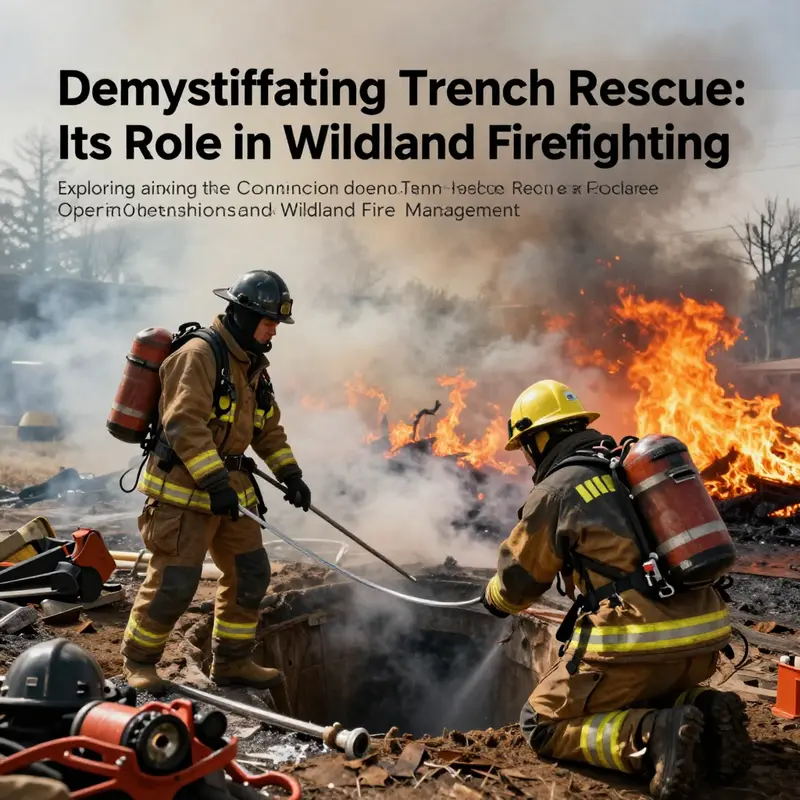
The intersection of trench rescue operations and wildland firefighting encompasses critical safety and operational tactics essential for effective fire management. As wildfires become increasingly volatile and complex, understanding various rescue strategies—including trench rescue—can aid first responders in their efforts. While trench rescue primarily focuses on urban settings, exploring its principles can provide insights into enhancing safety protocols during wildfires. The following chapters delve into the relationship between trench rescue and wildland firefighting, emphasizing the ‘trench effect’ phenomenon and its implications on fire behavior.
From Trenches to Timber: Why Trench Rescue Isn’t Wildland Firefighting—and What the Shared Skills Reveal About Extreme Fire Response
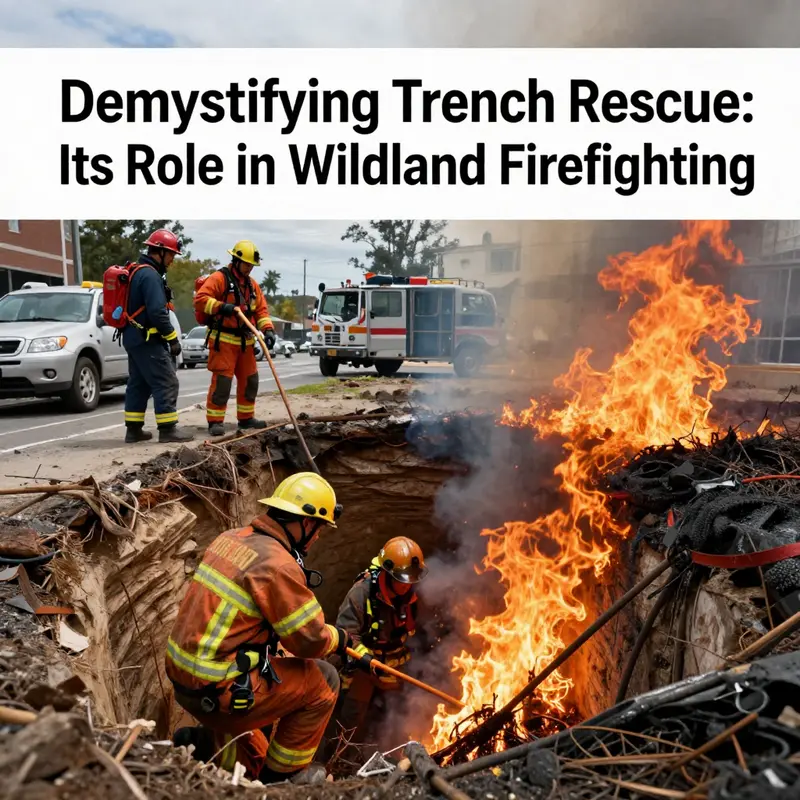
When people ask whether trench rescue is part of wildland firefighting, the answer is a careful no, followed by a careful yes in a different sense. Trench rescue, as a discipline, centers on extracting people who are trapped in collapsed excavations or unstable soil under urban or construction-site conditions. Wildland firefighting, by contrast, is the orchestration of suppressing and containing fires in natural landscapes such as forests, grasslands, and scrub, where the terrain, fuels, wind, and microclimates drive decision making. Yet the two domains share a human core: the imperative to protect life under pressure, to mobilize quickly, and to operate safely in environments that are unpredictable and dangerous. The way these fields intersect is not in the moment-to-moment tactics of one another, but in the broader philosophy of emergency response—where risk assessment, seamless communication, interagency coordination, and the disciplined use of safety protocols form the backbone of success. It is in this shared philosophy that the relationship between trench rescue and wildland firefighting reveals both boundaries and common ground, a convergence that matters for training, operations, and the culture of incident response as a whole.
To begin with, both disciplines hinge on rapid mobilization and the readiness of people who are trained to act when seconds count. A trench rescue team is composed not only of rescuers but of planners who anticipate soil behavior, potential cave-ins, and the shifting stability of a trench wall. A wildland firefighting crew comprises firefighters, incident meteorologists, along with lookout and transport personnel who must weigh fuel types, slope, and weather patterns as they move through a landscape that can shift from calm to chaotic in minutes. In both cases, responders operate under a shared pressure: a need to move from assessment to action while maintaining a cautious respect for the unknown. The speed with which a situation can deteriorate demands that responders be prepared with a decision framework, not just a set of physical maneuvers. This framework is built through rigorous training, drills, and standardized protocols that guide actions during the earliest moments of an incident and through the most complex phases of a response.
A critical overlap lies in the emphasis on safety gear and the communication technologies that keep teams connected when visibility is limited and risk is high. Personal protective equipment, fall arrest systems, ambient air monitoring, radios, and field tablets are common across both fields. In trench rescue, the immediate concerns are soil stability, shoring methods, and patient stabilization while protecting both the patient and the rescuers from a secondary collapse. In wildland firefighting, the priorities include airway protection from smoke, heat exposure control, and maintaining line-of-sight coordination in rugged terrain where lines, water resources, and aircraft support must be choreographed with precision. The shared reliance on PPE and communications underpins a culture of safety that transcends one specific operation. It is this shared culture that allows teams from different disciplines to recognize each other’s cues, understand each other’s constraints, and coordinate effectively when incidents bleed across jurisdictional boundaries or involve multiple agencies.
Operational protocols provide another throughline. In trench rescue, incident command practices and trench safety standards guide every phase of the operation—from site assessment and scene security to the staged removal of a patient. In wildland firefighting, incident command systems have similar logic: establish command, assess hazards, create a strategy, and adapt as conditions evolve. The National Fire Protection Association’s standards, for example, codify how responders manage emergencies in complex environments, emphasizing the importance of hazard assessment, role clarity, and structured decision making. While the specifics differ—soil mechanics versus fire behavior, trench shoring versus flank protection, or vehicle extraction versus backfiring and firebreaks—the underlying discipline is the same: think ahead, plan in detail, and execute with coordinated precision. The continuity in these principles helps explain why cross-disciplinary training can be so valuable, even when the operational endpoints diverge.
A further point of convergence is the use of technology to illuminate what is unseen. Drones and thermal imaging have become common tools in both trench rescue and wildland firefighting. Aerial reconnaissance provides situational awareness that is not possible from the ground alone. In a trench scenario, drone feeds can reveal soil conditions, water accumulation, and potential slide triggers without forcing additional exposure on the ground crew. In wildland fires, drones and thermal cameras help identify hot spots, track fire progression, and validate containment lines, sometimes in terrain that would be dangerous or impractical to reach by foot. This technological commonality fosters a cross-pollination of methods: teams trained in aerial assessment for one purpose can bring that experience to bear in another, broadening the risk picture and enabling better resource allocation. It also underscores a broader lesson about modern emergency response: the most effective teams are those that integrate multiple modalities of knowledge, not just a single skill set.
Yet, the differences between trench rescue and wildland firefighting are equally instructive. Trench rescue is fundamentally urban or construction-focused. Its core challenges revolve around soil stability, gas hazards, restricted access points, and the physics of collapse. The tools of the trade—shoring systems, confined-space protocols, patient packaging, and urban search-and-rescue (USAR) techniques—are tailored to environments where vertical or horizontal confinement, rather than open terrain, dominates risk. The objectives are precise: reach or stabilize a trapped individual and remove them safely, often under time-sensitive conditions that raise the emotional stakes for rescuers and families alike. The operational tempo leans toward meticulous, methodical extraction, with a premium on control and stability to prevent further harm.
Wildland firefighting, on the other hand, unfolds across broad landscapes where fuel, weather, and topography choreograph the tempo. The firefighting approach is to suppress, contain, and protect, with strategies that include building fire lines, conducting controlled burns to shape fuel ladders, and deploying aerial suppression to reduce heat and spread. The terrain demands adaptability, resilience to long shifts, and an ongoing read of environmental indicators like wind shifts and humidity. The stakes hinge on preserving life, property, and ecological balance in a setting where the fire’s behavior can shift suddenly from creeping to eruptive, especially on steep, rugged slopes or in situations where vegetation and topography create natural trenches and corridors—hence the conceptual tie to the trench effect, a term that has appeared in discussions about fire behavior in confined spaces. In these moments, responders must fuse theory with practice, translating observations into decisive actions that minimize risk to both civilians and responders.
To be clear, the trench effect itself is not a component of wildland rescue operations nor a direct mechanism by which trench rescue teams operate on natural terrain. The trench effect describes how flames can be funneled and intensified by confined spaces in urban structures, as highlighted by historical fire events such as the King’s Cross Underground disaster. Its relevance is most direct to structural or built environments and to understanding how confinement shapes fire dynamics within a building. However, the concept has informed some discussions about eruptive behavior in complex wildfire scenarios, particularly where terrain features channel winds and fuels in ways that resemble narrow corridors. This is a reminder that fire science travels across domains; ideas can travel from urban catastrophe studies into wildland risk analyses, but the operational reality remains distinct. Recognizing this distinction helps prevent the conflation of specialized rescue work with broader fire-suppression tactics while still acknowledging how insights from one area can enhance risk awareness in another.
The cross-disciplinary value becomes most evident when we consider training, standards, and professional development. Implementing consistent guidelines that govern how teams plan, communicate, and execute under stress is essential regardless of the setting. The NFPA standards cited in reputable sources provide a backbone for incident management and technical rescue practices. NFPA 1521, for instance, outlines the Standard for Emergency Services Incident Management System, a framework that supports incident command, resource management, and safety oversight across complex emergencies. NFPA 1001, the Standard for Trench and Excavation Safety, addresses the particular hazards associated with trench work and the safety practices necessary to protect workers and rescuers during excavation operations. These documents do not prescribe a single, universal response for every scenario; rather, they codify the ethical and operational commitments that allow diverse teams to integrate smoothly when incidents require multi-agency collaboration and the rapid adaptation of roles. They emphasize hazard assessment, clear delineation of responsibilities, ongoing risk management, and the need for continuous training to maintain proficiency.
In practice, what does cross-training look like if aimed at improving safety and efficacy across trench rescue and wildland firefighting? It starts with a shared vocabulary of risk and a common respect for the limits and capabilities of each discipline. It means familiarizing urban FD crews with the terrain assessment skills that wildland crews use to gauge slope gradients, fuel loading, and weather-driven fire potential. It means teaching wildland teams how to interpret soil stability indicators and restricted access realities when they encounter deep erosion features or unstable ground in natural canyons or roadside cuttings. It also means integrating incident planning practices that incorporate both the precision of a rescue operation and the strategic flexibility of a wildfire assignment. When teams train together—practicing scene size-up, safety briefings, and demobilization plans—they cultivate a kind of shared situational awareness that can bridging gaps in communication, reduce cognitive overload during an incident, and shorten the time from recognition to action.
One practical implication of this cross-pollination is the value of continuous education that extends beyond the walls of a single discipline. Some institutions have incorporated broad safety literacy into their curricula, emphasizing core competencies like hazard recognition, risk management, and ethical decision making. For readers exploring these ideas, resources such as Fire Safety Essentials Certification Training can be a useful entry point to broaden their foundational understanding of safety culture and incident leadership. This kind of training does not replace specialized rescue or wildfire expertise; it complements it by reinforcing the universal attitudes and practices that keep responders safe while managing uncertainty. The emphasis on core safety principles—communication discipline, orderly progression of tasks, and rigorous adherence to procedures—has practical payoffs in real incidents, from reducing near-miss events to improving patient outcomes in rescue operations and preserving critical pre-loss conditions in wildfires.
Operationally, the relationship between trench rescue and wildland firefighting encourages a broader view of incident response that goes beyond the immediate crisis. It invites leaders and responders to think about how to organize and maintain resilience over hours, days, and even weeks of ongoing response. It invites communities to invest in training infrastructures, equipment caches, and interagency agreements that acknowledge shared challenges with distinct solutions. It invites policymakers to recognize that the safety of responders is inseparable from the safety of civilians and the integrity of the environment. When these elements align, the result is a response system that can adapt, endure, and recover. It is not enough to excel in one domain if crossing into another would be possible or likely in the future; the most effective public safety professionals are those who carry a flexible, integrated skill set that translates across settings while honoring the unique demands of each.
Ultimately, the relationship between trench rescue and wildland firefighting speaks to a fundamental truth about risk management in public safety: preparedness is not a single destination but a path that we walk together. The shared ground—risk assessment, safety culture, coordination, and the judicious use of technology—provides a platform from which both disciplines can learn, improve, and protect lives more effectively. It also helps to clarify boundaries, ensuring that trench rescue remains a specialized urban operation focused on stabilizing soils and extricating patients, while wildland firefighting remains a terrain-driven mission aimed at limiting the spread of fire, protecting ecosystems, and preserving human life across large landscapes. Both are essential in their own right, and both benefit when practitioners can draw on broad safety literacy, shared standards, and collaborative training that respect the differences while valuing the common human aim: to respond decisively and safely when danger arises.
For readers seeking a deeper dive into the formal frameworks that support incident management in diverse emergencies, consult the NFPA 1521 standard for Emergency Services Incident Management System. This resource helps illustrate how the principles discussed here translate into concrete practices for command, coordination, and safety across both trench-rescue scenarios and wildland firefighting operations. As you explore the intersections of trench rescue and wildland firefighting, remember that the most powerful lessons often come from looking at how people from different backgrounds approach risk, communicate under pressure, and uphold a shared commitment to saving lives while protecting the responders who do the work. The journey from trench walls to timbered slopes is not a single route; it is a pathway defined by careful thinking, collaborative training, and an unwavering devotion to safety.
Internal link reference for broader safety literacy: Fire Safety Essentials Certification Training.
External resource: NFPA 1521: Standard for Emergency Services Incident Management System, https://www.nfpa.org/codes-and-standards/all-codes-and-standards/list-of-codes-and-standards/detail?code=1521
From Trench Physics to Forest Flames: Understanding the Trench Effect and Its Boundaries in Wildland Fire
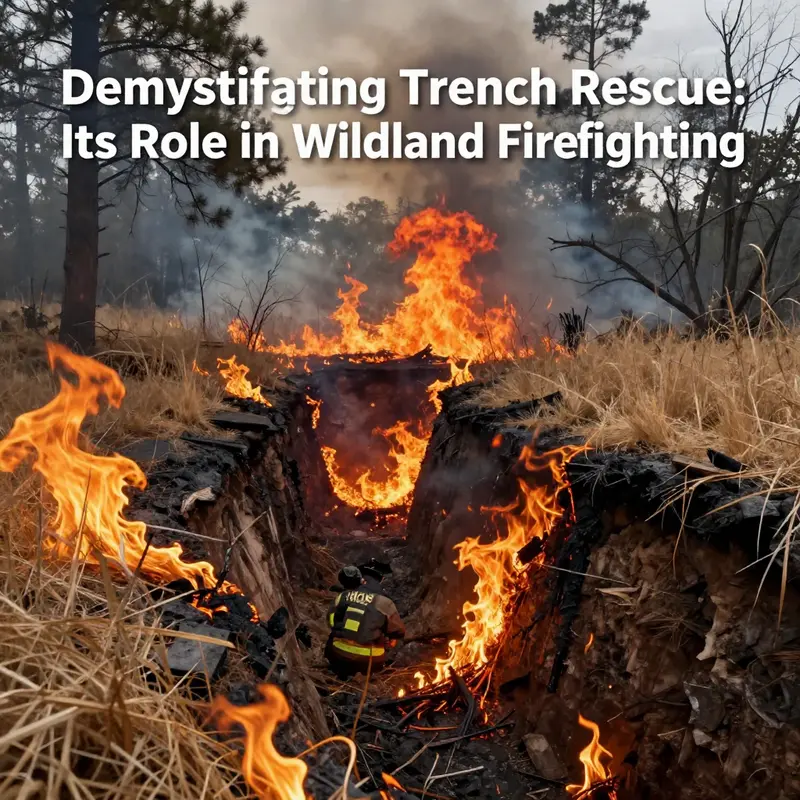
Fire science often travels across domains, moving from the orderly confinement of buildings to the rugged, expansive theaters of forests and grasslands. In this cross-domain journey, a concept known as the trench effect appears to bridge the gap between how flames behave in narrow, vertical passages and how they can behave on steep, confined terrains in the wild. Yet in the practical lexicon of emergency response, trench rescue remains a distinct discipline focused on extricating people from collapsed trenches or excavations. The trench effect, however, is a property of flame dynamics and topography that carries important implications for wildland fire behavior, risk assessment, and decision making on the fireline. This chapter explores how confinement alters flame motion, why that matters when fires spread across complex terrain, and where the boundaries lie between trench physics and trench rescue operations. It also considers how historical lessons, particularly from the King’s Cross underground fire, have informed thinking about extreme fire behavior in both structural and wildland settings, while making clear that the operational domains themselves do not overlap in practice—yet they share an emphasis on hazard awareness, rapid adaptation, and disciplined training.
At the heart of the trench effect are two physical phenomena that operate together when flames encounter confined, inclined spaces: the Coanda effect and the chimney effect. The Coanda effect describes how a jet of gas or flame tends to attach itself to nearby surfaces, hugging the geometry of a channel rather than dispersing freely into open air. In a narrow stairwell or a steep ravine, flames can cling to walls and rise along the slope, creating highly directional heat flow. The chimney effect concerns the buoyant rise of hot air and combustion gases that are trapped between vertical boundaries and then driven upward by density differences. When a space acts like a chimney, heat and gases accumulate and vent in an accelerated, highly efficient manner. In combination, these effects can dramatically increase flame temperature at fuel interfaces and concentrate heat in ways that propel rapid, sometimes explosive, spread.
The most cited demonstration of this dynamic is the 1987 King’s Cross Underground fire in London, a disaster that showed how a confined, vertical network of passageways could channel flames into rapid, high-energy growth. The event is studied less as a police or rescue failure and more as a stark reminder of how confinement, geometry, and venting conditions can convert a localized fire into a surge of heat and pressure. Importantly, the trench effect is not about how one conducts trench rescues; it is about how flames behave in tight, vertical or near-vertical channels. In structural fire scenarios, the effect is often discussed in terms of stairwells, escalators, shafts, and other confined conduits where heat, smoke, and combustion byproducts are concentrated and directed. In wildland contexts, the geometry shifts from built environments to natural contours: narrow ravines, gullies with steep sides, or tightly constrained drainages can create analogous “trench-like” paths that guide heat and preheated fuels upward and along the slope. The physics remains the same in principle, even if the geometry and scales differ.
In practical terms, the trench effect translates into heat accumulation and intensified combustion when a flame encounters a slope or a narrow channel that limits lateral air mixing. The result is a heat trap that can drive extremely fast flame spread, sometimes quoted as exceeding ten meters per second in extreme cases. While this figure reflects textbook and experimental scenarios rather than routine field observations, it underscores a real hazard: when wildland fire reaches terrain features that mimic confinement, traditional slope-driven intuitions about catchment area and wind-driven spread may be insufficient. The flame’s attachment to the slope, a hallmark of the trench effect, can heighten combustion efficiency by preheating and drying fuels along the interface, creating a feedback loop that sustains rapid progression even under moderate surface winds.
For wildland fire managers and responders, the implications of trench-like confinement are especially relevant in complex terrain. When a fire moves into narrow canyons, steep draws, or bench-cut ravines, fuel beds can align with the flame front in a way that concentrates heat and accelerates preheating of litter, duff, and shrub layers. The result is not a literal trench rescue operation but a terrain-induced hazard where the flame behaves as if carried by a chimney and pressed along vertical faces. In such settings, the rate of fire spread can respond strongly to slope angle: a well-documented observation in fire science is that increasing slope by about ten degrees can substantially increase the rate of spread, sometimes doubling it. This is not simply a matter of steeper terrain but of the way heat release, fuel preheating, and air exchange interact in a constrained topography. The trench effect thus provides a useful lens through which to view these phenomena, reminding us that the fire’s velocity is not governed by wind alone or by fuel type in isolation; it is also shaped by the geometry that fences air flow and confines heat.
Despite the salience of these ideas for understanding extreme fire behavior, it is essential to maintain a clear boundary between trench physics and the operational world of trench rescue. Trench rescue is a specialized discipline focused on patient or victim extrication from collapsed or undermined excavations. It requires technical rescue skills, shoring, stabilization, and coordination with medical teams. Wildland firefighting, by contrast, centers on preventing, controlling, and mitigating fires across natural landscapes. The trench effect informs risk assessment and decision making in wildland fires, but it does not entail trench extraction operations or structural collapse response under normal wildland incident conditions. In other words, knowing that confinement can promote rapid flame escalation helps responders anticipate hazards and adjust suppression strategies, but it does not redefine the scope of their mission. The two topics intersect conceptually in the sense that hazard awareness and terrain assessment are universal priorities for all responders, yet they diverge in practice because the tools, techniques, and objectives differ markedly between rescue work at a construction site and wildfire suppression in forests or grasslands.
The relevance of these ideas to wildland fire is reinforced by a lineage of research and analysis that traces back to structural fire studies. The King’s Cross case, and the subsequent investigations into how hot gases and flames behave in confined vertical channels, underscored the need for robust, physics-based models that integrate confinement, gravity-driven venting, and flame attachment. In wildland contexts, researchers have begun to translate those insights into models that account for topographic confinement. The goal is not to replicate the exact urban scenario but to capture the same principle: that geometry alters the energy balance of the fire system. When heat becomes trapped along a slope, when flames attach to surfaces, and when preheated fuels reach ignition thresholds more readily, the resulting fire can display bursts of speed that exceed the expectations set by free-surface, unobstructed flames.
This translation from laboratory and structural studies to field-scale wildland applications is not without gaps. Many operational wildfire spread models emphasize wind, slope, and fuel continuity but may underrepresent the potential for eruptive behavior driven by trench-like confinement on steeper, rugged terrain. The absence of fully integrated, confinement-aware dynamics means that some extreme-fire scenarios may be underpredicted by standard models. Recognizing this gap is not an invitation to sensationalize events but a call to refine forecasting tools and risk assessments so that firefighters and incident commanders can preemptively address potential rapid escalations. In response, international researchers have proposed feedback-based modeling approaches. These approaches treat the trench effect as a dynamic process that interacts with topography, wind, fuel type, and flame attachment in a way that can amplify fire intensity and spread under certain conditions. The emphasis is on capturing the nonlinearity of extreme behavior rather than predicting a single, deterministic outcome in every scenario.
At the same time, historical lessons from structural fires like King’s Cross continue to inform both structural and wildland research communities. They remind us that confined spaces can transform fire behavior in unexpected ways, and they stress the importance of training, hazard recognition, and rapid, evidence-based decision making. For wildland responders, those lessons translate into field practices that prioritize terrain assessment, escape routes that consider potential trench-like pathways for flame movement, and contingency plans for sudden surges in fire intensity along confined channels. Training programs increasingly emphasize not only suppression techniques but also the cognitive readiness to recalibrate plans when the fire interacts with terrain features that behave like restricted conduits for heat and gases. In this sense, the trench effect serves as a bridge between disciplines, a reminder that fundamental physics can manifest across different incident types and that cross-pertilization of ideas can yield safer and more effective responses.
While the trench effect helps illuminate why certain terrains pose outsized hazards, broader modeling efforts continue to evolve. There is consensus that no single parameter—fuel type, wind speed, humidity, or slope alone—adequately predicts eruptive behavior. Instead, a suite of interacting factors creates conditions where flames can accelerate dramatically. This perspective supports a precautionary approach to incident management: treat high-risk terrain as a potential site for abrupt changes in fire behavior, and maintain flexible suppression and evacuation strategies. The practical upshot for wildland operations is clear. Firefighters should integrate terrain-anomaly awareness into standard risk assessments, especially in mountainous forests, brush-dominated highlands, and urban-wildland interfaces where complex topography often confines heat and fuels in ways not captured by simple rate-of-spread calculations. In these settings, a trench-aware lens can help field personnel interpret unusual accelerations in fire behavior and adjust tactics before lines are breached by waves of flame.
From a training perspective, the topic also points toward ongoing professional development. Hazard recognition, scenario-based drills, and decision-making protocols can incorporate the trench effect as a conceptual tool rather than a prescriptive method. The aim is to cultivate a mindset that anticipates how geometry interacts with energy release. In practical terms, this means training that emphasizes terrain scouting, identification of potential confinement features, and rehearsal of rapid shift strategies in response to signs of heat buildup at the interface of slope, fuels, and wind. It also means cultivating a respectful skepticism about prediction in the face of nonlinear dynamics and ensuring that incident commanders keep options open for rapid evacuation or retreat when terrain features begin to behave like confined conduits for fire. The evolving science invites a collaborative posture among researchers, field practitioners, and training developers so that new insights can be translated into usable, field-ready tools and tactics.
The relationship between the trench effect and trench rescue remains one of distinction rather than confusion. Rescue operations on construction sites or in post-collapse urban settings demand specialized equipment, stabilization techniques, and medical coordination. Wildland fire response, by contrast, requires a different balance of suppression tactics, risk management, and safety circumspection. Yet the concept of confinement-driven flame behavior offers a unifying thread: all responders must read terrain as an active participant in the fire’s evolution. A slope or a narrow channel is not a passive backdrop but a dynamic element that can magnify heat, alter air flow, and reshape the fire’s energy pathways. Recognizing this dynamic prompts more cautious decision making, better assignment of resources, and a greater emphasis on situational awareness in the face of terrain-driven hazards. The end result is not a debate about disciplines but a shared commitment to safer operations in environments where geometry and physics conspire to intensify danger.
For readers seeking a deeper dive into the scientific foundation and experimental validation of the trench effect, the official UK Health and Safety Executive report provides a comprehensive, rigorous treatment of the phenomenon and its implications for fire behavior in enclosed spaces. This external resource offers a detailed technical backbone that supports the qualitative observations discussed here and invites researchers and practitioners to engage with the data and methods used to study confinement-driven flame dynamics. The report is accessible at the following link: https://www.hse.gov.uk/research/rrpdfs/rr342.pdf. In the broader literature, researchers continue to refine how confinement, slope, wind, and fuel characteristics combine to produce extreme fire behavior, and ongoing cross-disciplinary dialogue promises to yield more accurate models and more resilient strategies for both structural and wildland fire communities.
Within the broader arc of the article, the trench effect thus serves as a cautionary but constructive memory: it reminds us that even seemingly simple topographic features can reshape fire behavior in consequential and sometimes dramatic ways. It also underscores the value of integrating physics-based understanding into practice, of embracing uncertainty in the face of nonlinear dynamics, and of maintaining a disciplined approach to training and preparedness. Trench rescue, as a defined field, remains outside the scope of wildland firefighting, but the underlying principle—that terrain can actively mold fire—binds the two domains in a shared search for safer, more effective responses. In that sense, embracing the trench effect is less about blurring professional boundaries and more about enriching the toolkit with physics-informed insight that enhances vigilance, planning, and execution when fires traverse the complex, rugged stages of the natural world. The journey from confined flames to forest sparks thus continues, guided by evidence, shaped by terrain, and powered by a collective commitment to safety and service in the face of the fire’s relentless momentum.
Final thoughts
Understanding the nuances of trench rescue and its potential implications on wildland firefighting is crucial for developing more effective safety protocols for first responders. While trench rescue might not be commonplace in wildland scenarios, the principles derived from these operations can inform better strategies and responses to extreme fire situations. The incorporation of concepts like the ‘trench effect’ further enriches our comprehension of fire dynamics, ultimately fostering improved negotiation of challenging firefighting environments.

