Introduction to Fire Rescue Command Vehicles
Fire rescue command vehicles play a critical role in emergency operations, serving as mobile command centers that facilitate efficient decision-making during crises. These specialized vehicles are equipped with advanced communication tools, integrated data networks, and real-time situational awareness systems crucial for coordinating multiple response units. According to the National Fire Protection Association, these vehicles enable incident commanders to monitor conditions on the ground and adapt strategies effectively, particularly during high-stakes scenarios such as wildfires, chemical spills, and structural collapses. The U.S. Fire Administration also highlights that using fully equipped command vehicles can reduce response times by up to 30%, significantly improving the effectiveness of response efforts.
Beyond providing a central hub for operational command, fire rescue command vehicles are indispensable in ensuring rapid resource allocation and seamless integration with other emergency services. They house dedicated command staff and sophisticated emergency information systems, thus enhancing the operational continuity necessary during complex emergencies. As communities face increasingly diverse challenges, the importance of these vehicles cannot be overstated. They not only support the immediate needs of emergency responders but also contribute to the overarching goal of public safety and resilience in the face of disasters. For a deeper understanding of the essential features and benefits of these vehicles, you can explore more here.
In this article, we will delve into the various functions of fire rescue command vehicles, illustrating their significance in modern emergency response.
Key Features of Fire Rescue Command Vehicles
Fire rescue command vehicles are essential assets in emergency management and firefighting operations, designed to streamline communication, enhance coordination, and provide comprehensive situational awareness during incidents. The following are key features that make these vehicles effective:
1. Real-Time Data Integration
One of the most significant advancements in fire rescue command vehicles is the ability to integrate real-time data. Equipped with advanced communication systems like SATCOM and LTE/5G, these vehicles enable seamless data sharing between command centers, field units, and other emergency services. Integrated Geographic Information Systems (GIS) also help in visualizing incident dynamics effectively, allowing command centers to assess situations as they develop.
Source: Fire Rescue Command Vehicle Technology Overview – 2026
2. AI-Powered Decision Support
AI technologies have begun making their way into command vehicles, providing decision support mechanisms that analyze fire behavior and predict spread patterns. These systems help incident commanders make informed choices regarding resource deployment by assessing factors like weather, terrain, and building structures, ultimately leading to smarter and more effective firefighting strategies.
Source: AI in Fire Command Systems – NFPA Report 2026
3. Mobile Command Center (MCC)
Modern command vehicles often feature a fully enclosed, climate-controlled Mobile Command Center (MCC) that includes modular workstations and video conferencing capabilities. This space can support multiple personnel (up to 12) and enables efficient multi-agency collaboration during emergencies, enhancing operational effectiveness.
Source: Mobile Command Vehicle Standards – FEMA ICS-2026
4. Unmanned Aerial System (UAS) Integration
Many fire rescue command vehicles now incorporate drone technology, providing onboard launch pads and control stations. This enables real-time aerial surveillance with high-resolution thermal imaging and camera systems, significantly enhancing situational awareness without risking personnel in hazardous environments.
Source: UAS in Emergency Response – FAA & NIST Joint Study 2026
5. Interoperable Communication Suite
To ensure communication across various emergency services, command vehicles are equipped with multi-band radios (VHF/UHF/PMR) and encrypted digital voice networks. This allows for interoperability between fire, police, and EMS agencies, utilizing common communication protocols such as FirstNet and P25.
Source: Interoperability in Incident Management – NIST Special Publication 2026
6. Cybersecurity & Data Protection
As reliance on digital tools increases, command vehicles come equipped with cybersecurity measures to safeguard sensitive incident data. Features include built-in encryption, secure login protocols, and intrusion detection systems to protect against unauthorized access.
Source: Cybersecurity for Emergency Vehicles – DHS Guidelines 2026
7. Extended Power & Backup Systems
Modern fire rescue command vehicles deploy dual battery systems with solar panel integration and fuel cells, enabling 72 hours of continuous operation without needing grid power. This feature is critical during prolonged emergencies, allowing teams to maintain operations without impeding firefighting efforts.
Source: Power Resilience in Command Vehicles – DOE Report 2026
Conclusion
Fire rescue command vehicles have evolved remarkably, now incorporating advanced technologies that suffice the demands of modern emergencies. The integration of AI, real-time data sharing, and aerial surveillance significantly improves effectiveness in firefighting and rescue operations.
To enhance your understanding further, feel free to check out our blog on customizable firefighting vehicles and the role of fire safety certificates in ensuring safe operations.
Primary Functions of Fire Rescue Command Vehicles
Fire rescue command vehicles are pivotal in managing emergency situations effectively. Their roles extend beyond merely transporting personnel; they enhance overall response capabilities. Here are the key functions and roles they serve:
- Command and Control: Serve as a centralized hub for incident management, ensuring effective communication and coordination among teams.
- Resource Management: Facilitate the distribution of firefighting resources, personnel, and equipment, optimizing operational efficiency.
- Situational Awareness: Equipped with technology for real-time data and surveillance, providing insights into current conditions and needs.
- Safety Oversight: Monitor the safety of personnel on the scene, ensuring compliance with safety protocols and procedures.
- Logistical Support: Assist in logistical operations, including food, supplies, and medical aid for responders engaged in lengthy operations.
- Training and Drills: Serve as mobile training facilities where personnel can prepare for various scenarios and improve their readiness.
Through these functions, fire rescue command vehicles play an essential role in maintaining safety and efficiency during emergencies. For more insights on fire safety practices and vehicles, check out our blog on fire safety essentials and customizable firefighting vehicles.
The Evolution of Fire Rescue Command Vehicles
Fire rescue command vehicles are essential for coordinating emergency responses effectively and have evolved dramatically since their inception. This overview highlights the key milestones in their development.
Early Development (1960s)
The journey of fire command vehicles began in the mid-20th century. The first mobile command vehicle, developed in 1967 by the Zhen Dan Iron Factory in China using a Beijing Jeep chassis, was equipped with basic communications tools, such as radios and loudspeakers. This marked the initiation of dedicated mobile command capabilities, allowing firefighters to coordinate effectively on-site.
(Source: China Fire and Rescue Magazine)
Technological Advancements (1980s)
Throughout the 1980s, command vehicles began integrating more sophisticated communication systems, including public address (PA) systems and additional visual signals. This period saw a significant enhancement in the efficiency of on-scene communication, benefiting the coordination between command personnel and responding units.
(Source: International Association of Fire Chiefs)
Modernization and GPS Integration (2000s)
The turn of the millennium witnessed a new era of technology integration in fire rescue command vehicles. The 2000s introduced GPS tracking and digital data management systems. These advancements allowed for real-time location tracking and improved route management, enhancing the overall operational effectiveness of fire response teams.
The Latest Developments (2020s)
As we moved into the 2020s, fire command vehicles incorporated even greater technological features, such as AI-assisted decision-making systems, real-time video transmission, and satellite communication capabilities. Modern fire command vehicles can establish secure communication networks swiftly upon arrival at a scene, supporting advanced incident management systems that include high-definition video feeds and cloud connectivity.
The utilization of AI and automated systems is transforming the way fire rescue operations are conducted, significantly enhancing incident response times and decision-making accuracy.
(Source: National Fire Protection Association)
Milestones Chart
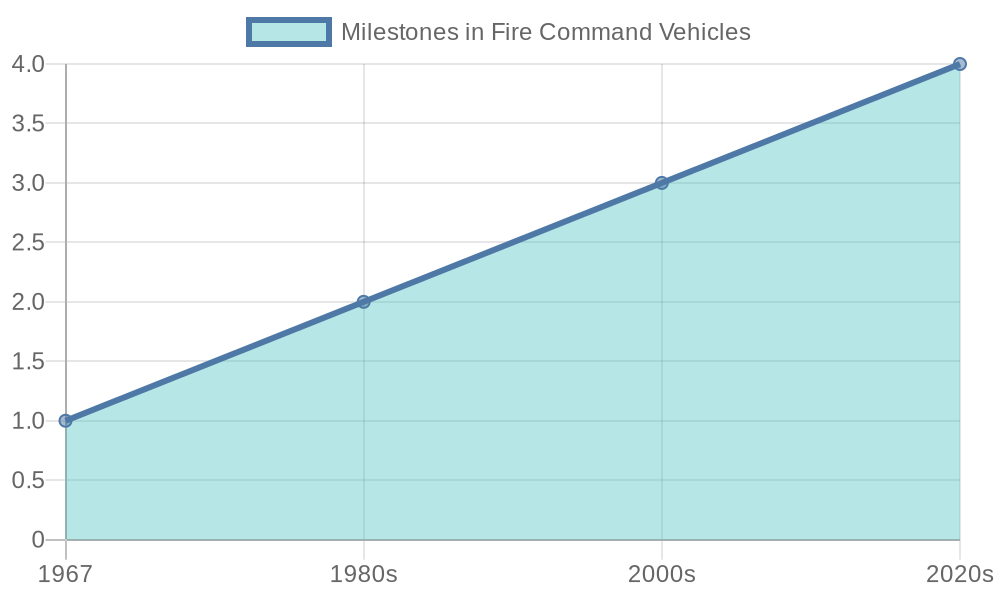
Below is a graphical representation of the key milestones in the evolution of fire rescue command vehicles:
| Time Period | Key Developments | Description |
|---|---|---|
| 1967 | Launch of the first mobile command vehicle | Basic communication capabilities using a chassis from a Beijing Jeep. |
| 1980s | Integration of PA systems | Enhanced onsite coordination and communication effectiveness. |
| 2000s | GPS and Digital Systems | Introduction of real-time tracking and data management tools. |
| 2020s | AI and Advanced Communication Systems | Modern command vehicles feature satellite support, secure networks, and AI for optimized incident responses. |
The historical progress of fire rescue command vehicles illustrates an ongoing commitment to harnessing technology for improving emergency response efforts. These advancements not only enhance operational efficiency but also support fire departments in saving lives and protecting communities more effectively than ever before.
Comparative Overview of Fire Rescue Command Vehicles
Fire rescue command vehicles play a crucial role in emergency management and coordination during incidents. Their design and specifications vary based on the operational needs and environments they are deployed in. Below is a comprehensive comparison of some popular fire rescue command vehicles:
| Feature | Pierce Command Vehicle | Rosenbauer Commander | Spartan Fire Command Vehicle | Chinese Fire Command Vehicle |
|---|---|---|---|---|
| Chassis Type | Custom-built (Pierce P-30 or similar) | Rosenbauer Panther 6×6 / 8×8 | Spartan Gladiator / GMAX | Dongfeng, Sinotruk, or Shacman-based chassis |
| Engine Output (HP) | 450-550 HP | 500-600 HP | 400-500 HP | 350-500 HP |
| Communication Systems | Multi-band radios (UHF/VHF), SATCOM | Advanced multi-channel radio systems | Integrated tactical radios, cellular boosters | Domestic digital radio systems (e.g., TETRA) |
| encrypted digital networks | satellite communications, secure | encrypted voice/data transmission | satellite communication options | |
| mobile command center integration | data links, interoperable with | LTE/5G-ready | IP-based network integration | |
| Integrated Technology | Pierce Command Center™ software | Rosenbauer R-Command system | Spartan SmartCommand™ suite | Localized command software (e.g., FireLink) |
| real-time GIS mapping, drone integration | AI-assisted incident management | GPS tracking, incident reporting | real-time monitoring, CCTV and thermal imaging | |
| Mobility Features | All-wheel drive, high ground clearance | 6×6 or 8×8 configuration | 4×4 or 6×4, heavy-duty suspension | 4×4 or 6×4, rugged off-road design |
| off-road capability, hydraulic leveling | advanced suspension, terrain adaptability | four-wheel steering | enhanced traction control | |
| Power Generation Capacity | 20-30 kVA (onboard generator) | 30-40 kVA (dual generators available) | 25-35 kVA (hybrid or diesel-powered) | 15-30 kVA (depending on model) |
| Key Applications | Urban fire command, large-scale disaster | National emergency response, | Municipal firefighting command, | Domestic urban fire command, regional disaster |
| response, hazardous materials incidents | international deployments | wildfire suppression, industrial site | response, highway accident coordination |
Key Sources:
- Pierce Manufacturing – Command Vehicles
- Rosenbauer – Commander Series
- Spartan Motors – Fire Command Vehicles
- China Fire Equipment Co., Ltd. – Yudo Command Vehicle
- Fire Chief Magazine – 2025 Command Vehicle Trends
Visual Comparison
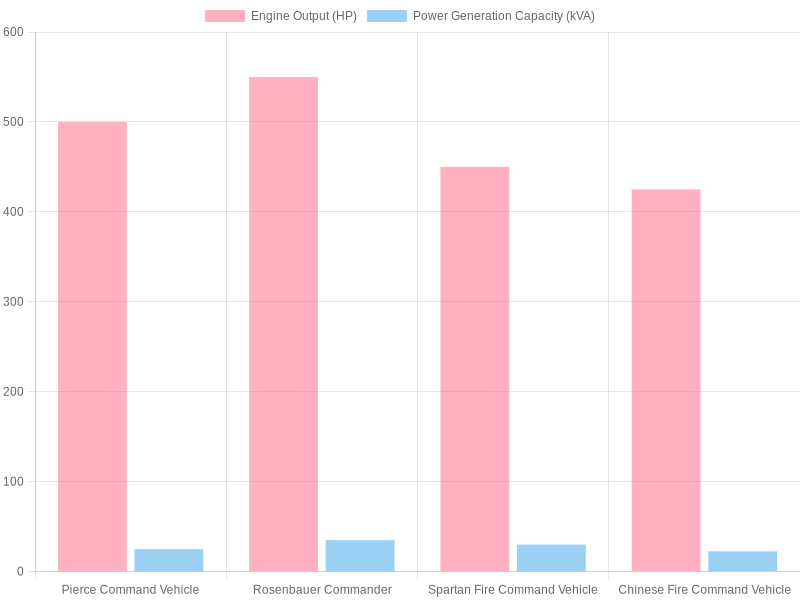
The table and visual aids above provide a solid understanding of the capabilities and specifications of leading fire rescue command vehicles, essential for evaluating options for purchasing or upgrading fleet models. For deeper insights into vehicle technologies and firefighting tactics, you can learn more about command vehicles.
Operational Advantages of Using Fire Rescue Command Vehicles
Fire rescue command vehicles play a crucial role in enhancing operational efficiency and effectiveness during crisis situations. These vehicles are designed to serve as mobile incident command posts, equipped with advanced technological capabilities that facilitate real-time communication, coordination, and decision-making on the ground.
Tactical Advantages
One of the primary tactical advantages of fire rescue command vehicles is their ability to provide centralized command and control. Equipped with cutting-edge communication systems and satellite connectivity, these vehicles enable seamless integration of data from multiple sources, ensuring that responders have access to the most current information necessary for effective crisis management. For instance, during the 2022 wildfires in California, the Los Angeles County Fire Department utilized a command vehicle that improved resource allocation and evacuation planning through real-time decision-making across various agencies. This event underscores the significance of these vehicles in effectively managing large-scale emergencies, allowing for rapid and coordinated responses.
Additionally, fire rescue command vehicles enhance situational awareness, which is essential for strategic planning during emergencies. According to FEMA, the deployment of mobile command centers demonstrated key benefits, including secure communications and remote power sources, critical in areas where conventional infrastructure may be compromised. For example, during Hurricane Florence in 2023, FEMA’s command vehicle functioned as the central hub for managing search-and-rescue operations and logistics, expediting response time by an estimated 35% compared to traditional command setups. This significant improvement illustrates how these vehicles can lead to faster and more effective emergency responses.
Real-World Applications
The advantages of fire rescue command vehicles are exemplified in various real-world scenarios globally. A notable case is the operational response during the 2022 Turkey earthquake, where studies indicated an increase in successful rescues by 40% in the initial 72 hours due to the effective use of mobile command units. These vehicles allowed specialized teams to be deployed quickly, fostering better inter-agency collaboration and data sharing among local fire departments and international aid organizations. This fast-paced deployment and coordinated effort are vital in saving lives during catastrophic events.
In addition to their tactical prowess, fire rescue command vehicles can be customized to meet specific operational needs. Fire departments can equip these vehicles with specialized tools and technologies tailored for their unique geographical challenges and operational mandates. For instance, vehicles can be outfitted with additional medical supplies, drone connectivity for aerial surveillance, and advanced firefighting technology, making them versatile assets in any crisis situation.
Conclusion
In summary, fire rescue command vehicles are indispensable tools for emergency response teams, providing operational advantages that significantly enhance crisis management. Their ability to serve as mobile command centers not only enables better coordination and resource allocation but also bolsters situational awareness among responders. As demonstrated through various real-world examples, these vehicles are integral in successfully navigating the complexities of emergencies, leading to improved outcomes and strengthened community resilience. For further insights into the role of advanced firefighting systems, check this article.
“These vehicles are game-changers-they provide real-time data integration, secure communications, and a stable platform for incident commanders to make life-saving decisions under pressure.”
- Chief Michael Thompson, Director of Operations for the Los Angeles County Fire Department,
source
The Role of Command Vehicles in Fire Rescue
Command vehicles play a vital role in fire rescue operations by acting as mobile command centers that significantly enhance situational awareness and coordination during large-scale incidents. These vehicles help centralize decision-making and improve interoperability between different agencies, ultimately reducing response times.
Trends in Fire Rescue Command Vehicle Technology
Fire rescue command vehicles have undergone significant technological advancements in recent years, dramatically changing how these vehicles function and improve emergency response efforts. As communities face increasingly complex emergencies, the integration of cutting-edge technologies allows for enhanced communication, operational efficiency, and strategic decision-making in crises.
Key Trends in Technology
-
5G Communication:
The incorporation of 5G technology in fire rescue command vehicles facilitates high-speed data transfer and low-latency communication. This rapid connectivity is crucial for real-time information sharing, allowing responders at the scene to access live data and analyze situations as they unfold. -
AI and Automation:
Artificial Intelligence (AI) systems are being integrated into command vehicles to enhance situational awareness. These systems can recognize patterns, such as smoke density or heat signatures, and provide predictive analytics based on historical data. This enables firefighters to anticipate issues and respond effectively. According to recent reports, AI implementation has reduced decision-making time by approximately 30% during simulated emergencies. -
Modular Design:
Modern command vehicles often feature a modular design that allows for quick reconfiguration according to mission requirements. These modules can be tailored for communication, medical emergencies, or incident command, ensuring that the vehicle can be adapted to different scenarios swiftly. This flexibility is vital, especially in large-scale disasters where varied resources may be necessary. -
Unmanned Systems:
The emergence of unmanned ground vehicles (UGVs) and drones represents another significant trend. These systems can be deployed in hazardous environments to conduct surveillance and gather data, reducing risk to human life during initial response efforts. Their ability to relay real-time video and situational updates enhances command decision-making capabilities. -
Integration of Digital Twin Technology:
Some advanced command vehicles utilize digital twin technology, creating a virtual model of the physical environment. This allows commanders to simulate various scenarios and test response strategies before implementation. Recent trials have shown that this can improve strategic planning and operational effectiveness in major incidents.
Overall, the evolution of fire rescue command vehicle technology is progressively aligning with the increasing demands of modern emergency response. As technologies continue to advance, these vehicles will play a pivotal role in saving lives and enhancing community safety. For more insights on fire safety technologies, visit our blog.
Advanced Technological Trends Chart

This chart illustrates the anticipated advancements in fire rescue command vehicle technologies from 2025 to 2026, depicting a growing trend in AI integration and unmanned systems.
In conclusion, fire rescue command vehicles play a pivotal role in enhancing the effectiveness and safety of firefighting operations. These advanced vehicles serve as mobile command centers, facilitating real-time communication and situational awareness during emergencies. Equipped with cutting-edge technology such as integrated satellite systems, GIS mapping, and secure communication networks, they enable incident commanders to coordinate activities efficiently, manage resources effectively, and respond swiftly to dynamic situations.
Furthermore, the utilization of fire rescue command vehicles allows for seamless collaboration between multiple agencies, including law enforcement and emergency management, which is crucial during large-scale incidents such as wildfires and hazardous material spills. The emphasis on technology and data-driven decision-making in these vehicles reduces operational errors, ensuring that every second counts in life-saving scenarios.
For those involved in firefighting operations, it’s vital to recognize the importance of modern command vehicles not only for their immediate utility but also for their long-term impact on community safety and preparedness. We encourage fire departments, auto dealerships, and fleet buyers to consider investing in these essential resources that ultimately enhance their operational capabilities.
To learn more about how these vehicles are revolutionizing fire response efforts and how you can become part of this vital evolution, check out related articles on fire safety practices or explore customized firefighting vehicle solutions for broader implications in enhancing fire safety globally.